Showing posts with label Nipponki '46. Show all posts

Thursday, 26 September 2024

Watanabe G11W (IJNAF Me210) What-if by Dizzyfugu


1:72 Kyushu G11W1-KAI (license-built Me210) with Igo-1-A-I glide bomb; ‘145’ of the Imperial Japanese Navy Air Force, 711th Kokutai; Sasebo (Kyushu/West Japan), early 1945 (Whif/modified Bilek kit)

Some background:<
The Messerschmitt Me 210 was a German heavy fighter and ground-attack aircraft of World War II. Design started before the war, as a replacement for the Bf 110. The first examples were ready in 1939, but they proved to have unacceptably poor flight characteristics due to serious wing planform and fuselage design flaws. A large-scale operational testing program throughout 1941 and early 1942 did not cure the type's problems. The design entered limited service in, but in Luftwaffe service the Me 210 was soon replaced by the Messerschmitt Me 410 Hornisse, a further, re-badged development of the Me 210 which rectified many of its shortcomings.

The type was, however, offered for license production, despite its flaws. In Europe the Me 210 was license-produced in Hungary (where 179 were built with the designation Me 210 Ca-1 from 1942). In Asia, the Imperial Japanese Army Air Force received one aircraft (Werksnummer 2350, a modified Me 210 A-2 which already incorporated many elements that would be integrated into the improved Me 410) bought in Germany for tests and delivered by U-boat. It was operated by the Testing unit of the First Tachikawa Air Army Arsenal. Despite its improvements the upgraded Me 210 did not find favor by the IJA, but the Imperial Japanese Navy became interested in the type because it would provide its land-based units with a versatile two-engine aircraft that could be adopted into a wide range of uses.

An agreement for license manufacture in Japan by Watanabe Tekkōjo, Kyūshū Hikōki K.K. (九州飛行機, Kyūshū Aircraft Company Ltd.) was signed by the Imperial Japanese Navy Aviation Bureau in late 1942. However, the IJN found the original Me 210 to be too complicated and heavy, and demanded changes that eventually led to the Kyushu G11W, how the license-built but much modified derivative was designated. The most important and obvious modification was the deletion of the original liquid-cooled DB 601 engines and their exchange with domestic air-cooled Mitsubishi Ha-102 14-cylinder radial piston engines. This required a re-design of the nacelles and of parts of the landing gear, as well as new engine mounts. The Ha-102s offered less power than the German DB 601 but provided net weight savings of almost 600 kg because the coolers and their respective ducting could be omitted, too.


Another weight-saving measure concerned the Me 210’s defensive armament, originally a pair of remote-controlled Ferngerichtete Drehring-Seitenlafette FDSL 131/1B barbettes on the fuselage flanks behind the cockpit. IJN officials were impressed by the engineering efforts behind this installation but had doubts about the weapons’ efficiency, its relative weight and reliability, so that the whole installation was rejected and deleted, too. Instead, two manually operated 7.7 mm (0.303 in) Type 97 aircraft machine guns were installed in simple ball mounts, operated by the rearward-facing navigator/radio operator. In service, these were frequently upgraded to 13.2 mm (0.520 in) Type 3 machine guns, though. The deletion of the motorized barbettes saved roughly another 400 kg, and with some other structural simplifications the reduction of overall weight could compensate for the slightly enlarged frontal area and loss of power induced by the radial engines, so that the G11W’s performance remained on par with the Me 210. As another side effect, due to a shift of the aircraft’s center of gravity forward, the G11W’s overall handling became less hazardous than the Me 210’s and the lower gross weight made the aircraft more responsive to control input.

Conceived as a fast bomber, the G11W’s offensive armament remained comparable with the German Me 210, with two light machine cannon and machine guns each in the nose, just Japanese weapons were mounted. The shallow bomb bay under the cockpit was retained, too, and could hold up to 1.000 kg (2.205 lb) of bombs. However, indigenous additions were plumbed hardpoints under the outer wings for 300 l drop tanks to extend range for long-range missions over the sea and for ferry flights in the PTO.

G11W serial production started in 1944, but the establishment of the type’s production line at the Kyushu plant was delayed and indigenous aircraft designs had received priority, so that the work’s capacity was never fully exploited. Only limited numbers of the new multi-purpose baseline aircraft, the G11W1, were delivered to frontline units, primarily to fill operative gaps.Most were adapted to special missions, though, and this led to a wide range of modifications of the equipment and even of the basic airframe. Beyond the original fast bomber/attack role many G11Ws were re-equipped as G11W1-C heavy fighters; their bomb bays were filled with more guns, and some late aircraft even received on-board radar to convert them into night fighters (called G11W1-S), even though the type’s maximum altitude was not sufficient to intercept the fast heavy B-29 bombers. Instead of additional forward-firing guns in the bomb bay these machines were frequently outfitted with an extra pair of forward up-firing Type 99 20 mm cannons behind the cockpit, in the space where the Me 210 formerly carried its motorized gun barbettes. A small number of G11Ws were furthermore outfitted with cameras in the bomb bay, lost their offensive gun armament, were lightened wherever possible, and used for tactical reconnaissance (as G11W1-R).

A special role the G11W was adapted for, too, was the attack of enemy ships with newly developed guided air-to-surface weapons, including missiles and glide bombs. These machines were typically baseline bombers and were designated G11W1-KAI which had a reduced offensive armament (typically the light machine guns in the nose were deleted) to compensate for additional radio equipment to control guided air-to-surface weapons. One of the few weapons that found its way into operational use on board of G11Ws was the Mitsubishi Igo-1-A, also known as Mitsubishi Ki-147 within the IJA. Developed along its sister projects of Kawasaki Igo-1-B and Tokyo Imperial University designed Igo-1-C, the Igo-1-A was a simple, visually guided, and radio-controlled glide bomb propelled by a Toku-Ro Model 3 solid-fuel rocket booster, which provided 240 kgf of thrust for up to 80 seconds.

The Igo-1-A’s design began in 1944 and it was developed in a hurry, probably with engineering support from Germany. The weapon resembled a classic torpedo with wings and tail surfaces. The Igo-1-A had an overall weight of 1.400 kg (3,083 lb), including an 800 kg (1.762 lb) HEAT warhead from a No. 80 standard bomb, a length of 5.77 m (18 ft 11 in) and a wingspan and wing area of 3.60 m (11 ft 10 in) and 3.60 m² (38.6 sq ft), respectively. Test trials were already carried out from a modified Kawasaki Ki-48 light bomber in late 1944 and quite successful. Launched at an altitude of 5.000m (16,000 ft) the Igo-1-A demonstrated a maximum effective range of about 11 km (7 miles), and the rocket boosters allowed an even higher range. However, effectively aiming the glide bomb into a major ship target beyond this distance turned out to be impossible. Despite its many deficiencies the weapon was quickly refined into the operational Igo-1-A-I, which had a modified configuration to make it better suited for aircraft operations. In this form the weapon was ordered by the war ministry and adopted by both IJA and IJN. The Igo-1-A-I’s planned standard mother aircraft were IJA’s Kawasaki Ki-102 heavy fighter and the IJN’s G11W. In both cases, a single glide bomb was carried under the fuselage on a massive pylon, in the case of the G11W its protruded from cut-outs in the bomb bay doors.

Beyond the simple radio guidance, more sophisticated means of target acquisition were under development, too, primarily to make it possible for the bomber to turn away after dropping the weapon without having to continue observing the target or even having to fly over it. One direction was a television seeker and a transmitter on board of the guided bomb and a viewing device on the carrier aircraft. Images of the target were transmitted via a VHF transmitter to the image receiver in the guided aircraft, which could be used by the bombardier for target control and flight path directions. The most important part of the television camera was a compact image pickup tube (a super iconoscope). It converted the optical image provided by a lens into electrical signals, with which the transmitter built into the bomb was modulated and the HF signal was fed to an amplifier with an antenna for transmission. The picture consisted of 441 lines with 50 picture changes according to the interlaced method. In the carrier aircraft, the gunner observed the monitor on which the image recorded by the camera was reassembled into a television image. The combination of transmitter, transmitter output stage and TV receiver was built and tested in only a small number, though.

Another guidance method for anti-ship weapons used a heat-seeker. The idea behind the concept was simple and resulted in one of the first fire-and-forget weapons: a bomb with a heat-sensitive seeker head, which would, when locked onto its ship target, steadily correct the bomb's flight path from constant deviations, without external guidance. This concept was based around the idea that a steam-powered (battle) ship would produce a distinct heat signature and therefore an easy target - esp. at night, in good contrast to the colder sea around and with no sun interferences which could jam or distract the sensor. The seeker head used a bolometer, a device for measuring radiant heat by means of a material having a temperature-dependent electrical resistance, to home in on its target. Deviations from the ideal flight path (with the strongest recognized temperature signal) would cause tail rudders to correct the flight path, so that the bomb would follow a zig-zag path during its braked dive from about 2.000 m launch altitude. Tests were made with a target float on which a huge fire burned, but with appallingly poor results at first, because there was no way to confirm whether the seeker had locked onto the intended target upon launch or not. However, the heat-seeker was constantly improved, including a transmitter to control the bolometer’s readings and confirm its correct input, and it was expected to be ready for service in late 1945. Another novel guidance concept used the shock waves of a battleship’s firing guns to attract/guide a missile or guiding bomb without the need to actively control it.

None of these more sophisticated guidance measures made it to the operational Igo-1-A-I glide bombs, though. Until the end of hostilities, approximately 180 missiles were built and launched against Allied ships, but only with highly limited success and many carrier aircraft lost to AA fire and Allied air supremacy.

General characteristics
Crew: 2
Length: 11.41 m (37 ft 4 1/2 in) w/o Igo-1-A guidance antenna
Wingspan: 16.3 m (53 ft 6 in)
Height: 4.2 m (13 ft 9 in)
Wing area: 36.2 m² (390 sq ft)
Empty weight: 7,069 kg (15,584 lb)
Max. takeoff weight: 9,705 kg (21,396 lb)
Fuel capacity: 2,500 L (660 US gal; 550 imp gal) in four wing tanks

Powerplant: 2× Mitsubishi Ha-102 (Army Type 100) 14-cylinder air-cooled radial piston engines, 810 kW (1,080 hp) each for take-off and 787 kW (1,055 hp) at 2,800 m (9,186 ft), driving 3-bladed all-metal constant-speed propellers

Performance
Maximum speed: 580 km/h (360 mph, 310 kn) at 6,700 m (21,980 ft); 507 km/h (315 mph, 274 kn) at sea level
Cruise speed: 400 km/h (250 mph, 220 kn) at 4,000 m (13,123 ft)
Range: 2,000 km (1,200 mi, 1,100 nmi) with internal fuel; 3,102 km (1,927 mi, 1,675 nmi) ferry range
Service ceiling: 8,900 m (29,200 ft)
Rate of climb: 9.083 m/s (1,788.0 ft/min)
Time to altitude: Climb to 6,000 m (19,700ft): 11 min

Armament: 2× 20 mm (0.787”) Type 99 cannon with 120 RPG and 2× 7.7 mm (0.303”) Type 97 aircraft machine guns with 500 RPG in the nose, plus 2× flexible/manually operated 7.7 mm (0.303”) Type 97 aircraft machine guns with 500 RPG firing backwards (often replaced with 13.2 mm (0.520”) Type 3 machine guns and 200 RPG).
Shallow bomb bay under the cockpit for 2× 500 kg (1,100 lb), 2× 250 kg (550 lb) or up to 8× 50 kg     (110 lb) bombs; 2× underwing hardpoints for a single 250 kg (550 lb) bomb or a 300 l drop tank each    Total in- and external ordnance of 1.500 kg.

The kit and its assembly
This project had been lingering on my to-do list and in The Stash™ for quite a while, because it’s a combination of leftover parts from previous builds. The inspiration was based in real life, though: the German Me 210 was actually tested in Japan, and I wondered what a serial production/service aircraft could have looked like – primarily only livery-wise.A Bilek me 210 had, long ago already “donated” its FDL 131 weapon stations (to a modified He 115 floatplane), and after that it also lost its inline engines/nacelles and underwing radiators to a Germanized Ki-46III (the Gotha 146 B-1), leaving only the kit’s core. Since the Arii Ki-46III’s engines and respective nacelles were also left over the plan began to take shape to create a “Japanized” Me 210 with radial engines, as if the airframe had been adapted to local needs/preferences. And this is what became the Kyushu G11W1.

Building the Me 210 core went straightforward. The openings for the gun barbettes were filled, and as an alternative defensive armament I added mounts for single, hand-held machine guns that were fitted into the inside of the backward-facing flat glass panels of the rear cockpit section. Simple and effective.

Things became more demanding with the new radial engines and their respective nacelles from the Ki-46. The original nacelle fairings on the Me 210 wings had been completely cut away, leaving gaps in the wing surfaces, so I completed the new engines first, including their own nacelle extensions, and tried to trim them down so that they’d slip over the wings’ leading edges and upper/lower surfaces, attempting to minimize PSR. That turned out to be easier and more effective than expected – the Ki-46 nacelles just covered the gaps, and only the nacelles’ curvature for the upper wing surfaces had to be adjusted. The nacelles could be slipped over the Me 210 wings like gloves! The propellers were taken OOB, but – as usual – modified with long metal axles to make the spin freely and insert them once the whole model had been painted/finished. The landing gear was taken over from the Me 210 kit, I just had to scratch mounts for a stable hold of the struts inside of the new nacelles.

The Bilek Me 210 kit itself is …mediocre. Details are all a bit clumsy, and the fit of major parts (esp. of the ventral section that includes the bomb bay and the wing/fuselage intersection on both sides) is really poor. Nothing matched, and the whole thing required PSR on every seam.

Since the aircraft’s paint scheme would be quite simple (see below), I decided to add some special equipment, namely a Ki-148 glide bomb (an A&V resin “kit” from the Czech Republic, upgraded with some extra bits), and a PE guidance antenna (left over from an MPM Boulton Paul Defiant night fighter) on the nose, inspired by real Japanese radar systems of the model’s era.

Even though I wanted to add a pair of drop tanks under the outer wings, taken over from a Ki-61, I eventually left them away because the glide bomb would have eaten away almost all of the Me 210's ordnance load capability of 1.5 tons.

Painting and markings
This became intentionally “dry”, because many late-WWII IJN aircraft received very simple paint schemes, mostly with green upper surface and grey undersides. This concept was also applied to the G11W, even though I went a step further and tried to create the impression of a hastily camouflaged bare metal aircraft (only with grey-green fabric-covered rudders). For this purpose, the model received an initial overall coat with Tamiya XF-16 (Flat Aluminum). Once dry, the upper surfaces were unevenly painted with Tamiya XF-11 (IJN Green,). To break the look up a little and add more Japanese flavor I painted the engine cowlings in anti-glare black-blue, mixed from Humbrol 85 and a little 15, and the propellers were painted with red-brown primer (Humbrol 160 for the blades, 186 for the spinners).

The cockpit interior was painted in a yellowish green (“bamboo”) tone, mixed from Humbrol 83 and 80, while the landing gear wells and the inside of the engine cowlings were painted with aodake iro over the white aluminum basis – actually a clear blue acrylic paint was used. The landing gear struts were painted in semi-gloss black.

The Igo-1-A was a bit challenging, because there is only little visual evidence about this weapon’s livery. A b/w picture I found suggests an overall light grey paint scheme (probably only a test weapon, though). I rolled with that with an overall basis of Humbrol 147 (FS36495), but to add some excitement I painted war head in grey and added triangular black markings to the wings to help identify the bomb’s direction for the guiding WSO in the mother ship.

The G11W's markings became minimal, just six Hinomaru (those under the wings without white contrast border), the tactical unit code as well as the "registration plate" on the tail, and - as the only extraordinary marking - a yellow fuselage band.

After some more weathering and wet-sanding on the surface the model was sealed with a shiny mix of matt and semi-gloss acrylic varnish, and some soot stains around the guns and the exhaust stubs were added. I also added some oil traces behind the engines' cooling louvres with Tamiya's Smoke.

Thursday, 28 July 2022

Heads-up! - Mitsubishi J4M "Senden by Mikromir

Ukrainian manufacturer Mikromir, has released in 1/72 two quite interesting kits of an obscure IJNAF X-fighter, the Mitsubishi J4M "Senden". 

The first kit is with the more conventional propeller.


The other kit has a "Sakae thermojet engine". 


Note that the box mentions that the kit was "Made during the russian-Ukrainian wartime".
SLAVA UKRAINI!

Saturday, 30 April 2022

Tachikawa Ki-38-Ic “Brad” by Dizzyfugu


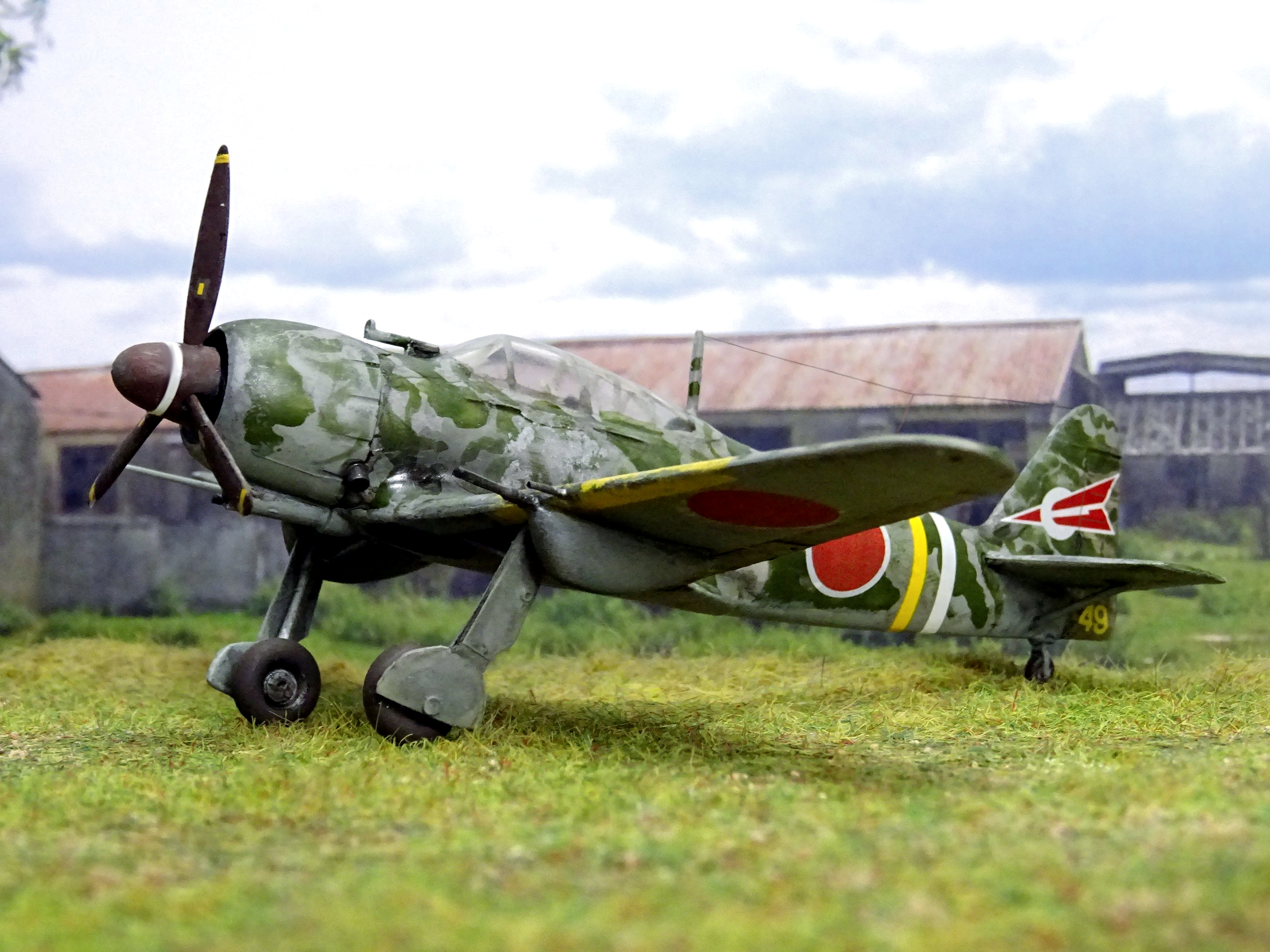
1:72 Tachikawa Ki-38-Ic (Allied code name “Brad”); aircraft “49” of the Imperial Japanese Army (IJA) 2nd Chutai, 17th Sentai (Fighter Group); Luzon/Philippines, early 1942 (What-if/modified Heller kit)


Some Background:
The Ki-38 fighter was designed by the Tachikawa Aircraft Company Limited (立川飛行機株式会社, Tachikawa Hikōki Kabushiki Kaisha) near Tokyo, an aircraft manufacturer in the Empire of Japan, specializing primarily in aircraft for the Imperial Japanese Army Air Force. The Ki-38 prototype was produced in response to a December 1937 specification for a successor to the popular fixed-gear Nakajima Ki-27 Nate. The specification called for a top speed of 500 km/h (310 mph), a climb rate of 5,000 m (16,000 ft) in five minutes and a range of 800 km (500 mi). Maneuverability was to be at least as good as that of Ki-27.
When first flown in early January 1939, the Ki-38 prototype was a disappointment. Japanese test pilots complained that it was less maneuverable than the Ki-27 Nate and not much faster. Even though the competition was eventually won by the Ki-43, service trials determined the aircraft to hold sufficient promise to warrant further work, leading to the adoption of an expanded and strengthened wing and a more refined Mitsubishi Ha-102 (Army Type 100 1,050hp Air Cooled Radial) 14-cylinder air-cooled radial piston engine. During spring 1939, following the completion of further proving trials, an order for a pre-production batch of 25 aircraft was placed.
As a whole, the Ki-38 was an all-modern design consisting of all-metal skin and understructure construction with low-set monoplane wing appendages. The wings were straight in their general design with rounded tips and set well-forward of amidships. The engine was fitted to the extreme forward section of the fuselage in a traditional manner, powering a three-bladed propeller installation. Interestingly, the cockpit was also situated well-forward in the design, shortening the visual obstacle that was the engine compartment to some extent. However, views were still obstructed by the short engine housing to the front and the wings to the lower sides. The fuselage tapered at the rear to which a single vertical tail fin was affixed along with mid-mounted horizontal tailplanes. The undercarriage was retractable and of the "tail-dragger" arrangement consisting of two main single-wheeled landing gear legs and a fixed, diminutive tail wheel leg at the rear.
The series-production Ki-38-I was further modified to enhance its performance. These changes involved a major weight saving program, a slimmer and longer fuselage with bigger tail surfaces and a new, more streamlined bubble-style canopy that offered, even while bearing many struts, the pilot a very good all-round field of view.
In addition to good maneuverability, the Ki-38-I had a good top speed of more than 500 km/h (310 mph). The initial Ki-38 was armed with four 7.7 mm (0.303 in) Type 89 machine guns in the wings, but this soon turned out to be insufficient against armored Allied fighters and bombers. Quickly, the inner pair of weapons was, after just 50 aircraft, replaced with 12.7 mm (0.50 in) Ho-103 machine guns in the Ki-38-Ib (the initial version subsequently became the Ki-38-Ia), of which 75 were built. On board of the following Ki-38-Ic, the inner weapons were replaced with a pair of even heavier and more effective 20 mm (0.787 in) Ho-5 cannon, which required fairings for the ammunition under the wings and made this version easy to identify. The Ki-38-Ic became the most frequent variant, with 150 examples built. All types also featured external hardpoints for a drop tank under the fuselage or a pair of bombs of up to 250 kg (550 lb) caliber under the wings. Late production aircraft were designated Ki-38-II. The pilot enjoyed a slightly taller canopy and a reflector gunsight in place of the earlier telescopic gunsight. The revised machines were also fitted with a 13 mm (0.51 in) armor plate for the pilot's head and back, and the aircraft's fuel tanks were coated in rubber to form a crude self-sealing tank. This was later replaced by a 3-layer rubber bladder, 8mm core construction, with 2mm oil-proof lamination. Some earlier aircraft were retrofitted with these elements, when available to the field workshops, and they dramatically improved the aircraft’s resilience to enemy fire. However, the bladder proved to be highly resistant only against light 7.7 mm (0.303 in) bullets but was not as effective against larger calibers. The Ki-38-II’s armament was the same as the Ki-38-Ic’s and 120 aircraft were built.
Ki-38 production started in November 1939 at the Tachikawa Hikoki KK and at the 1st Army Air Arsenal (Tachikawa Dai-Ichi Rikugun Kokusho) plants, also at Tachikawa. Although Tachikawa Hikoki successfully managed to enter into large-scale production of the Ki-38, the 1st Army Air Arsenal was less successful – hampered by a shortage of skilled workers, it was ordered to stop production after 49 Ki-38 were built, and Tachikawa ceased production of the Ki-38 altogether in favor of the Ki-43 in mid-1944.
Once it was identified and successfully distinguished from the IJA’s new Ki-43 “Oscar” and the IJN’s A6M “Zero” (Oscar), which both had very similar outlines, the Ki-38 received the Allied code name “Brad”. Even though it was not produced in the numbers of the Ki-43 or the A6M, the Ki-38 fought in China, Burma, the Malay Peninsula, New Guinea, the Philippines, South Pacific islands and the Japanese home islands. Like the Oscar and the Zero, the Ki-38 initially enjoyed air superiority in the skies of Malaya, Netherlands East Indies, Burma and New Guinea. This was partly due to the better performance of the Brad and partly due to the relatively small numbers of combat-ready Allied fighters, mostly the Curtiss P-36 Hawk, Curtiss P-40, Brewster Buffalo, Hawker Hurricane and Curtiss-Wright CW-21 in Asia and the Pacific during the first months of the war.
As the war progressed, however, the fighter suffered from the same weaknesses as its slower, fixed-gear Ki-27 "Nate" predecessor and the more advanced naval A6M Zero: light armor and less-than-effective self-sealing fuel tanks, which caused high casualties in combat. Its armament of four light machine guns also proved inadequate against the more heavily armored Allied aircraft. Both issues were more or less mended with improved versions, but the Ki-38 could never keep up with the enemy fighters’ development and potential. And as newer Allied aircraft were introduced, the Japanese were forced into a defensive war and most aircraft were flown by inexperienced pilots.


General characteristics
Crew: 1
Length: 8.96 m (29 ft 4 in)
Wingspan: 10.54 m (34 ft 7 in)
Height: 3.03 m (9 ft 11 in)
Wing area: 17.32 m² (186.4 sq ft)
Empty weight: 2,158 kg (4,758 lb)
Gross weight: 2,693 kg (5,937 lb)
Max takeoff weight: 2,800 kg (6,173 lb)
Powerplant: 1× Mitsubishi Ha-102 14-cylinder air-cooled radial piston engine with 1,050hp (755 kW), driving a 3-bladed variable-pitch propeller

Performance:
Maximum speed: 509 km/h (316 mph, 275 kn)
Cruise speed: 450 km/h (280 mph, 240 kn)
Range: 600 km (370 mi, 320 nmi)
Service ceiling: 10,000 m (33,000 ft)
Time to altitude: 2,000 m (6,600 ft) in 3 minutes 24 seconds
Wing loading: 155.4 kg/m2 (31.8 lb/sq ft)
Power/mass: 0.182 hp/lb (0.299 kW/kg)

Armament:
2× 20 mm (0.787 in) Ho-5 cannon with 150 rpg
2× 7.7 mm (0.303 in) Type 89 machine guns with 500 rpg
2× underwing hardpoints for single 30 kg (66 lb) or 2 × 250 kg (550 lb) bombs    
1× ventral hardpoint for a 200 l (53 US gal; 44 imp gal) drop tank


The kit and its assembly:
I always thought that the French Bloch MB 152 had some early WWII Japanese look to it, and with this idea I recently procured a relatively cheap Heller kit for this conversion project that would yield the purely fictional Tachikawa Ki-38 for the IJA – even though the "Ki-38" existed as a Kawasaki project and eventually became the Ki-45, so that the 38 kitai number was never actively used.
The Heller MB 152 is a vintage kit, and it is not a good one. You get raised panel lines, poor details (the engine is a joke) and mediocre fit. If you want a good MB 152 in 1:72, look IMHO elsewhere. For the Ki-38 I wanted to retain most of the hull, the first fundamental change was the integration of a cowling from a Japanese Mitsubishi Ha-102 two-row radial, left over from an Airfix Ki-46 “Dinah”. It received a new three-blade propeller with a different spinner on a metal axis inside, and the donor engine received some more interior details, even though the spinner blocks most sight upon them.
The next, more radical move was to replace the MB 152’s spinal cockpit fairing with a bubble canopy and a lowered back. I found a VERY old (maybe 40 years!?) and glue-tinted canopy from a Matchbox A6M in the spares box, and it turned out to be very suitable for the Ki-38 project. However, cleaning the clear piece was quite challenging, because all raised struts had to be sanded away to get rid of the old glue and paint residues, and re-polishing it back to a more or less translucent state took several turns with ever finer sandpaper, polishing paste and soft polishing mops on a mini drill. The spine was re-created with 2C-putty and the canopy was blended into it and into the fuselage with several PSR turns.
Inside, I used a different pilot figure (which would later be hard to see, though), added a fuel tank behind the seat with some supporting struts and inserted a piece of styrene sheet to separate the landing gear well from the cockpit – OOB it’s simply open. The landing gear was basically taken OOB, I just replaced the original tail skid with a wheel and modified the wheels with hub covers, because the old, toylike kit wants you to push them onto long axis’ with knobs at their tips so that they remain turnable. Meh! The fairings under the guns in the wings (barrels scratched from the MB 152’s OOB parts) are conformal underwing fuel tanks from a late Seafire (Special Hobby kit).


Painting and markings:
The initial plan was a simple green/grey IJA livery, but even without any paint the what-if model looked SO much like a classic A6M that I rather decided to give it a more elaborate paint scheme. I eventually found an interesting camouflage on a Mitsubishi Ki-51 “Sonia” attack plane, even though without indications concerning its unit, time frame or theater of operations. However, after some research I assume that it was used in the China-Burma-India theater. The aircraft received  an overall light grey base, onto which opaque green contrast fields/stripes had been added, and the remaining light grey upper areas were overpainted with thin sinuous lines of the same green. This was adapted onto the Ki-38 with a basis in Humbrol 167 (RAF Barley Grey) and FS 34102 (Humbrol 117) for the green cammo. I also wanted to weather the model considerably, as a measure to hide some hardware flaws, so that a partial “primer coat” with Aluminum (Revell 99) was added to several areas, to shine through later. The yellow ID markings on the wings’ leading edges were painted with Humbrol 69. The propeller blades were painted with Humbrol 180, the spinner in a slightly lighter mix of 180 and 160.
Interior surfaces were painted with a dull yellowish green, a mix of Revell 16 and 42, just the inside of the landing gear covers became grey as the outside, in a fashion very similar to early Ki-43s.
The decals came form various sources, including a Hasegawa Ki-61 sheet for the unit markings and some stencils and hinomaru in suitable sizes from a generic roundel sheet.
Some dry-brushing with light grey was done to emphasize edges and details, and some soot stains were added with graphite to the exhausts and the guns. Finally, the kit was sealed with matt acrylic varnish, some more dry-brushing with aluminum was done, esp. around the cockpit, and position lights were added with translucent paint.


Some final words:
An unexpected result – I was not prepared that the modified MB 152 would look THAT much like a Mitsubishi A6M or the Ki-43! There’s even an Fw 190-ish feel to it, from certain angles. O.K., the canopy actually comes from a Zero and the cowling looks very similar, too. But the overall similarity is baffling, the tail is the most distinguishing feature! However, due to the poor basis and the almost blind canopy donor, the model is far from stellar or presentable – but some in-flight shots look pretty convincing, and even the camouflage appears to be quite effective over wooded terrain.

Tuesday, 24 August 2021

Ki-46 Gone German by Dizzyfugu


What if the Mitsubishi Ki-46 had been license-built by Germany…?
Several German aircraft, including the Junkers Ju 87 or the Messerschmitt Bf 109E and Me 210, had been evaluated by Japan – and there had apparently interest in Japanese aircraft by the RLM, too. In literature the Mitsubishi Ki-46 frequently pops up as a hot candidate for potential license production in Germany, but the circumstances remain obscure, and in real life this never happened. However, this historic development offers a nice plain canvas for a “what-if” model of a Germanized Ki-46, and my interpretation became the fictional Gotha Go 146 reconnaissance aircraft, and a respective model of it: a 1:72 scale Gotha Go 146 B-1; aircraft ‘P3+KN’ of II(F)/FAG 104 (5. Staffel, 2. Gruppe, Fernaufklärergruppe 104), Deutsche Luftwaffe; Biblis (Hessia, near Mannheim), late 1944.


Some background
The Gotha 146 was a fast reconnaissance aircraft that was used throughout WWII by the German Luftwaffe, and one of the results of a mutual technology exchange program with Japan. The Go 146 was actually a license-built, but modified variant of the excellent Mitsubishi Ki-46. The latter type's career started in late 1937, when the Imperial Japanese Army Air Force issued a specification to Mitsubishi for a long-range strategic reconnaissance aircraft to replace the Mitsubishi Ki-15. The specification demanded an endurance of six hours and sufficient speed to evade interception by any fighter in existence or development at that time, but otherwise did not constrain the design by a team led by Tomio Kubo. 
The resulting design was a twin-engine, low-winged monoplane with a retractable tailwheel undercarriage. It had a small diameter oval fuselage with the pilot and observer situated in individual cockpits separated by a large fuel tank. The engines, two Mitsubishi Ha-26 radials, were housed in close-fitting cowlings to reduce drag and improve pilot view. 
The first prototype aircraft, flew in November 1939 from the Mitsubishi factory at Kakamigahara, Gifu. Tests showed that the Ki-46 was underpowered and slower than required, only reaching 540 km/h (336 mph) rather than the specified 600 km/h (373 mph), but, otherwise, the aircraft tests were successful. As the type was still faster than the Army's latest fighter, the Nakajima Ki-43, as well as the Navy's new A6M2, an initial production batch was ordered. To solve the performance problems, Mitsubishi switched to Ha-102 engines, which were Ha-26s fitted with a two-stage supercharger, while increasing fuel capacity and reducing empty weight. This became the Ki-46-II, and this type was also demonstrated to German officials who immediately noticed its potential.
Knowing that the German Luftwaffe lacked this specialized, fast type of aircraft (German reconnaissance aircraft of that time were either slow artillery observation types, or variants of bombers or heavy fighters), the RLM immediately asked for a batch of airframe kits to adapt it to the European theatre and test its capabilities. Seven engine-less airframe kits were delivered to Germany in early 1940. In the meantime, with the help of blueprints and other documentations, an alternative engine installation had been devised: the “Germanized” aircraft was to be powered by liquid-cooled DB 601 engines, which delivered more power than the Ha-102 and offered improved aerodynamics, despite the necessity to add radiators under the outer wings. Many stock parts from the contemporary Messerschmitt Bf 110 heavy fighter were incorporated, so that the development time was very short, and the commonality of mechanical parts eased logistics and maintenance. 
In May 1940 the first batch of the Gotha 146 A-0 pre-production aircraft (which had officially been described as a further development of a four seat, twin-engine transport aircraft from the 1930s to cloud its origins and mission) was ready. They were immediately transferred to the Western Front for field tests, and the specialized Go 146 became quickly popular among its crews. It was fast, agile and easy to fly – almost on par with state-of-the-art fighters like the Bf 109. During the test phase in summer 1940 the Go 146 proved to be slightly faster than its Japanese Ki-46 ancestor, and with a top speed of more than 375 mph (600 km/h) it was hard to intercept by any British or French fighter of the time. The results were so convincing that the type was ordered into serial production, and from October 1940 on the Go 146 A-1 was produced in limited numbers at the Gothaer Waggonfabrik in Thuringia. Even though production only ran at small scale, it was continuous, and the Go 146 was steadily developed further, including the change of the nose section that came with the Ki-46-III, stronger engines and an improved defensive armament. 
This evolution led to the Go 146 B, which had the traditional stepped windshield replaced with a smooth, curved, glazed panel extended over the pilot's seat. This not only provided a more aerodynamic nose profile, the modified nose section also offered room for an extra fuel tank. The space between the two crewmen, connected with a crawl tunnel, held another fuel tank, the radio equipment (a Sprechfunkgerät FuG 16 ZY and a FuG 25a „Erstling“ IFF beacon), as well as a ventral compartment for up to three cameras with several windows. Different combinations of Rb (“Reihenbildner” = serial picture device) 20/30, 50/30 and 75/30 camera devices could be mounted, for a wide range of mission profiles.
On the Go 146 B, power came from a pair of new Daimler-Benz DB 603A liquid-cooled piston engines, which offered 1,290 kW (1,750 hp) each for take-off. Since the engine mounts had to be re-designed for the different powerplants (the Go 146 A had used adapters to attach its shorter DB 601s to the original Ha-102 radials’ hardpoints), German engineers used the opportunity to redesign the complete engine nacelles. As a result, their diameter and “wet” surface was reduced, so much that the landing gear had to be modified, too. It now rotated 90° upon retraction, so that the main wheels were lying in shallow wells within the wing structure. Beyond better aerodynamics, structural measures all over the airframe saved almost 250 kg (550 lb). Instead of the Go 146 A’s single 7.92 mm (.312 in) MG 17 machine gun in the observer's cabin, facing rearwards, the defensive armament was improved and consisted of a pair of 13 mm (0.51 in) MG 131 machine guns, firing rearward from FDSL 131/1B remotely-operated barbettes, one per side. The guns were electrically fired, and an electrical contact breaker prevented the gunner from shooting off the aircraft’s tailplane. When not in use, the guns would return to a neutral position that would allow to fire directly backwards with both guns.
Furthermore, plumbed hardpoints were added to the inner wings, just inside of the engines. These could carry a 300 l drop tank each for an extended range and loiter time. Single bombs of up to 250 kg or racks with four 50 kg bombs each were theoretically possible too, but the aircraft lacked any bomb aiming support. Crew protection was slightly improved, too, but the airframe was overall kept as light as possible. Despite these efforts, however, MTOW rose to 6,500 kg (14,317 lb), but this was still relatively light in comparison with the similar contemporary Me 410 multi-purpose aircraft, which weighed more than 9 tons and was powered by similar engines. Consequently, and thanks to its clean lines, the G 146 B had a top speed of almost 700 km/h (434 mph) at ideal altitude and the aircraft retained its excellent handling, even though its structure was rather fragile and could not take much stress and punishment.


Two versions of the Go 146 B were produced, steadily but only at a low rate because the aircraft received, due to its highly specialized role and limited offensive capabilities, only a low priority. The B-1 was the main variant and kept the A version’s standard wing, a total of 54 were produced between 1943 and 1945. Additionally, the B-2 was produced between late 1943 and early 1944 as a dedicated high altitude photo reconnaissance aircraft. This sub-variant had an extended wingspan of 16.00 m (52 ft 5 in) instead of the standard 14.70 m (48 ft 2¾ in) and an improved oxygen system, even though the cabin was not pressurized. Its maximum service ceiling was almost 12.000 m (39.305 ft), with a maximum speed of 415 mph (668 km/h), a cruise speed of 250 mph (400 km/h) and a range of 3,200 km (1,987 nmi). Only twelve of these machines were produced and put into service, primarily for flights over Southern Great Britain. When the Arado Ar 234 became available from September 1944 on, though, this new, jet-powered type immediately replaced the Go 146 B-2 because it offered even better performance. Therefore, the B-3, a planned version with a fully pressurized cabin and an even bigger wingspan of 19.00 m, never left the drawing board.
Furthermore, the RLM had idea to convert the fast Go 146 into a fighter and even a night fighter in mid-1944 as the “C” series. But these plans were not executed because the light airframe could hardly be adapted to heavy weapons or equipment like a radar set, and it was unsuited for vigorous dogfighting. The type’s poor climbing rate made it ineffective as an interceptor, too. There were, nevertheless, tests with at least one Go 146 B-1 that carried four Werfer-Granate 21 rocket launchers under the outer wings, as a fast bomber interceptor esp. against the high-flying B-29, which was expected to appear over continental Europe soon. But this kind of weaponry never reached frontline units and the Go 146 was never operated as a fighter of any kind.
There were, however, other uses: in 1944 the Go 146 was enlisted as a fast liaison aircraft for the RLM (Ministry of Aviation) in Berlin. Stripped of any armament and cameras and outfitted with two passenger seats in the rear cabin, at least one Go 146 B (with the confirmed registration “ST+ZA”, others in similar configuration may have existed, too) was operated by the RLM’s Zentralabteilung (central command) from Tempelhof airfield for top brass officials between Luftwaffe locations on German terrain. ST+ZA’s fate after January 1945 is uncertain, though.


Gotha Go 146 B-1 specifications:
Crew: two (pilot and observer/tail gunner)
Length: 11.00 m (36 ft 1 in)
Wingspan: 14.70 m (48 ft 2¾ in)
Height: 3.88 m (12 ft 8¾ in)
Wing area: 32.0 m² (344 ft²)
Empty weight: 3,830 kg (8,436 lb)
Loaded weight: 5,661 kg (12,480 lb)
Max. takeoff weight: 6,500 kg (14,317 lb)

Powerplant:
2× Daimler-Benz DB 603A V-12 inverted liquid-cooled piston engines, rated at:
- 1,290 kW (1,750 hp) each for take-off
- 1,360 kW (1,850 PS) at 2,100 m (6,890 ft)
- 1,195 kW (1,625 PS) at 5,700 m (18,700 ft)
- 1,162 kW (1580 PS) combat power at 2500 rpm at sea level

Performance:
Maximum speed: 695 km/h (377 knots, 430 mph) at 5,800 m (19,000 ft)
Cruise speed: 450 km/h (245 knots, 280 mph)
Range: 2,800 km (1,522 nmi, 1,740 mi) with internal fuel
Service ceiling: 11,250 m (36,850 ft)
Wing loading: 157.8 kg/m² (32.3 lb/ft²)
Climb rate: 14.7 m/sec (2,900 feet per minute)
Climb to 8,000 m (26,250 ft): 15 min 20 sec

Armament:
2× 13 mm (0.51 in) defensive MG 131 machine guns with 500 RPG, each firing rearward from FDSL 131/1B remote-operated turret, one per side
2× underwing hardpoints under the inner wings for 250 kg (550 lb) each, typically occupied by 300 l drop tanks


The kit, its assembly and paint scheme
This is a déjà vu build: I already did a “Germanized” Ki-46 in 2015, an Airfix Ki-46-II outfitted with DB 601s from a Bf 110 as a pre-series Gotha Go 146 A-0. However, as I built this modified Dinah back then I already felt that the concept had more potential, and the streamlined Ki-46-III just lent itself for an updated, later version.
This variant was based on the LS Models (ARII boxing) Ki-46-III kit from 1975. It was basically taken OOB, but, naturally, with some mods: inline engines and parts of their wing fairings were transplanted from a Bilek Me 210, together with the underwing radiators. This switch was insofar easy because the LS Models Ki-46 kit has separate parts for the engines and their fairings which also contain the main landing gear wells. The main wheels were replaced with slightly smaller and narrower ones from the scrap box.
Inside, I implanted a dashboard for the pilot and the rear cabin seat was reversed and moved further forward. A scratched targeting scope/weapon control column for the FDSL 131 installation was added. The wacky OOB figures were replaced with better Matchbox pilots. Due to the heavily framed canopies, little of the interior can be seen, though.
The gun barbettes were scratched from WWII bombs as fairings and leftover landing gear struts as gun barrels. The barbettes look somewhat superficial on the slender Dinah, but they are a nice, typically German detail, über-complicated for this type of fast aircraft that probably would have more benefited from leaving them away altogether. The 300 l drop tanks came from Hobby Boss Bf 109s, outfitted with four small, scratched pylons each.
The paint scheme evolved gradually and was inspired by real German late WWII aircraft. The basis became an overall coat of RLM 76 (Tamiya XF-23, Light Blue), with blotches of RLM 77 “Hellgrau” added to the flanks. I used XF-19 (Sky Grey) as a low contrast option (the real RLM 77 was almost white) and extended the mottles under the fuselage and the engine nacelles, for a semi-wraparound scheme.
The upper surfaces were painted with cloudy RLM 02 and 75 (Tamiya XF-22 and XF-XX as proxies) over the uniform RLM 76 base, and to further lighten everything up and break up the aircraft’s outlines, I added a meander pattern with RLM 77 (again XF-19).
Markings are intentionally minimal. Balkenkreuz markings only consisting of outlines were used for a low-visibility look. The model/aircraft belongs to a fictional unit, its code “P3” in front of the fuselage Balkenkreuze has no real-world reference and was done in small black 2mm letters, a typical late WWII measure. A fictional unit badge, depicting a running greyhound, was added under the cockpit, it belongs to a German tank unit (taken from a Hasegawa 1:72 Panzer V Panther sheet).
The “KN” part of the code, including the red “Ks” on the nose, came from an Airfix Ju 87 B sheet. As an aircraft belonging to the 5th squadron within the unit’s 2nd group, the 4th letter in the code became “N”, while the 3rd letter “K” denotes the individual aircraft. The color code associated with any 5th Luftwaffe squadron was red, incorporated on the aircraft as a thin red outline around the individual aircraft letter. Since this aircraft would operate over the Western front from German home ground, no further ID/theatre markings like fuselage or wing bands or wingtips in yellow or white etc. were added. After some exhaust and oil stains with graphite and Tamiya “Smoke”, a coat of acrylic matt varnish finally sealed the model and a wire antenna, made from heated sprue material, was added.