Tuesday, 4 September 2012

Nakajima E4N3

A photo from a vintage, April 1939, publication showing Nakajima E4N undergoing maintenance and although straightforward looking there are a number of puzzling details.
First, the photo was taken during a visit of the magazine reporters in IJN's Marine (Kaiheidan) training installations in Yokosuka. We were unable to locate any information about the Japanese Marines having any aviation unit or such.
Second, the kanji on the fuselage side is the first of the word "KYOiku" (education/training). This is an unknown marking, not corresponding to any known IJNAF unit.
Third, the type of the aircraft is also a puzzle. Are they E4N2 seaplanes with their floats changed to wheels or are they E4N2-C (later re-designated E4N3) of which very few were built? We tend towards the latter since the Yokosuka Kokutai had a few E4N3s and the seaplane E4N2 type was still in active duty.


Monday, 3 September 2012

Vintage ad - Nippon Koku Yuso Kabushiki Kaisha

A beautiful ad from a vintage, March 1931, magazine.


Right side downwards: 
"Fixed flights. Sight-seeing flights."
"Tokyo-Osaka-Fukuoka-Ulsan (S. Korea)-Seoul- Pyongyang- Dalian (China)" "Pamphlet available upon application"
"Office (phone numbers) - Tokyo, Ginza 2566 / Osaka, North 5776 / Fukuoka 5024 / Ulsan 107 / Seoul, main office 1709 / Pyongyang 1578 / Dalian 5571"
"Nippon Koku Yuso Kabushiki Kaisha"
"(Address) Tokyo-city, Shiba-ku, Sakurada Hongo-cho, Aviation Building" 

Saturday, 1 September 2012

Kawanishi H6K "Mavis"

 A photo, from a vintage publication, of a "Mavis" getting refuelled.


Friday, 31 August 2012

VIPs-IJAAF Uniforms


On April 1st, 1940, on the 30th Anniversary of the record flight of Lt General Baron Tokugawa Yoshitoshi (here), the "Wild Eagles" of IJAAF invited no less than 414 politicians and dignitaries for an air show in Tachikawa Airfield, Tokyo.
The exhibition started at 10:30 with front-line air combat simulations. Following that the guests were divided into more than 30 groups and flew with the latest bombers of the IJAAF over Tokyo.

President of the Chamber of Representatives, Koyama Shoju, is getting prepped.

Tanakadate Aikitsu (b. 1856) professor of Geophysics in Tokyo University. He was involved with aviation from the very early stages and was nicknamed the "foster father of Japanese Aviation". According to the article, from a vintage publication, he thoroughly enjoyed his flight. One of the asteroids in the Asteroid Belt of our Solar System has been named after him (here).

In the photos below (from Ebay) we can see in colour how exactly these pilot uniforms and boots looked like. It's the later type of IJAAF pilot's winter uniform.

Wednesday, 29 August 2012

Artwork - "Nishizawa and his A6M3 model 22" by AJay

A beautiful drawing of Nishizawa Hiroyoshi "The Devil of Rabaul" by AJay.
Sakai Saburo has famously said about Nishizawa: 
"Never have I seen a man with a fighter plane do what Nishizawa would do with his Zero. His aerobatics were all at once breathtaking, brilliant, totally unpredictable, impossible, and heart-stirring to witness."


Don't forget to visit AJay's blog HERE for news and availability of his work.
Thank you AJay for your kind words and contribution to our blog.

Monday, 27 August 2012

Kawasaki Ki-61 "Hien" (Tony) - 56 Sentai

The official order to put the unit together was given on March 23, 1944. From April 12, the organization of the unit begun in Taisho airfield, Osaka and was completed two weeks later.
On April 28 moved to Itami, Osaka where they started training with five Kawasaki Ki-61 "Hien" and two Nakajima Ki-43 "Hayabusa" they received from Akeno. All pilots of the unit except sentai-cho (regiment commander) Major Furukawa Haruyoshi and hikotai-cho Capt Ogata Junichi were fresh from the schools with no experience whatsoever. Due to maintenance problems there were many accidents with the "Hien" which received the nickname “Killer Plane”. 
On May 20 the unit moved to Komaki airfield, Nagoya, where they continued training. From the end of June they begun night flight training. 
In July the unit became part of the 11th Hikoshidan (Air Division), were assigned the air defense of Chukyo Area (Nagoya-Osaka) and performed daily patrols against B-29s at 8,000m.
From the middle of June 1944, B-29s based in China started arriving over North Kyushu. On August 21 the unit came under the Seibu-Gun (Western Area Army). On that day the unit strength was 17 "Hien" and in the same month the unit moved to Tachiarai airfield. September 1 the unit was relocated in Jeju Island (Saishu in Japanese), Korea, for advanced interception of B-29s.

A 56th Sentai Ki-61-I Hei, serial number 3294, found on Jeju Island after the end of the War. (NARA)

October 25 signified the first air battle of the unit against B-29s. Following reports from the China Army that over 100 B-29s are heading towards Northern Kyushu, 17 "Hien" of the 56th scrambled, but they took-off too late and missed the US bombers on their way to the target. They caught them on their way back, after they had bombed Oomura, shooting down one B-29 and damaging six while eight of their own received damages.
On the next day one B-29 arrived over Oomura to asses the damage and three "Hien" from the 56 took-off again to intercept but all of them failed to return. Two of the planes including hikotai-cho Ogata were forced to make a belly landing escaping with their lives while the third plane was probably lost over the sea.
On November 15 the unit relocated back to Itami via Tachiarai but 5 days later the unit with 14 "Hien" relocated yet again to Tachiarai to participate in the Ko-I-Go Operation. 
On November 21 the unit shot down three B-29s and on December 1 three pilots were assigned to a tokotai unit. 
Following reports that B-29s were going to attack the Osaka area, the unit relocated yet again in Itami. On December 13 the first B-29 air raid was contacted over the Nagoya area flying higher than 9,000m well above the normal service ceiling of the "Hien". Following modifications including the improvement of the oxygen system for the pilot, the removal of the bullet proof protection of the oil tanks as well as the removal of the wing 20mm cannons, the airplanes became light enough to reach that altitude.
During the December 18 interception the unit managed to shoot down two B-29s and damage two more. 

56th Sentai tail marking illustrated by Devlin Chouinard.

On January 3 1945, the unit intercepted again B-29s over the Nagoya area shooting down two enemy planes damaging many. One pilot 1st Lieut Wakui crashed his plane on a B-29. One more pilot Sgt Takamukai crashed his plane too, lost the tip of one of his wings and was shot numerous times but managed to return to base. 
On March 14, B-29s bombed Osaka. Due to heavy clouds only experienced pilots scrambled including Sgt Takamukai. Unfortunately immediately after take-off he crashed on a factory chimney near the airport. 
On March 17 during an air raid against Kobe, sentai-cho Ogata and two other pilots were lost.
On March 31 the unit was assigned to the 12th Hikoshidan to participate in the battle for Okinawa and with 27 planes moved to Ashiya airfield in North Kyushu for air defense duties. On April 29 the unit relocated to IJNAF’s Saeki airfield.
On May 4 US forces attacked the Japanese bases including Saeki airfield. More than a dozen "Hien" were lined up on the landing strip but with the help of Navy personnel, three managed to take-off. Soon after, B-29s arrived at a height of about 5000m and started pounding the airfield. Five planes were burned and five destroyed on the ground. The unit also suffered seven dead and five seriously injured. As a result the Sentai was left with only the 3 planes that managed to take-off.
On May 20 unit returned to Itami to reorganize and get new planes making a stop at Ashiya where they changed to "Hien" Model 2.
On July 9, 1945 the unit had their first aerial encounter with P-51s loosing three pilots. From that time on the unit stopped daytime operations. 
In the end of July the unit had 20 planes and 48 pilots in their strength. Until the end of the War the unit shot down 11 B-29s losing 33 of their own including ground crew members.

Saturday, 25 August 2012

Manga

Another new publication, this time by Gakken. The title is "Teito Boku Kessen - The Decisive Battle of The Air Defence" and features ten stories by eight illustrators including Takizawa Seiho, we previously introduced, Ueda Shin, Kobayashi Takeshi, Tanaka Tetsuo, Tanaka Masato, Yabuguchi Kuroko, Moriya Tetsumi and Matsuda Taisho. Lot's of X-planes like Yokosuka R2Y "Keiun" and jet-powered Kyushu J7W "Shinden". Price is 500Yen or $US7.

Tuesday, 21 August 2012

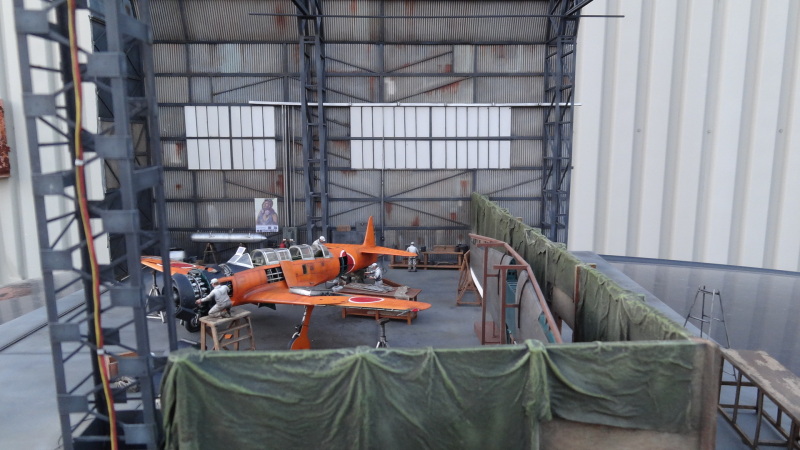
Nakajima "Saiun" 1st prototype diorama by Panagiotis Koubetsos

Hi all!
At last the Nakajima "Saiun" prototype diorama is over! I’d like to thank George once more for helping me in many ways with his huge amount of knowledge bring this project to an end! He is also a good reason for me to stick to IJNAF and IJAAF projects for many years to come, God permitting of course!
Panagiotis 

Only one word: 
UNBELIEVABLE!!!!! 信じられない!!! ΑΠΙΣΤΕΥΤΟ!!!

Sunday, 19 August 2012

Indonesian Yokosuka K5Y "Akatonbo" (Willow) #2

Following yesterday's posting we hope to continue our discussion on the very interesting subject of AURI aviation.
The second issue of our magazine released in October 2005 featured a short but very interesting article by Jacob T. on the subject of Indonesian "Willows". The accompanying artwork showed the sample aircraft in green top and trainer orange bottom. I would like to explain a bit why we opted for this particular scheme.
It is very important to keep in mind that Japanese aircraft left the factories painted according to their officially designated role, not how they were eventually used by the units. According to official regulations, from 1939 onwards, all trainers were to be painted "trainer orange" (or orange-yellow or yellow-orange...). So all trainers left the factories in overall "trainer orange" regardless of how they were used by the units that received them. Sometimes trainers were used for liaison, transport or even reconnaissance purposes. Therefore front line units camouflaged their planes as best they could but that does not mean that they stripped the aircraft of their previous factory applied paint and repainted them; an extremely tedious and time-consuming process for front line units having their hands busy with combat.
Simply put, if a Navy Air unit somewhere in Indonesia happened to have an "Akatonbo" trainer but used it to transport mail, they probably camouflaged the top surfaces (to hide the plane while on the ground) but wouldn't bother to change the colour of the lower surfaces to "gray".
I would like to ask our readers to imagine for a second the process of painting or re-painting the under surfaces of a plane by comparing it to a car mechanic under a vehicle using an airbrush or even a simple paint brush. Not very comfortable or pleasant, right?
Ofcourse as very often happens with Japanese airplanes, there were exceptions but some collaborating evidence (a testimony or a colour photo) would be necessary to prove the exception to this general rule.

"TJ" stood for "Tjureng", the way the Japanese word "Churen" (sort for Chukan Rensuki = intermediate trainer) was written in Indonesian. 
From left to right: Tjureng 72- TJ 54 and a Tjukiu wreck.
Photo: Jacob T. via Herman Dekker

When AURI found the "Akatonbo" left back by the surrendering Japanese forces, they either used them as they were by changing the national insignia or they brought some of them to airworthy condition. Yes, they most probably camouflaged the top surfaces to hide the planes on the ground from the Dutch forces but until now we have seen no evidence that they spent time overpainting the wing and/or fuselage undersurfaces "gray" or some other colour. We hope our Indonesian friends would be interested to share with us their thoughts on the colour subject. We would also be very interested in testimonies of Indonesian pilots who flew the "Willow" if available.
Feel free to commend or send us material directly to our email address.
Terima kasih.

Hello fellow readers,
This photo might gave us hint what is the underside color of Indonesian Churen.


From my point of view the underside color was a dark color slightly in the same shade with the red portion on the roundel. Photo was taken from an AURI internal publication magazine but I forgot to write down the date of publication. But I'm sure it was before 1970. 
Sinang

Saturday, 18 August 2012

Indonesian Yokosuka K5Y "Akatonbo" (Willow) by Sinang Aribowo

Today we have the pleasure to introduce the exquisite "Akatonbo" in Indonesian markings of our friend Sinang Aribowo in 1/72.