Friday, 8 November 2019

CINCPAC - CINCPOA Translations - Nakajima B6N "Tenzan" (Jill), 131 Kokutai pt.1

Today's post is a follow-up of the excellent "Jill" photos of the 131Ku. It's an interrogation report of a Japanese POW, a "Jill" pilot of the 131Ku that gives a lot of interesting information about the unit but also technical details of the aircraft, the methods used for torpedo attacks and the training of the pilots. The POW was captured on April 1, 1945 off Okinawa and we chose not to include his name  or other personal information. 


PRELIMINARY POW INTERROGATION REPORT NO. 142
                             -------------------------------------------------------------------------------

EDITOR'S NOTE 
Information in this detailed report is confined principally to three subjects: Naval Air Order of Battle, air training, and the performance of JILL 12.
POW was a pilot attached to K-256th Flying Unit (HIKOTAI), 131st Air Group (KOKUTAI). His information on the history, strength, personnel, and organization of this outfit, as well as of other Units and Air Groups, is detailed and, as far as it could be checked from other sources, accurate.
The various stages of POW's training as a pilot are considered here at some length. Certain grave deficiencies are apparent. His instruction lacked diversity, he had very few flying hours according to our standards, he had no knowledge whatever of radio navigation aids (he depended entirely on his navigator for navigation and instrument orientation), and his training in instrument flying and night flying was cursory at best.
Finally, POW gave considerable information on the performance of JILL 12. It was his opinion that performance figures in TAIC MANUAL NUMBER 1, JAPANESE AIRCRAFT, PERFORMANCE AND CHARACTERISTICS, are generally too high. 

2. CHRONOLOGY 
1943
Aug  -  Volunteered as reserve flying cadet at TOKYO. 
13 Sept  -  Entered MIE Air Group for pre-flight training. 
1944 
4 Jan  -  Transferred with 400 other cadets to TAKAO Air Group.
10-11 Jan  -  Boarded CHOHAKUSAN MARU and left MOJI in convoy of about nine vessels including two DDs. One SS contact en route, but convoy not attacked. POW heard SS was depth-charged without observed results.
17 Jan  -  Arrived TAKAO; reported to OKAYAMA (TAKAO) Airfield and entered TAKAO Air Group. Took elementary flight training in Type 93 training plane.
30 April (approx)  -  Completed elementary flight training and transferred to TAINAN Air Group with about 400 cadets from TAKAO. Took combat-plane training in Type 97 TB KATE.
30 June  -  Commissioned Ensign.
28 Aug  -  Transferred to USA Air Group as flight instructor in KATE.
Late Dec  -  Transferred to K-256th Flying Unit (HIKOTAI), a JILL 12 outfit in the 131st Air Group at KATORI Airfield. 
1945
29 March  -  Left KATORI with about 20 JILL 12 from K-256th HIKOTAI, arriving KUSHIRA Airfield, KYUSHU.
31 March  -  Left KUSHIRA Airfield on his first war mission at about 2230 ITEM in JILL 12 on torpedo attack mission against US trapsports off OKINAWA. About 25 JILL 12 were to participate, but all were to proceed and attack independently. Planes left from 2100 on.
1 April  -  Reached US transport area about 0130, launched torpedo at transport without observed results. Crashed. Captured.

3. DETAILS OF CAPTURE
When POW launched his torpedo, he was at an altitude of about 50 meters (164 ft). Flying low, he turned right to avoid one or more US night-fighters, possibly P-61, coming in from his left. As he came out of the turn, still very low, he kept his eyes on the US planes. This moment of inattention to his altitude apparently caused the crash. The radioman was lost, but the plane captain-navigator and POW were rescued by a US DD.
POW was not on a suicide mission.

4. ORGANIZATION

131st Air Group 
POW joined the K-256th Flying Unit (HIKOTAI) of this Air Group at the and of Dec 1944 or early Jan 1945 at KATORI Airfield, remaining at this field until 29 March 1945. The Air Group was composed of the following units:

K-256th HIKOTAI 
A JILL 12 outfit. The HIKOTAI flight personnel were made up of about 60 pilots, 60 navigator-bombardiers, and 60 radio operators. As of the end of March 1945, the plane complement was about 35 JILL 12, scheduled complement about 50 JILL 12. This included at most five reserve planes, with a scheduled reserve of about 10. Maintenance personnel complement was about 100.
The outfit was organized at KATORI in early Jan 1945 with new planes. Officer flight personnel, about 25, had for the most part been instructors after finishing combat-plane training. Including POW, three officer pilots, former instructors, had come from USA. Most of the flight personnel had come straight from training Air Groups (combat-plane training).
The unit was scheduled to move to KUSHIRA Airfield, KYUSHU, at the end of March 1945, but by 31 March only about 20 planes had arrived there. Maintenance personnel had not been sent at this date, but POW thought they would probably be sent to KUSHIRA. The CO of the 131st Air Group also moved to KUSHIRA with the K-256th HIKOTAI. His staff did not come; he went merely to look after the HIKOTAI. 
Combat organization was five Divs (CHUTAI) of two Secs (SHOTAI) each, four planes per SHOTAI. A KUTAI consisted of two planes; there were two KUTAI per SHOTAI.

K-5th HIKOTAI  
A radial-engince JUDY outfit formed at KATORI at the same time as K-256th HIKOTAI. Plane strength aggregated about 50 but included about five GRACE. Flight personnel numbered about 60 pilots and the same number of crewmen. The number of maintenance personnel was unknown. As of 29 March the unit was still undergoing training at KATORI.

Unidentified Fighter HIKOTAI  
Scheduled to join 131st Air Group at KATORI, but had not arrived by 29 March.

Maintenance BUNTAI
 About two attached to 131st Air Group; separate from HIKOTAI maintenance outfits. 

5. IDENTIFICATION OF OTHER UNITS 

MIE Air Group
POW entered this Air Group 13 Sept 1943 for pre-flight training as a reserve cadet (YOBIGAKUSEI); he remained in the Air Group until 4 Jan 1944. Student personnel numbered about 2,500 reserve cadets who entered with POW in 12 BUNTAI and about 2,000 enlisted trainees (RENSHUSEI). There were about 1,000 permanent personnel. No new classes came while POW was there. 
POW estimated that about 40% of the reserve cadets were to become pilots and, except for a few trainees for ground administrative jobs (perhaps 3%), the rest were to become navigator-bombardiers. Men were chosen by a physical and mental fitness examination shortly after arrival, for those duties. Enlisted trainees were to become pilots and air crewmen, percentages not known. When POW graduated, about 400 cadets including POW were sent to TAKAO Air Group for elementary flight training. Other MIE cadets went to SUZUKA, OI, CH'ING-TAO (TSINGTAO) and HIMEJI Air Groups, numbers sent to each unknown.
POW had heard that there was a detachment (BUNKENTAI) of the MIE Air Group known as the NARA detachment which was quartered in an old temple presumably in NARA. According to hearsay, the detachment was composed of enlisted trainees undergoing pre-flight training.
The MIE Air Group was located just NW of KARASU-MACHI, ICHISHI (ISSHI)-GUN, MIE Prefecture, as shown in the sketch below. The barracks area lay to the north with a drill ground in the south part of the designated area.
Barracks construction was still going on at the Air Group in early Jan 1944. POW estimated the facilities to be about 70% complete at that time.

TAKAO Air Group
POW was attached to this Air Group at OKAYAMA (TAKAO) airfield from 17 Jan 1944 to 30 April 1944, taking elementary flight training in Type 93 training plane. About 400 cadets who came with POW from MIE composed the student personnel. Permanent personnel numbered about 600, including about 300 maintenance men and 100 instructors. Of the latter, about 12 were warrant officers and about ten were officers, the rest being enlisted personnel. Plane complement was about 150 Type 93 Trainers. About 20 planes were assigned to each of the first four BUNTAI and the remainder were reserve. The first four BUNTAI comprised the cadets and flight instructors and constituted four HIKOBU for purposes of tactical organization. The lst and 2nd HIKOBU trained together, as did the 3rd and 4th, but two HIKOBU were not termed a HIKOTAI. The 11th and 12th BUNTAI were maintenance personnel, intermediate BUNTAI unknown.
There were no new classes entering TAKAO while POW was there. There had been enlisted trainees there, POW had heard, but they had gone before POW's group arrived and were not replaced by other enlisted trainees while POW was at the field.
P0W had heard that a gunnery school under this Air Group was in the vicinity of TAIKOZAN Mt, FORMOSA. 

MITA Detachment of U/I Air Group
Stationed at OKAYAMA (TAKAO) Airfield early 1943. A combat-plane training outfit for enlisted air-crewmen. Used NELLs. Facilities at Airfield separate from those of TAKAO Air Group and near south corner of field. 

TAICHU Air Group 
Heard to have been a Type 93 Trainer elementary flight training unit stationed near TAICHU, FORMOSA.

TAINAN Air Group 
POW was transferred to this Air Group on 30 April 1944 and remained there until 28 Aug 1944. The Air Group was a combat plane training unit with about 50 KATEs and approximately the same number of VALs. Student personnel comprised about 400 cadets from TAKAO, originally from MIE,
who had accompanied POW on his training course, plus about 200 enlisted air-crew trainees. The TAINAN Airfield was only a training field at the time POW was there. About half the students trained in VALs and about half in KATEs. Organization was standard. Four BUNTAI were composed of flight personnel, student and instructor, and two of maintenance men. Permanent personnel totalled about 1,600, including about 400 maintenance personnel. The Air Group was stationed at TAINAN Airfield. Pilots who completed training here with POW were sent, among other placos, to LUZON, OKINAWA, and SUZUKA.

USA Air Group
POW was transferred to this Air Group on 28 Aug 1944 and remained there as a flight instructor in KATE until the end of Dec 1944. Plane complement was about 50 KATEs and perhaps the same number of VALs. Trainees, all taking combat-plane pilot training, totalled about 70 reserve cadets, 70 regular cadets, and about 100 enlisted men. The reserve cadets, POW thought, had come from the TSUIKI Air Group, where they had had elementary flight training; they, had had pre-flight training at YOKOSUKA. Regulars were graduates of the Naval College. Permanent personnel numbered about 400, including about 20 instructors.

601st Air Group
While POW was at KATORI Airfield from early Jan 1945 to 29 March 1945, the 601st Air Group was stationed there. To the best of his knowledge, it then had only 20 ZERO 52 and functioned as permanent fighter guard for the field. 

KATORI Air Group
A maintenance training Air Group. 

K-254th HIKOTAI 
A JILL outfit organized at KATORI in early March 1945. At KATORI it had about 10 planes. Left KATORI for KUSHIRA Airfie1d about 8 March. When POW reached KUSHIRA on 29 March, K-254th HIKOTAI had about 20 planes, but POW estimated that it was scheduled to have about 50.

K-251st HIKOTAI 
A JILL 12 unit stationed at KUSHIRA with about 50 planes, about 20 of which took part in attacks against US shipping off OKINAWA. POW thought that this HIKOTAI belonged to the 701st Air Group, the Air Group possibly being based at KANOYA.

K-210th HIKOTAI (?) 
A JILL 12 Unit, part of which arrived at KUSHIRA on 29 March 1945, reputedly from the MEIJI Air Base in the NAGOYA area. (IN: POW was fairly certain of his identification; but as the 210th Air Group is known to have been based at MEIJI, it is possible that he confused the Air Group or a detachment from it with the HIKOTAI.)

K-3 HIKOTAI
Reported to be a JUDY outfit; location and further details unknown. As far as POW knew, it was not at either KATORI or KUSHIRA while POW was at these fields.

KUSHIRA Air Group
Heard that it was a training Air Group for maintenance nen. 

Combined Training Air Groups
POE believed that there were seven, numbered 12 through 19 but omitting 14. He said that TAKAO, TAINAN, SHINCHIKU, and TAICHU were in the same combined Air Group, possibly the 12th, Hq at TAINAN. TSUCHIUKA and MIE Air Groups, he thought, were in the 19th. Others unidentified. (IN: POW was not certain of designations of Combined Training Groups. What he called 12th appears to be the 14th.)

Tuesday, 5 November 2019

IJAAF & IJNAF photos & more

A set of photos I recently discovered in the "Asahi Shimbun" collection.
According to the caption:
"KANOYA, JAPAN - MAY 01: A kamikaze attack aircraft carrying a torpedo under the body of the plane takes off at the Imperial Japanese Navy Air Base circa May 1945 in Kanoya, Kagoshima, Japan. The air base was the centre of the Japan's suicidal Kamikaze Attacks, along with the Imperial Army Air Force Chiran Air Base at the end of the Pacific War. (Photos by Yasuo Tomishige/The Asahi Shimbun via Getty Images).


The Nakajima B6N "Tenzan" (Jill) belong to the 131 Kokutai as indicated by their tail marking.
The unit was organized on July 10, 1944 in Yokosuka by combining the Recce 11 Hikotai equipped with Nakajima C6N "Saiun" (MYRT) and Yokosuka D4Y reconnaissance with the Sento 851 Hikotai that was equipped with Nakajima J1N "Gekko". Their next base was Katori, Chiba Prefecture. From the end of July, the "Gekko" of the 851 flew air defence and patrol missions in the Okinawa area but the 131Ku was re-organized on November 15 and this time it was equipped with carrier bombers and attackers. The two previous hikotai were replaced by Kogeki 105 and 251 who now made up the kokutai. On December 1, 1944 the unit had 48 carrier bombers and 48 carrier attackers.
Early January 1945 the unit was organized with three hikotai; 3, 105 and 251.
On March 1, 1945, the Sento 804, 812, 901, all night fighter units, were attached to the 131Ku and the previously mentioned hikotai equipped with attack bombers and became: Kogeki 5, Kogeki 254 and Kogeki 256.
The night fighter units were very active during the Okinawa campaign together with the bombers.
On April 1, 1945 the unit had 48 carrier bombers, 48 carrier attackers and 96 night fighters.
The Kogeki 254 had aircraft numbers from 01 to 49 while the Kogeki 256 numbers from 50 to 99.
Throughout its history the 131Ku operated: Zero-sen, Zero night fighters, "Gekko", Val, "Suisei", "Suisei" night fighters, "Tenzan", "Ryusei" and "Saiun".

The 131Ku together with "Tenzan" from other kokutai, also organized Kamikaze groups based in Kushira base, Kagoshima Prefecture and participated in the "Kikusui" attacks.
The first group of  nine "Tenzan" from the 254 relocated to Kushira base on March 30 and were named "TenO-tai" (Heavenly Cherry Blossoms). On April 1 and 2 attacked enemy ships in the Okinawa area but only two survived.
The combined "Tenzan Unit" took part in the 1st Kikusui on April 6. Two "Tenzan" from the 131Ku, 254 named "Raifu Raigeki-tai" (Thunder Wind Torpedo Unit), three from the 256 named "Jinpu Raigeki-tai" (Squall Torpedo Unit) and four from the 701Ku.
Also participated in the 3rd Kikusui of April 16 but this time six "Tenzan" from 701Ku and  one from the 901Ku.
On May 11 it was the 6th Kikusui and ten "Tenzan" from the 931Ku took part.
All the above mentioned "Tenzan" that took part in Kikusui missions were equipped with 800kg bombs, not torpedoes.

Considering all the above information (from Akimoto Minoru, Model Art #458 and Japanese Wikipedia), the aircraft in the photos with tail number "131-64" belongs to the Kogeki 256 of the 131Ku and is NOT taking part in a suicide mission but rather a conventional torpedo attack.

Sunday, 3 November 2019

Japanese Aircraft Online Model Contest 013 - JEAN BARBY

Tamiya Nakajima J1N1 "Gekko" in 1/48, based in Borneo, credited with two victories. The plain IJN Nakajima camo is not evident to shade in order to give some relief to an otherwise monochromic green. I did rivet the plane and used Fine Molds 20mm barrels for the guns, otherwise, out of the box! 

- Jean Barby -


Friday, 1 November 2019

CINCPAC - CINCPOA Translations - Attacking Large Bombers Pt. 3

Part #3

Account
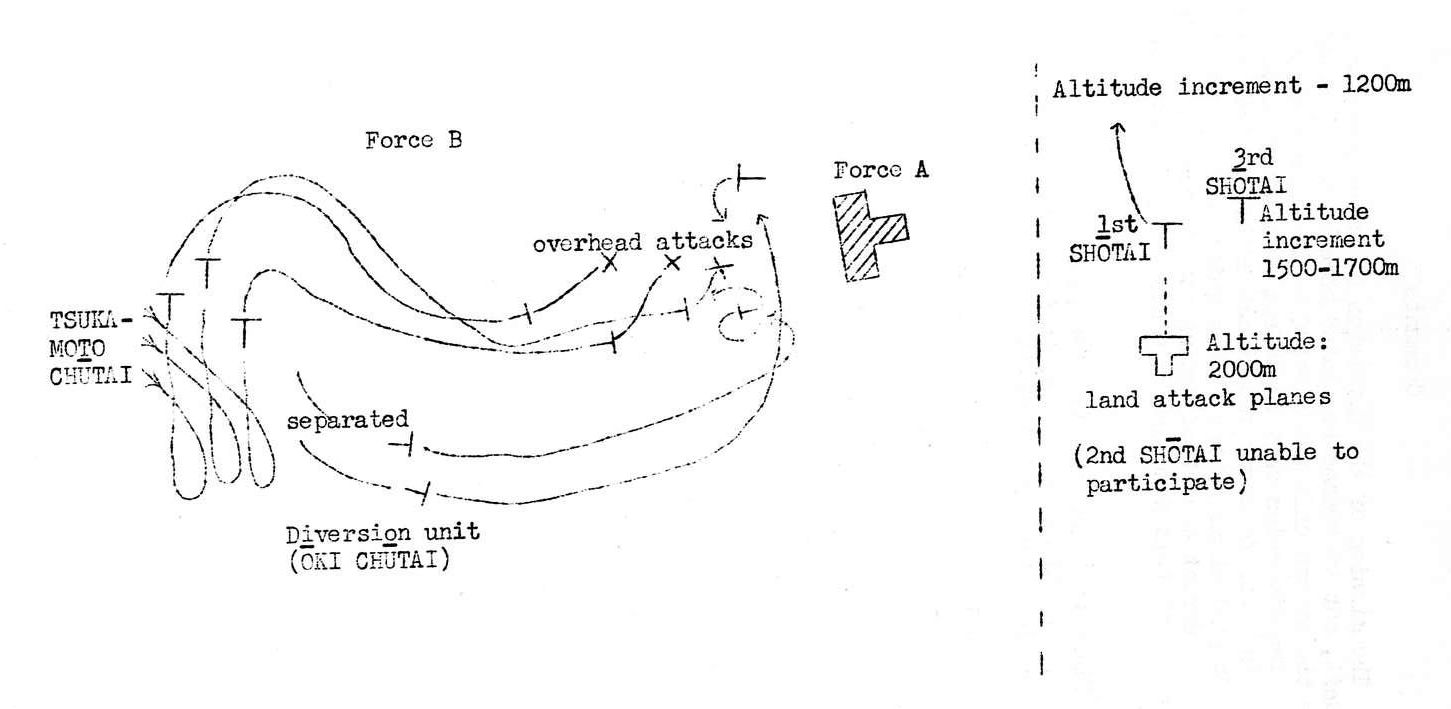
While Force B was patrolling, its diversion unit (OKI, or 2d CHUTAI) became separated from the attack unit, then sighted and approached the direct escort unit of Force A. At this moment the attack unit also sighted the enemy, turned right, and approached the medium attack plane unit of Force A. During this maneuver the 3rd (YAMAMOTO) SHOTAI was delayed a little, and the attack unit became drawn out.
Immediately after the attack unit begun to approach the enemy, the diversion unit was engaging A's direct escort unit (in an overhead approach). The latter broke away and came up in front of the medium attack plane unit in an attempt to attack Force B's attack unit, but were unsuccessful (though they were of some hindrance to the later  attacking SHOTAI of Force B). SHOTAIs 1, 2, and 3 were able to make an effective, concerted assault.

Comments
1. The mission of the diversion of Force B was to cover the attack unit, but it became separated through poor communication; to leave the attack unit unprotected while it made a run was poor tactics. The diversion unit on patrol should fly above and a little to the rear to cover the attack unit, but just before the run it must pull ahead of the attack unit; the same tactics apply to the direct escort of medium attack planes. Keeping a close liaison at this juncture is a necessity; (a difficult maneuver).
2. Since the planes' formation is the basis of aerial combat between formations of planes, it is very important to exert every effort to maintain formation.

Essentials of formation flying: 1. Speed and precision, 2. A formation that is too tight is better than one that is too spread out, 3. To arrive too early is better than arriving late.

3. The diversion unit in patrol formation follows the attack unit; its mission is further complicated by its being required to fly ahead when the enemy is sighted. For this reason, a reciprocating patrol () might be carried out at right angles to the direction from which the enemy is expected, and the diversion unit placed on the side towards the enemy. If the diversion unit is stationed above and diagonally to the rear in the patrol formation, it will be in front of the attack unit. It is also thought that maneuvering will be facilitated by this disposition. (Lt. (jg) MASUDA)
A direct escort unit (KO fighters) must be attached to the attack unit (OTSU fighters), and the diversion unit (KO fighters) kept separate. The direct escort unit (TN: This is presumably the subject of the sentence, although the Japanese text is extremely vague.) must seize any good opportunity for checking and disrupting the enemy and then attack. The diversion unit will have as its mission the direct protection of the attack unit; its duties will be reduced and its mobility facilitated. However, since the missions of the attack and diversion units are inseparably interrelated, it is needless to emphasize the importance of preserving the closest coordination of movement between them.

                                                   ---------------------------


Account
Force A's direct escort unit set out for the attack over CHIBA. While it was still gaining speed in an effort to take up its position as direct escort for the medium attack plane unit, Force B's attack unit approached and attacked the bombers. By the time the attack unit had climbed ahead, the direct escort unit was in its prescribed position and ready for a run.
As the 1st and 2nd SHOTAI were weaving, Force B's attack unit again came in for an attack. The 1st and 2nd SHOTAI of the direct escort unit engaged them. The 1st and 2nd SHOTAI, above them with an altitude advantage of 700 meters, engaged the diversion unit of Force B. As a result, the attack unit's run was pulled flat.
In general, the direct escort unit of Force A maintained good position and was able to prevent any effective attacks. 

                                                   -------------------------


Account
While on patrol over its YOKOSUKA base, Force B sighted 6 fighters (Army SHOKIs) (TN: TOJO) in the direction of CHIBA at a distance of about 4000 meters. Though very near to them, the diversion unit (MASUDA CHUTAI) mistook these planes for the "enemy", became separated from the attack unit, and made a run on the fighters. However, realizing their mistake, the hastily turned, and attempted to rejoin the attack unit; but since they were already at some distance, only the 2nd SHOTAI was able to catch up and fly ahead of the attack unit.
When the enemy was actually sighted, the 2nd SHOTAI made an overhead attack on the enemy's direct escort unit. The attack unit beat off an attack by Force A's direct escort unit and attacked the medium attack plane unit (but was again attacked by part of the direct escort unit).
Hereupon, the 1st SHOTAI of Force B's diversion unit also joined the fight, but was unable to give the attack unit complete protection.

Comments  
1. It is exceedingly poor tactics for the diversion unit to part from the attack unit;. The diversion unit bears an inseparable relationship to the attack unit; it must maneuver so as to be in advance when the attack unit starts its approach.
2. When approaching the bombers, the attack unit should roll over with an altitude advantage of 500-700 meters (TN: make its run), and pull out immediately in front of them.
When an altitude advantage of about 1000 meters has been regained, and an air speed of about 130 knots (indicated) has been reached, roll over, and another approach will be easy. Rolling over for the run after approaching with an altitude advantage of 1000 meters and at an air speed of 170-190 knots (indicated) makes for over-acceleration and rather difficult deflection firing.

Thursday, 31 October 2019

CINCPAC - CINCPOA Translations - Attacking Large Bombers Pt. 2

Part #2
Account 
Air patrol carried out at 3500 meters. Enemy sighted at 6000-5000 meters, bearing 040°. The 1st CHUTAI immediately approached enemy. The 2nd CHUTAI turned inside at high speed and, coming out in front of the last CHUTAI, engaged A's direct escort unit in a head-on approach and recovered below. The 1st CHUTAI deployed and made an overhead approach.
The cooperation of the 1st and 2nd CHUTAI was in general well timed.
The 2nd CHUTAI (diversion unit), after passing the direct escort unit in a head-on approach, made an overhead attack against the enemy attack planes. (The latter were judged to be too far away from the direct escort unit). A's 3rd SHOTAI delivered a head-one attack which was considered effective on the whole.
The 1st and 2nd SHOTAI of Force A made a head-one attack against B's diversion unit, pulled out, and then attempted to attack those planes of Force B which were trying to an over-head approach, but were unable to deliver a positive attack from a 600-800 meter firing range.
It was judged that B's attack unit did not consider this approach and could have made a run.
Comments
a. Since the number of planes on both sides was small during this trial, we can only imagine what would have happened with more planes participating. To conclude that Force A was able to check Force B skillfully with just 12 fighters is premature; greater participating strengths should be assumed in judging.

b. Since Force B was composed entirely of Zero fighters during the trial, it was more convenient to use them without distinguishing between a diversion unit and an attack unit; but further study on this matter is necessary.
1. The leading unit made the diversion unit, without its being considered a separate entity. The leading unit may proceed as usual and make a run, if it appears that an overhead attack is warranted by the condition of the direct escort unit, in which case the next SHOTAI will become the diversion unit. Or, the entire force, or a part of it, may make a surprise overhead attack.
2. Operating with two distinct units.
(It is assumed that local interceptors () will seek out enemy fighters but not engage them in combat).

c. The air patrol unit (JOKU SHOKAI TAI)
1. Patrol formations, maneuvers, disposition, and approaches.
Example: When the enemy bombers are well spread out, the unit making the overhead attack will approach and strike, also in spread-out formation.
2. The overhead approach.
When there are three enemy planes or less, there should be 300 meters distance between each BUNTAI attacking. If the enemy planes are about one CHUTAI strong, the attack is made by one SHOTAI at a time. The distance between the 1st and 2nd BUNTAI is approximately 100 meters with the 1st BUNTAI on the outside and the 2nd BUNTAI on the inside. The distance between SHOTAI will be about 300 meters, and the attack carried out as with BUNTAI alone.

d. In an attack by local interceptors against large planes, KO () fighters should go along as direct cover, to oppose interference by enemy direct escort planes which must certainly be expected.
Combat methods for this type of diversion unit and methods for its cooperation with the attack (local interceptor) unit remain open for investigation.

e. To protect a land attack plane unit against an attacking fighter unit approaching on opposite course and making a wide-angle, overhead attack, it is thought best to have the direct escort unit disposed 2000-2500 meters forward of the land attack plane unit and 1500 meters higher.

                                                ------------------------------


Account
Force A assumed assault formation () at 0840 immediately after making its rendezvous, but the medium attack plane unit then turned to the left. The 3rd SHOTAI (MASUDA SHOTAI), which was farthest in advance, did not observe this, lost sight of its companion units, and continued separately on its course. The 1st SHOTAI (TSUKAMOTO SHOTAI) and 2nd SHOTAI (OKI SHOTAI) also delayed in turning; and in the approach to the objective, the 2nd SHOTAI pulled too far to the side and lost sight of the medium attack plane unit. The 3rd SHOTAI, proceeding directly, sighted the "enemy" fighter unit (Force B's diversion unit) at 0850. When it turned to the left during its engagement with these fighters, it noticed the medium attack plane unit far behind and flew back in an attempt to reassume its escort station. The 1st SHOTAI, mistaking the 3rd SHOTAI for Force B, veered to the right. 
At this point the KODA CHUTAI of Force B made its run on the medium attack plane unit. Although the 1st SHOTAI executed a head-on attack against the 2nd SHOTAI of Force B (OKUTANI SHOTAI), it was a little too late. In the meantime, the 3rd SHOTAI reengaged B's diversion unit to the right as the latter came in for a run, and hastened to its direct escort station. But it was too late; the medium attack plane unit had already been attacked.   

Comments
1. Since the starting points were too close, and visibility was exceptionally good, it was difficult to simulate the attack approach of actual combat.
2. The direct escort units, as soon as they were in assault formation, carried out weaving together, 2000-2500 meters in front of the medium attack plane unit and at an altitude increment of 1000-1200 meters.
Though exercising their maneuverability in this manner, they should not lose sight of the medium attack plane unit. (This maneuver is admittedly difficult.)
3. Since the 3rd SHOTAI (MASUDA SHOTAI) became separated, a tryout of the double-level disposition () was impossible.
4. The cooperation between diversion and attack units, which became separated, was poor. The diversion unit should always protect the attack unit to permit the latter's making an effective overhead approach. (Further experiment is necessary on the position the diversion unit should maintain and on the timing of its run.)
5. Since the 2nd and 3rd SHOTAI of B's attack unit made their runs at almost the same time, a bracketing attack developed. Here the SHOTAI leaders should use proper judgement, to break off the attack, and maneuver for a second decisive approach, once their planes have reformed after a good break-away.
6. In patrol formation, it is important that each SHOTAI and each plane should not become separated too much. There have been times when the CHUTAI commander has decided to attack, but the chance to engage was lost, through the disrupted or unprepared attack formation of succeeding SHOTAI.    

                                              --------------------------------


Account
Force A's medium attack plane unit set its course prematurely, so that the direct escort unit was unable to assume its proper assault formation. The 3rd SHOTAI (MATSUBA SHOTAI) was late in getting into its supporting position and fell behind.
Force B's diversion unit (2d, or MASUDA CHUTAI) sighted Force A at 1034 and approached the latter's direct escort unit (at 3600 meters). Force B's attack unit turned on sighting the enemy, but its formation became confused owing to the delay of the 2nd (OKI) and 3d (YAMAKAWA) SHOTAI in turning. Although the 2nd CHUTAI presented a satisfactory high cover screen (), the 1st and 2nd SHOTAI of Force A's direct escort unit avoided engagement with them and made an undeviating head-one attack against Force B's 1st CHUTAI.
In the meantime, the 2nd CHUTAI of Force B inflicted a head-on attack and an overhead attack on Force A's 1st and 2nd SHOTAI respectively. Force B's 1st CHUTAI was checked by the direct escort units; and because it rolled over too soon, its dive was too steep. But it immediately pulled out, looped, and attacked satisfactorily. The movement of Shotai 2 and 3 of Force B was held in check by the direct escort unit; they had to be contented ultimately with a weak attack.
The 2d BUNTAI of the 2d SHOTAI proceeded independently to the left, where the direct escort unit was thinly dispersed, and made a successful attack.     
Comments
1. When the direct escort unit of Force A was attacked by the diversion unit of Force B, it should have counter attacked and then evaded, as in actual battle. It should not, however, get too involved in combat, lest it leave the medium attack planes exposed. In this encounter, its evasion was insufficient, and it was subjected to attack.
2. When unable to effect a steep overhead approach because of poor position, it is better not to go ahead with the attack, but to withdraw temporarily and plan a strike which will be sure not to fail.
The maneuver of the 2d BUNTAI (TAISHOYA BUNTAI) of the 2nd SHOTAI in Force B's 1st CHUTAI was well timed.
Greater stress should be placed these days on the attack formation of fighters on the timing of their attack.
(YAGI, Air Group Comdr.)

                                                     ------------------------

Account
The medium attack plane unit was delayed in its take-off; and while the direct escort unit waited at the rendezvous, the 2nd and 3rd SHOTAIs became separated and started out on the attack before they could regain formation. The 2nd SHOTAI (OKI CHUTAI) and the 3rd SHOTAI (Lt. (jg) MASUDA) pushed ahead under full throttle, fell back and slightly to the left.
Force B sighted the "enemy" too late, and having no time to deploy, made its run while still in patrol formation, bearing 330°  from the medium attack plane unit and with an altitude advantage of about 1200 meters. As a result, Force A's 3rd SHOTAI was able to deliver both a head-one and overhead attack against Force B.
The diversion unit of Force B was too late to check Force A's direct escort unit, which effectively attacked Force B's attack unit. The latter being also attacked in the center, fell behind. 
Comments
1. Because of bad formation flying by Force A's 2nd and 3rd SHOTAI over CHIBA, they were not in their assault formation positions. At the time of B's run the 2nd SHOTAI had fallen behind and the 3rd SHOTAI was off to the left. SHOTAI leaders must understand precisely the positions to be taken for direct escort and see to it that the formation is constantly maintained.
2. Although the direct escort unit stays behind and above the medium attack plane unit when advancing for the attack, it is advisable that it occupy a superior position 500-700 meters above the designated altitude in order to facilitate its proceeding ahead of the attack planes before the enemy's run.
3. There must be a plan for rallying under the CO's plane after completion of an attack. (301st Air Group)

Wednesday, 30 October 2019

CINCPAC - CINCPOA Translations - Attacking Large Bombers Pt. 1

The next document, in three parts, is detailing ways to attack and shoot down heavy bombers and the results when Yokosuka and 301 Kokutai put these ideas to the test. A very rare and historically important document.

CONFIDENTIAL CINCPAC - CINCPOA TRANSLATIONS

Source: Captured on SAIPAN.
Subject: Experiment and research on Methods of Attacking Large Bombers. Fragmentary document; undated; issuing authority unidentified, but this mimeographed reference work may possibly have been issued by the YOKOSUKA Naval Air Group.
Editor's Note:
This document was discussed at considerable length in CINCPAC-CINCPOA WEEKLY INTELLIGENCE, Vol. 1, No. 16, 27 Oct 1944, pages 28-32, and is reproduced here in full because of its value as a discussion of fighter tactics. 

-------------------------------------------------------------------------------------------------------

EXPERIMENT AND RESEARCH ON METHODS OF ATTACKING LARGE BOMBERS
                                                    (First Report) 
Attacks with Forward-Fixed Guns 
I. Object
To establish the most effective method of attack with forward-fixed guns, on armored, fireproofed, heavily protected large bombers.
II. Results and Comments 
A. Suitable methods of attack. 
1. Basic methods of attack.

a. Steep overhead (TN: Lit: from above & astern) attack. 
A steep overhead attack (angle at instant of firing:70°- 45°; firing range: 600 to 300 meters) is most effective and little damage is sustained by the attacking plane. It is considered the most suitable method of attacking large planes. Its advantages are as follows:
(1) Percentage of hits is good. For the reasons stated in paragraph (2), (3) and (4), a high percentage of hits is characteristic of this method.
(2) The approach and attack are simple; their essentials can he grasped by an inexperienced pilot with only a short period of training. 
(3) Execution of the attack is seldom affected by the enemy's formation at the time he is sighted or by his changing course during your approach.
(4) Errors in sighting, especially in firing range, are slight. 
(5) Since the relative angles of attack and breakaway are large, little damage is suffered from enemy defensive fire.
See Appendix #1 for essentials of the attack.
b. The effectiveness of the head-on attack, made from almost directly ahead (within 10° left or right and 15° above or below the enemy plane's line of flight; firing range 800 to 300 meters), is relatively great, and maneuvering for the attack is easy. This is considered a good method of attacking large planes.
See Appendix #1 for essentials of the attack. 

c. Firing with sights. The advantage of deflection (angle) firing ( ) are as follows: 
(1) Although deflection (angle) firing has the fault of making errors in the firing angle at once produce errors in deflection, it has little effect on errors in firing range. Because it is direct sighting, sighting errors are small, and the percentage of hits is higher than with deflection (amount) firing (). (2) In the overhead approach especially, the firing angle is large, producing some error in its calculation; but bullet drift is small, so from the practical standpoint the method is advantageous and there is no further need for consideration of it.
See Appendix #3 for the details of deflection (angle) firing. 

1. Attacking large planes provided with escort fighters. 

a. A combat air patrol (JOKU CHOKUEI TAI) is divided into a diversion unit (YUGEKITAI) and a bomber interception unit (BAKUGEKIKI GEKITSUI TAI).

b. The diversion unit will vary with the number of planes of each side and with the situation, but generally includes sixteen planes. It engages, checks and destroys enemy escort fighters, and gives indirect cover to the bomber interception unit.
The bomber interception unit usually consists of eight to sixteen planes. It avoids combat with enemy fighters and forcefully attacks and destroys enemy bombers. When necessary, the bomber intercpetion unit is divided into two parts, one concentrating on attacking the bombers, the other becoming a direct escort unit for the first.

c. Although it is preferable for the diversion unit and the bomber interception unit to be in strength when the number of planes on both sides is large, the optimum number is 32 planes, otherwise confusion in the air will result.

d. The diversion unit mast engage the enemy escort fighters before the bomber interception unit begins its assault. When the diversion unit is in strength, it is sometimes preferable to have it accompany the bomber interception unit to ensure coordination.

e. If a coordinated attack is executed by having a part carry out a frontal attack while the greater part makes an overhead assault, it gives the enemy no time to prepare and is very effective.

B. Improvements in armament.
In an overhead attack using 20 mm Mark II MG's (target speed being 250 knots), the deflection will be 9° 47' for the firing angle of 70° and range of 600 meters; or 7° for the firing angle of 45° and range of 300 meters. Because it is difficult to aim with the present sight and armament, the following is required:
1. Manufacture of sights with a good field of vision below and in front.
2. Elevation of MG's and sight at least 5° from the plane's longitudinal axis to improve the field of vision below and in front during firing.

C. Study of various methods of attack. 
1. If a stern attack from below is executed properly, it gets very good results with slight risk of damage. This attack requires great skill and will be difficult to execute unless by a pilot well practiced in the maneuver. 
2. The steep frontal attack and the side approach are not only difficult to execute and rather ineffective, but the risk of being damaged is great.

III. Summary of Fxperiments.
A. Participants
YOKOSUKA Air Group:       16 Zero fighters, 2 RAIDEN 
301st Air Group:                     16 Zero fighters, 2 RAIDEN
IV. Results
1. Essentials of basic approaches: Appendix #1
2. Attacking in formation: Appendix #2 
3. Deflection (angle) firing: Appendix #/3 

Appendix #1
Essentials of Basic Approaches against Large Planes
I. Head-on Attacks from Above and Below
A. Essentials of execution.
1. Angle of attack
2. Firing range: 800-300 meters
3. Deflection (Angle) firing:
The deflection is as shown in the annexed tables
4. Recovery
Whether attacking head-on from below or above, you should fly on opposite course, just clearing the enemy plane. If necessary, slip off to one side quickly to get out of the effective range of the enemy's guns. In doing this your angular speed relative to the enemy plane will be very great, rendering the enemy's fire ineffective. 
When a second approach is necessary after recovery, you must stay 1000 meters or more laterally from the enemy plane (outside the effective range of his guns).

B. Precautions 
1. There is a general tendency toward increasing the firing range. You should pay attention to the determination of the firing range, in order to avoid long range firing. During the experiments made by the YOKOSUKA Air Group, errors were made in estimating the 1400 meter maximum (TN: firing) range and 1000 meter maximum breakaway range. 
Because gunnery training has been carried out with sleeve targets, the firing range against real targets becomes excessive, as the target seems larger and the tension of actual combat predominates. Consequently, a medium attack plane should usually act as the target for photo-firing or simulated attacks. Or permanent targets the size of a large enemy plane may be laid out on the ground, so that planes returning from gunnery practice can make simulated strafing attacks. In any case, there must be a refinement in the judgment of firing range. 
2. To roll and turn directly in front of the enemy plane during your breakaway, while concentrating on the next approach, is very dangerous. This is because your angular speed in relation to the enemy plane is very small during a turn, and because your plane appears to be at a standstill for a moment. You present a large target to the enemy gunner, and cannot see his plane yourself; in other words, you're a fine target. Furthermore, during training the chances of a crash in mid-air are great.
3. When executing deflection (angle) firing during a head-on approach from above or below, it is easy to err in the direction of deflection, so care is required. 
4. In a concentrated attack the SHOTAI should be slightly more open than in patrol formation and should send in its four planes on successive attacks from directions differing by a small angle. 
II. Overhead attack. 
A. Essentials of execution. 
1. Approach and turn.
Your lateral distance from the enemy plane when making a frontal approach with an altitude advantage of 800-1000 meters should be small. When the target appears below and in front of you at 30° to 40° (target speed 250 knots), roll over with a half slow roll, keeping your sight on the target after the turn. If, imeediately after rolling over, you nose your plane down too much and withhold your fire, the target will then be beyond your guns, and the extreme difficulty of maneuvering to counter this will make effective attack impossible. On this account, it is necessary to keep the target in the sight from the moment of roll-over and to aim, maintaining a fixed lead. 
3. Firing range: 600-300 meters. 
Air speed is about 280 knots within firing range and about 325 knots at the break-away, but there is no need to fear for the strength of the airframe. (Air speed reaches 330 knots only after the plane has dropped 2500 meters following the roll-over, with the engine at full throttle. Terminal velocity is 340 knots.)
4. Leading your target and sighting. 
Although we rely on deflection (angle) firing, "leading" a target with the sight in present Zero fighters is impossible if the target speed is fast. Hence, the pilot's seat has been fully raised and your firing is sighted along the middle of the cowling. When this is done, the deflection is 6° - 7° (there is some variation depending on the fuselage).
5. Recovery.
When finished firing, continue diving to increase your angular speed to its maximum while within the enemy's effective firing range; then quickly retire out of effective range.
6. Repeated attacks.
After retiring out of effective range, nose your plane up slowly for another approach. With an altitude advantage of 5000 meters at a distance of 2000 meters, loop over and attack. If your lateral distance from the target is kept as slight as possible when starting your run, it will be easy to get lined up with the target's flight path and your attack will be facilitated.

B. Precautions.
1. Never make a flat diving attack. If you should fall behind the target after rolling over, give up the attack completely and recover as soon as you can. (Although it is better to continue diving after firing and then recover, a recovery above is possible when you still have considerable altitude advantage immediately after your roll-over, and when there is no fear of being under effective fire.) In attacks at an angle less than 45° your angular speed relative to the enemy plane is small, and the chances of your being damaged are great.
2. When holding your sight steady and making a persistent close-in attack, caution is required; your initial angle of attack must be good, or else it will rapidly flatten out as you close to firing range. You must concentrate on sighting and on the abrupt reduction in diving angle which accompanies your closing to firing range.
3. After rolling over and during your approach, you should constantly maintain the position you desire relative to the enemy. A "waiting attack" (MACHIUKE KOGEKI) is dangerous, since it is very likely to cause a mid-air crash.
4. A concentrated attack by a SHOTAI is rather difficult; consecutive strikes by BUNTAI at close intervals is more effective. In the formation for the latter approach there should be 30 meters distance between each plane, about 100 meters distance between BUNTAI, and about 300 meters distance between SHOTAI.

Reference data:
Observations made from a medium attack plane on an attack by 8 Zero fighters against 3 special training Type 96 land attack planes, 6-7 January 1944.
1. Overhead approach.
a. It is impossible to direct your MG's against a steep overhead approach, and firing with sights (SHOJUN HASSHA) is difficult as well. It is also difficult to fire on planes on opposite course and with an altitude advantage of about 1000 meters when they roll over, since they are at extreme range and will go into a steep dive immediately after rolling over. Because of the target's speed of movement gained from its fast dive, there is only a moment to fire lefore it breaks away.
b. It is easier to fire on those planes whose delayed run-in makes them fall behind or enter a shallow dive. Those who attempt close pursuit are similarly easy targets. In ceneral, the tailman ( ) of a SHOTAI has a tendency to be "pulled flat". 

2. Head-on approach.
During an enemy plane's approach from opposite course, its movement is slight, making it an easy target for the defending gunners. It is almost impossible, however, to fire on planes which continue on opposite course and recover above; they retire beyond firing range. It is easy to fire on planes which roll over in front of their target, especially on those which recover in inverted flight.

Appendix #2

Formation Attacks on Large Planes 
(Account of Experiments) 

I. Dates and Place. 
From 10 January 1944 to 13 January 1944. 
II. Personnel and Planes Participating. 
YOKOSUKA Air Group fighter personnel (16 Zero type carrier fighters) 
301st Air Group fighter personnel (16 Zero type carrier fighters)
III. Plan
A. Organization.
Force A    (9 Type 1 land attack planes 
                 (12 Zero fighters
Force B     20 Zero fighters
B. A combat air patrol of fighters would intercept some bombers with direct escort fighters (trying primarily to shoot down the large planes at one crack with a steep overhead approach), and the results of the attack would then be studied.
IV. Account and Comments. See annexed tables.
V. General Comments.
Since this experiment was carried out with a very small force and covered only one-phase of attack methods, there is still much room for further study. 

A. In addition to direct escort fighters, a strong diversion unit should be attached to the bomber interception unit.
B. The escort fighters should be disposed to provide protection against overhead attacks by enemy fighters approaching on opposite course. In addition to the usual direct escort disposition one unit (TAI) should be stationed 2000 meters in front and 1000-15000 meters above the attack plane unit.

Formation attacks on Large Planes (4 planes to a SHOTAI)
1. Formation Plan
Execute Weaving (BARIKAN UNDO)
2. Account
At 1310 the KISARAZU Air Group took off and gained altitude. The altitude of land attack plane unit was 2000 meters. The direct escort unit, taking position as shown above, proceded with a weaving maneuver.
The enemy was sighted at 1314, 6000-8000 meters distant.
When Force B's land attack plane unit attacked, Force A's direct escort unit had dropped too far back from its direct escort position to repulse the steep overhead approach of Force B's fighters in time. Although A's direct escort unit was directly above the land attack plane unit, the point where B's planes rolled over was 1500-2000 meters forward of it, so that A's planes were outdistanced and of no use in stopping the attack.
More study was needed on the disposition of direct escort units (cf. second trial). Since A's planes peeled off prematurely, B's patrol unit was late in assuming patrol formation. Tryout of a diversion unit in particular was impossible. (In the second trial, allowance was made.)

3. Comments.
a. Some planes made shallow attacks because their roll-overs were poorly timed or executed too close together.
b. Whereas many planes did not get in the vertical plane of their target, they should have been as directly above and behind it as possible. CHUTAI and SHOTAI leaders needed more practice in the approach and run. (In selecting a target it is preferable to attack the wing-men first.)
c. Some pilots made poor recoveries. (They recovered by pulling out above.)
Break-away from the enemy after an attack should be rapid. (The superior speed achieved in the dive should be used in the break-away, so that the enemy direct escort fighters cannot jump upon you.)

Saturday, 26 October 2019

CINCPAC - CINCPOA Translations - Nakajima J1N1 "Gekko" (Irving)

This is the first installment in a new series featuring primary source material we recently located in the National Diet Library. 
Since our current contest is about "Japanese Night Fighters", in this posting, we present a 14-page document regarding the installation of upward and downward cannons on the Navy Type 2 Reconnaissance Aircraft or Nakajima J1N1-C.

First, here's what Wiki has to say:
"In early 1943, Commander Yasuna Kozono of the 251st Kōkūtai in Rabaul came up with the idea of installing 20 mm cannons, firing upwards at a 30-degree angle in the fuselage. Against orders of central command, which was skeptical of his idea, he tested his idea on a J1N1-C as a night fighter. The field-modified J1N1-C KAI shot down two B-17s of 43rd Bomb Group attacking air bases around Rabaul on 21 May 1943."

And the report:

CONFIDENTIAL CINCPAC - CINCPOA TRANSLATIONS

Item No. 9311, page 1. 
Source: Unknown. 
Subject: Fighter Unit, YOKOSUKA Air Croup: Reference Notes on Upward and Downward Inclined Fixed 20 mm MG's for Type 2 Land Recce Plane; dated August 1943; 14 pages, mimeographed. 
Editor's Note: 
The installation described in this important document, issued by the tactical research center of the Japanese Air Force, became standard on Japanese night fighters in the latter part of 1943. The document has previously been summarized and commented upon in "WEEKLY INTELLIGENCE" Vol. 1, No. 2, 21 July 1944. The arrangement of inclined cannon described in it represents a modification of "Irving's" armament, replacing the remote controlled after-turret guns found to be unsatisfactory for either day or night fighting. In "WEEKLY INTELLIGENCE" Vol. 1, No. 8, 1 September 1944, two photographs confirm and amplify the documentary evidence. Of interest is the fact that the 20 mm fixed nose cannon is retained. 
--------------------------------------------------------------------------------------------
Military - Very Secret (GUNGOKUHI)                                          Fighter Unit, 
Copy #7 of 50                                                                 YOKOSUKA Air Group 
                                                                                              August 1943 

REFERENCE NOTES ON UPWARD AND DOWNWARD INCLINED FIXED 20 mm MG's FOR TYPE 2 LAND RECCE PLANE 

Contents 
I. Inclined Fixed Machine Gun Installation 
II. Electric Firing Circuit 
III. Pneumatic Charging System 
IV. Rules for Bore Sighting 
V. Firing Tactics and Battle Lessons 

I. Inclined Fixed Machine Gun Installation 
1. As proposed by Commander KOZONO, all of the initial armament of the Type 2 Land Recce Plane was removed from the fuselage and it was equipped with 2 upward inclined and 2 downward inclined 20 mm Mark 2 fixed MG's (100 round magazines) as described below: 


(2) The machine gun installation is virtually fixed; and slight adjustments can be made in the rear mounting sufficient to correct errors in the installation. 
(3) Method of harmonization: 
The machine gun and the sight are completely harmonized along parallel lines by the ABUNE (TN: phonetic) water level (TN: sight). The methods of correcting the sight, in accordance with the particular aerial combat conditions, and the harmonizing and correcting of sights so as to orient the line of sight to the center of the shell's impact in accordance with the results of actual aerial firing in the anticipated aerial combat are still in process of investigation. 

V. Firing Tactics and Battle Lessons 
(1) The relation between the speeds of the two aircraft and the point of impact of the MG shell: 
(a) The rate of fire of the 20 mm Mark 2 machine gun is 480 rounds per minute (8 rounds per second) and so if the speed of the plane is 250 knots, the shells will hit as follows: 
(b) Stationary land target - 1 shell every 16 meters. 
(c) Against a target on the same course at the same speed - all shells will hit at the same point. 
(d) If your speed is 250 knots and that of the enemy plane is 230 knots on the tame course, your hits will be 1.25 meters apart on the target. 
(e) If the planes are both flying at 250 knots in opposite directions, your hits will be at intervals of 36 meters. 
(f) The above figures are based on one machine gun, and since this plane has 2 machine guns firing in the same direction, each shot puts 2 rounds within the above spaces. 
(g) In accordance with the above, the most advantageous attack tactics for this plane are obviously to pursue the target on the same course and fire while keeping it continuously in the sights. 

(3) Battle Lessons 
In April, 1943, two planes of the 251st Air Group were equipped for the first time with lower guns at an angle of 40 degrees and upper guns at an angle of 30 degrees. In May, 1943, they went out into a combat area. We select battle lessons which can be examined below. 
(a) While on night patrol on 21 May 1943, at about 0237 an enemy large model plane was discovered at an altitude of 2500 meters, our altitude being 2,000 meters. We closed to a firing range of 300 meters. One burst by the upper guns started a fire, and one burst by the lower guns shot it down into the sea. The upper guns fired 30 rounds, and the lower guns 10 rounds. 
(b) The same night at about 0328, seeing four parachute flares dropped from above the clouds, we discovered an enemy plane. The upper guns, in two bursts, shot down an enemy B-17. The upper guns fired 140 rounds. 
(c) After that, the same air unit using a total of nine planes shot down five enemy planes (two of them unconfirmed) out of a total of 45 large model planes which conducted four night raids between 1 June and 15 June. 
(d) That it is profitable (to use) this plane as a night fighter is confirmed by the above battle results. By gradually increasing the number of planes, notable results will soon be achieved. 
(e) The following opinions are presented in accordance with subsequent actual results: 
1. It is desirable to install both the upper and lower guns at an angle of 30 degrees. 
2. It is necessary to increase immediately the number of rounds of ammunition carried. 
3. Since the Type 2 land recce plane is too slow to repulse daylight attacks, we are planning to install this tape of armament on the Type Zero land recce plane or possibly on the Type 2 carrier recce plane. Since the windshield is cut of curved glass and it is difficult to see the front sight of the upper gun, make this part of flat glass. 
4. It is necessary to install inclined fixed machine guns in single seater fighters. 
(End) 
--------------------------------------------------------------------------------------------

According to "Moonlight Interceptor" by Robert C. Mikesh & Osamu Tagaya, the 251Ku aircraft was flown by "Superior Flight Petty Officer (SFPO)" Kudo Shigetoshi in the pilot seat and "Lt. (jg)" Sugawara Akira.
The two B-17s  were flown by Major Paul I. Williams (his bomber was named "Honi Kuu Okole" Hawaiian for "Kiss my ass", s.n. 41-9244 ) and Capt Joseph W. Geddes (his unnamed bomber had s.n. 41-9011) of the 64th Bomb Squadron.

Wiki continues:
"The Navy took immediate notice and placed orders with Nakajima for the newly designated J1N1-S nightfighter design. This model was christened the Model 11 Gekko (月光, "Moonlight"). It had a crew of two, eliminating the navigator position. Like the KAI, it had twin 20 mm Type 99 Model 1 cannon firing upward in a 30° upward angle, but added a second pair firing downward at a forward 30° angle, allowing attacks from above or below. This arrangement was effective against B-17 Flying Fortress bombers and B-24 Liberators, which usually had Sperry ball turrets for ventral defense. The Gekko's existence was not quickly understood by the Allies, who assumed the Japanese did not have the technology for night fighter designs. Early versions had nose searchlights in place of radar. Later models, the J1N1-Sa Model 11a, omitted the two downward-firing guns and added another 20 mm cannon to face upward as with the other two. Other variants without nose antennae or searchlight added a 20 mm cannon to the nose."