Tuesday, 21 August 2012

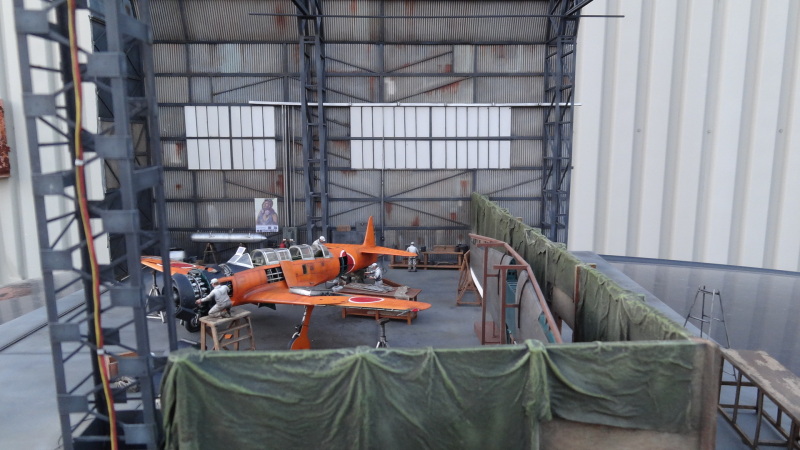
Nakajima "Saiun" 1st prototype diorama by Panagiotis Koubetsos

Hi all!
At last the Nakajima "Saiun" prototype diorama is over! I’d like to thank George once more for helping me in many ways with his huge amount of knowledge bring this project to an end! He is also a good reason for me to stick to IJNAF and IJAAF projects for many years to come, God permitting of course!
Panagiotis 

Only one word: 
UNBELIEVABLE!!!!! 信じられない!!! ΑΠΙΣΤΕΥΤΟ!!!

Sunday, 19 August 2012

Indonesian Yokosuka K5Y "Akatonbo" (Willow) #2

Following yesterday's posting we hope to continue our discussion on the very interesting subject of AURI aviation.
The second issue of our magazine released in October 2005 featured a short but very interesting article by Jacob T. on the subject of Indonesian "Willows". The accompanying artwork showed the sample aircraft in green top and trainer orange bottom. I would like to explain a bit why we opted for this particular scheme.
It is very important to keep in mind that Japanese aircraft left the factories painted according to their officially designated role, not how they were eventually used by the units. According to official regulations, from 1939 onwards, all trainers were to be painted "trainer orange" (or orange-yellow or yellow-orange...). So all trainers left the factories in overall "trainer orange" regardless of how they were used by the units that received them. Sometimes trainers were used for liaison, transport or even reconnaissance purposes. Therefore front line units camouflaged their planes as best they could but that does not mean that they stripped the aircraft of their previous factory applied paint and repainted them; an extremely tedious and time-consuming process for front line units having their hands busy with combat.
Simply put, if a Navy Air unit somewhere in Indonesia happened to have an "Akatonbo" trainer but used it to transport mail, they probably camouflaged the top surfaces (to hide the plane while on the ground) but wouldn't bother to change the colour of the lower surfaces to "gray".
I would like to ask our readers to imagine for a second the process of painting or re-painting the under surfaces of a plane by comparing it to a car mechanic under a vehicle using an airbrush or even a simple paint brush. Not very comfortable or pleasant, right?
Ofcourse as very often happens with Japanese airplanes, there were exceptions but some collaborating evidence (a testimony or a colour photo) would be necessary to prove the exception to this general rule.

"TJ" stood for "Tjureng", the way the Japanese word "Churen" (sort for Chukan Rensuki = intermediate trainer) was written in Indonesian. 
From left to right: Tjureng 72- TJ 54 and a Tjukiu wreck.
Photo: Jacob T. via Herman Dekker

When AURI found the "Akatonbo" left back by the surrendering Japanese forces, they either used them as they were by changing the national insignia or they brought some of them to airworthy condition. Yes, they most probably camouflaged the top surfaces to hide the planes on the ground from the Dutch forces but until now we have seen no evidence that they spent time overpainting the wing and/or fuselage undersurfaces "gray" or some other colour. We hope our Indonesian friends would be interested to share with us their thoughts on the colour subject. We would also be very interested in testimonies of Indonesian pilots who flew the "Willow" if available.
Feel free to commend or send us material directly to our email address.
Terima kasih.

Hello fellow readers,
This photo might gave us hint what is the underside color of Indonesian Churen.


From my point of view the underside color was a dark color slightly in the same shade with the red portion on the roundel. Photo was taken from an AURI internal publication magazine but I forgot to write down the date of publication. But I'm sure it was before 1970. 
Sinang

Saturday, 18 August 2012

Indonesian Yokosuka K5Y "Akatonbo" (Willow) by Sinang Aribowo

Today we have the pleasure to introduce the exquisite "Akatonbo" in Indonesian markings of our friend Sinang Aribowo in 1/72.

Friday, 17 August 2012

VIPs "Pen Butai"

From the very beginning of the Second Sino-Japanese War in 1937, the Japanese media were interested to cover the hostilities especially in the bigger cities like Shanghai. By 1938 with the war expanding to the Chinese interior, groups of journalists and writers but also painters and musicians visited the front under the auspices, separately as always, of the Japanese Army and Navy. The groups of writers were nicknamed "Pen Butai" (Pen Units) while the musician groups were called "Record Butai". In August 1938 two such groups consisting of 24 writers for the Army and eight for the Navy visited the front where the Battle for the city of Wuhan was at full force (here).
On September 14, 1938 a Navy "Pen Butai" of seven members took-off from Haneda/Tokyo and landed in Shanghai. The previous day a 7-member Army "Pen Butai" had started from Fukuoka in North Kyushu and landed in Shanghai as the photo below from a vintage publication testifies. The mission of both groups was to cover the Battle of Wuhan.


The most famous member of the Army "Pen Butai" was writer Kume Masao (here), standing third from right with the moustache. 
First from left is novelist Kataoka Tepei. In 1932 he was imprisoned for his "leftist inclinations" and while in prison he made a turn to more "popular" literature.
Second from left is poet Sato Sonosuke while next to him is poet Asano Akira. Asano became a member of the Japanese Communist party in 1926. He was arrested during the "March 15 incident" (here) and was imprisoned for one year. After his release he changed to more traditional and cultural poems. It is said that Mishima Yukio read Asano's poem "Ten to Umi" (Heaven and Sea) before taking his own life.
Second from right is novelist Kawaguchi Matsutaro (here) and next to him is writer and mountaineer Fukuda Kyuya (here).
Standing alone in the middle is author Hayashi Fumiko (here) who led a quite adventurous and most interesting life. She often visited the front and from October 1942 to May 1943 she sent reports from French Indochina, Singapore, Java and Borneo.
The star of the Navy group (not in the photo) was Kikuchi Kan (here), one of the most famous Japanese authors.

The various "Pen Butai" were the precursors of the "Nihon Bungaku Hokoku Kai" (Japanese Patriotic Association of Literature) which was particularly active with propaganda during the Pacific War.
Note the Douglas DC in the background especially the very hastily applied camouflage.

Wednesday, 15 August 2012

Artist: Takizawa Seiho

Following yesterday's posting, we got in touch with Takizawa-san and he kindly gave us exclusive permission to feature samples of his artwork on our blog.
He explicitly requested that his artwork should not be re-posted on any other site or blog without his permission and we hope our readers will respect the artist's wishes.

 "Geigeki Sento-tai" (Interceptor fighter Unit)
 
"WHO [sic] FIGHTER"
 
Visit Takizawa-san's personal site HERE and also THIS SITE that he recommended.

Monday, 13 August 2012

Manga

A brand new publication entitled "Hondo Boku Sentoki Tai" (Mainland Air Defence Fighter Unit) with 13 stories starring lots of Japanese what-if and X-planes, written and beautifully illustrated by artist Takizawa Seiho. The stories were orinally featured in the magazine Model Graphics (9/1990-8/1992 & 3/1994-12/1995). 218 pages, published by "LEED", all in Japanese, price 350Yen or $US5 or 4€.
Take a good look at the cover!

Sunday, 12 August 2012

Yokosho K2Y2 - Etajima

In March 1941 Asahi reporter Hayashida Jugoro had the chance to visit the aviation section of the Imperial Japanese Naval Academy in Etajima (here) and the photos below from a vintage publication accompanied his brief article.

In this most interesting and rather rare photo of a Navy Type 3 Primary Trainer (Yokosho K2Y2), a design based on the Avro 504, all the details of the Gasuden "Jinpu" engine are clearly visible.

Friday, 10 August 2012

Mitsubishi Ki-2 & Kawasaki KDA-7, Ki-3

A set of photos from vintage publications showing a Mitsubishi Ki-2 and a Kawasaki Ki-3 getting ready for another bombing mission during the battle for the city of Xuzhou (here & here) in May 1938.

Wednesday, 8 August 2012

Vintage ad - Heinkel He116A

A romantically nostalgic vintage (May 1940) ad for a medication that is still around, offers us a glimpse of one of the two Heinkel He116A, registration J-BAKD, that were obtained for the "Aerial Silk Road".
The "poem", though, may sound a little dorky by today's standards.


"Digestive medicine WAKAMOTO"

"Spread your wings"
Fly, fly
Blue sky, white clouds, green wind
Full of energy, no obstacles, healthy wings
Pierce (the sky), effectively, tablets Wakamoto
Hopeful, improving your health, the only way
When your digestion is unwell, increase the blood flow, disinfect
Young, young, with a rosy face, full of vitality
Endless sky, healthy body

Price: bottle for 25 days - 1yen 60sen
For:
chronic digestion disorders
tubercular diseases
pregnant and nursing mothers
Physically weak infants and children
generally improving the health condition of the sickly
Main office: Tokyo, Shibakoen

Friday, 3 August 2012

Kawasaki Ki-61 "Hien" (Tony)

A quite interesting photo from a vintage, February 7, 1945, publication of a Kawasaki Ki-61 "Hien" belonging to the 244th Sentai.
The ground crew is refuelling the Number 1 fuel tank (185l) on the starboard wing but also the Number 2 (165l) and probably 3 (200l) fuel tanks located under the cockpit and behind the cockpit respectively.
They are also maintaining the fuselage-mounted Ho-103, 12.7mm, machine guns but note the absence of the wing cannon. Perhaps a plane belonging to the "Shinten Seiku-tai" the air-to-air ramming squadron of the 244?
Note also that half of the spinner is yellow. It seems that this did not indicate the sub-unit within the 244 but combined with the fuselage stripes and the numbers on the wheel covers, which in this case is missing, was a way to recognise each individual aircraft.