Thursday, 14 May 2020

IJAAF & IJNAF wrecked aircraft #17 - Atsugi pt. 3, Nakajima G5N "Shinzan"

The video today features a very rare Nakajima G5N "Shinzan" (Liz) found at Atsugi.


The photo below clearly shows the markings of the particular aircraft.
Another photo of the same aircraft. Both photos from here.

Another "Shinzan" was also found at Atsugi.
Photo above from here.

Photo NARA via Arawasi.

Here's the story of these two aircraft (source FAOW blue #90, October 1977).
First, take a look at Wikipedia, here.
The first two G5N prototypes had Mitsubishi "Kasei" engines since the development and delivery of Nakajima engines was delayed.
From the third to the sixth completed aircraft, Nakajima "Mamoru" (or "Mamori") engines were installed. These were known as "Shinzan-kai".
The type was plagued with various problems, especially with the underpowered engines and did not meet the specifications for a heavy bomber. As a result the four aircraft with Nakajima engines were modified as transports in 1943 designated "Shinzan-kai Yusoki" (yusoki=transport).
The first two Mitsubishi engine aircraft were destroyed on the ground during a raid against Yokosuka base.
The other four transports were given to the 1021 Kokutai, therefore the "21" on the tail, organized on January 1, 1944, and based on Katori airfield, Chiba Prefecture. It was also called "hato butai" (pigeon unit) and initially used the kanji "" (hato-pigeon) until spring 1944. Then used the number "21". The unit used the aircraft to transport fuel drums, propellers, engines but also ammunition, medical supplies and more, 6-7 times originally to Tinian and Saipan from March 1944, and, when these was captured by the U.S. forces, later briefly to transport supplies to Manila.
The first of the four (3rd produced "Shinzan"), tail marking "21-01" together with one more "Liz" was to fly to Saipan on a transport mission (exact date unknown) but the second aircraft aborted the mission due to engine trouble. "21-01" arrived in Saipan, but the aircraft was bombed and destroyed while on the ground. 
The second of the four (4th produced "Shinzan"), tail marking "21-02" was lost during a landing accident on April 19, 1944 near Kasanohara base, which was near Kagoshima, Kyushu.
When transport missions became too dangerous, the third aircraft operated by the 1021Ku, tail number "21-03" (5th produced "Shinzan") and the fourth, tail number "21-05" (not "21-04" because the number 4 in Japan can be read as "shi" meaning death, more here) were given to SagamiKu, based in Atsugi, to be used for maintenance training. They kept their 1021Ku tail markings and this is where they were found by the U.S. forces.
In the end, both aircraft were scraped.
Photo above also from here.

Wednesday, 13 May 2020

IJAAF & IJNAF wrecked aircraft #16 - Atsugi pt. 2

As we saw in the previous post, some runways in Atsugi needed to be extended for the bigger U.S. transports.
In the video, here, we can see the Japanese working parties and also some very nice views of Japanese tracks.
We also took a glimpse of a 302Ku (in Japanese: san-maru-futa Kokutai) "Raiden" in the background, when the children were loaded with the 20mm cannons. Here's a still of this particular "Raiden".

I'm not 100% sure, but I'm leaning towards a "ヨD-1161" tail marking instead of "ヨD-161".

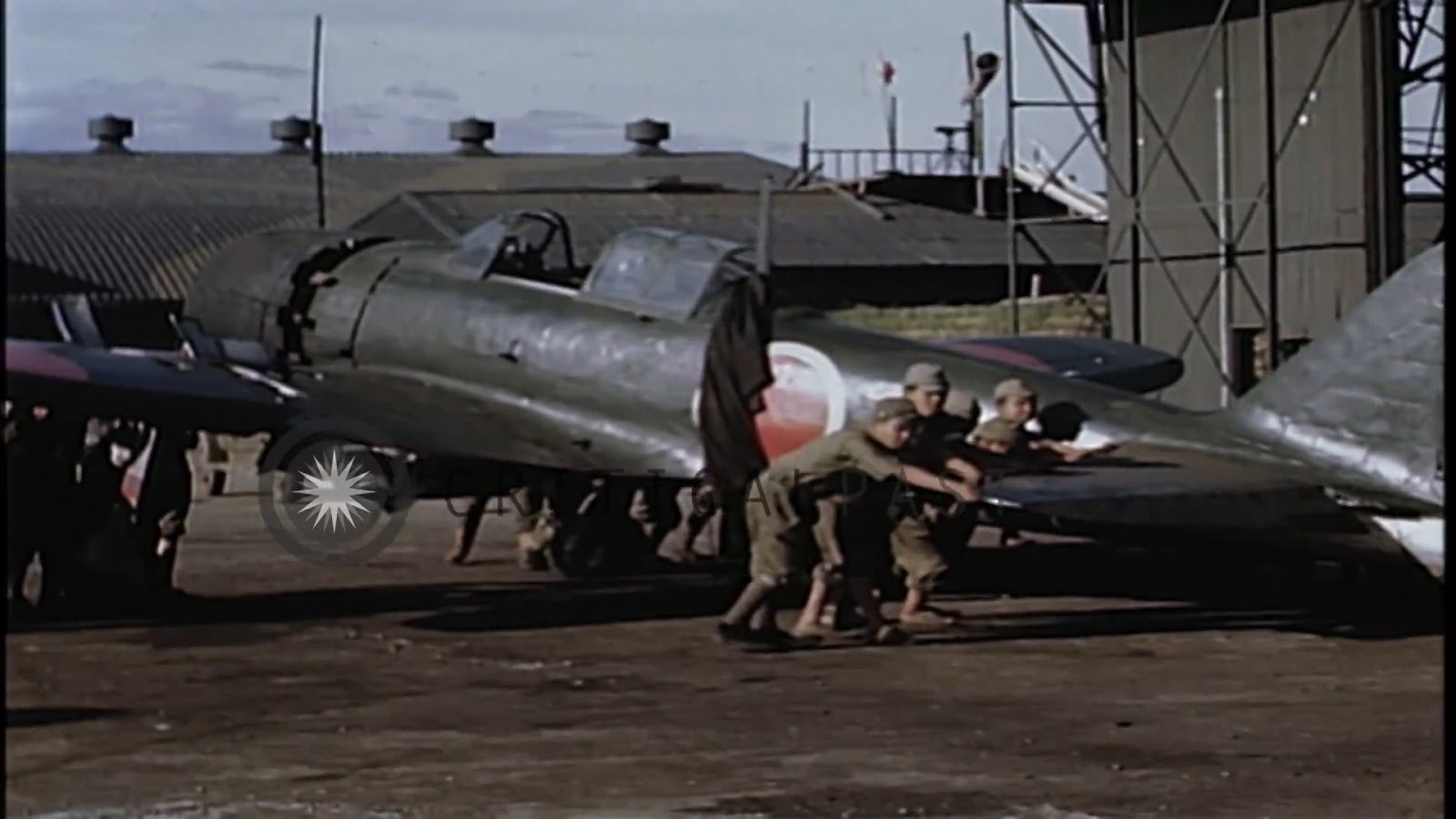
Before the arrival of the airborne divisions and General MacArthur, the Japanese aircraft had to be pushed or towed out of their hangars. In the first video below, we can see the previously mentioned detachment of the Naval Security Corps which guarded the Atsugi airfield and an A6M5 Zero, tail marking "ヨD-135" or "ヨD-136".


Some of them were put to work pushing first an A6M2-K Zero trainer. Note the trainer orange yellow on the leg covers.


The next aircraft pushed out of a hangar was a Mitsubishi J2M "Raiden" with tail marking "ヨD-152" with five kill markings.


The aircraft was flown by Lt Ito Susumu. The top two kill markings depict "yaezakura", a kind of cherry blossom with many layers of pedals, meaning certain kills.
Wikipedia
The lower three depict "hitoezakura" which has about five pedals, meaning unconfirmed kills.

Under the tail marking there is the name of the maintenance leader "池田一整曹" (Ikeda 1seiso - name: Ikeda, rank: maintenance petty officer 1 class).
A photo of this "Raiden" during the war, can be found in FAOW #61, p.70 but the pilot standing in front of the tail is not Lt Ito but another one from the unit. I found a nice photo from HERE. Again, the pilot on the wing is not Lt Ito but another pilot of the unit.

Following the "Raiden" is an A6M2 the full tail marking of which is not visible, but note that the "ヨD" has been overpainted a previous marking. Note also the heavy weathering on the wing root, not visible on the newer A6M5 that follows without a tail marking.


In the following video we see again fighters been towed out of the hangars by a tractor and taken to a nearby field.

The first aircraft is a beautiful A6M2 with tail marking "ヨD-1101".


Of particular interest is the repetition of the number "1101" on the wheel cover. Note also the way the green camo paint has been applied on the cover.

And then we are treated with a variety of very interesting details.
 

1. The number "1101" is also repeated on the carburettor intake.
2. There is a white data plate on the cowling side. 
3. Note the very thin yellow IFF stripes
4. Again, note the green camo applied on the wheel covers
5. Note that the front of the spinner is green, but the rear is brown.
And finally note in the photo below the very small yellow marking on the top of the tail.
The last plane featured in the clip is another Zero, an A6M5 this time with tail marking "ヨD-132". Note the red "no step" lines on the wing.


Did you notice the "Ginga" and the "Gekko" in the background?
And last but not least, compare the "color" of the area in the rear of the cockpit, under the canopy of the YoD-1101 and YoD-132.   

Tuesday, 12 May 2020

IJAAF & IJNAF wrecked aircraft #15 - Atsugi pt. 1

In this series we will examine details from various clips, some well-known some less so, featuring the arrival of U.S. forces and Genral Douglas MacArthur in Atsugi base and what they found there. The sources for the videos will be included in the last post.

Below is a quite detailed piece about what transpired (from the U.S. point of view ofcourse) during these first days (source: here)  

Implementation of Operations:
"Blacklist "

General Eichelberger had moved his Eighth Army Command Post from the eastern coastal plain of Leyte to Okinawa on 26 August. On Okinawa both the 11th Airborne and the 27th Division were stalled on the scheduled airlift to Japan by the succession of typhoons.
All available troop transports of the Far East Air Force and dozens of the huge "Skytrains" and "Skymasters" of the Pacific Air Transport Command had been mobilized at Okinawa for this mammoth air operation-the greatest aerial movement during the Pacific war. The initial target date was officially postponed from 26 August to 28 August because of the adverse weather.
Then the weather cleared and a cool, refreshing breeze, "very refreshing to the spirit," blew over the Kanto Plain.
At Atsugi airfield near Tokyo, Japanese planes sat helplessly stripped of their propellers. A picked detachment of the Naval Security Corps, armed with clubs, guarded the Atsugi airfield where Lt. Gen. Seizo Arisue, Lt. Gen. Senichi Kamada, Captain Chuzaburo Yamazumi and Ken Tsurumi of the Foreign Office awaited the arrival of the American advance forces.
The heralds of that advance force, American Corsairs and Grummans, had appeared with the dawn of that historic day and continued to fly in strong formations over the entire Tokyo Bay and Atsugi area.
The first American formations flying from Okinawa were not expected until 0900, but half an hour earlier a twin-engined aircraft appeared in the skies from the south. It was a C-46 transport. The plane circled the field and then came in from the south to touch down upon the center runway at 0828. This plane was followed by fifteen others.
From the leading plane debarked Colonel Charles P. Tench, GSC, of the G-3 Section of GHQ, commanding the advance party. Waiting automobiles conveyed Colonel Tench and party to the Japanese reception group.
General Arisue stiffly saluted Colonel Tench and, after introductions, the group entered a tent in the center of the field. General Arisue offered food, but Colonel Tench who had brought his own rations, declined with thanks.
Colonel Tench explained that his party consisted of approximately 150 officers and men and that their directive from the Supreme Commander was divided into four main divisions. It was as follows:
a. Reconnaissance of the Atsugi airdrome area to determine its suitability for the airborne operation to follow.
b. Establishment of required air installations and supplies to support initial phases of the air operations in the area as provided by the Commanding General, FEAF.
c. Supervision and coordination of improvements required at the Atsugi airdrome.
d. Establishment of communications with GHQ, AFPAC, without delay and reporting on suitability or non-suitability of the Atsugi airdrome for the purpose intended. All messages to be transmitted in code. Reporting over signal communications net additional information desired by the Commanding General, FEAF.
While this initial conference took place, soldiers debouched from the planes coming to earth every few moments, unloaded jeeps, and prepared to form exploratory parties. Colonel Hutchinson, who had been assigned as billeting officer, led the first of these on an inspection of the former Sagamigahara Air Unit barracks at the west end of the airfield. It was proposed by the Japanese that this barracks should serve as accommodations for the advance party. Other inspection teams immediately deployed over the entire airfield area.
A second flight of fifteen C-54's, C-46's, and C-47's arrived at 0935 and a third group of fifteen C-54's landed at 1100. These planes, carrying a total of 30 officers and 120 men wearing regular combat equipment were escorted by ten carrier-based Seventh Fleet F6F liaison planes flying from Sagami Bay.
The Japanese were amazed by the efficiency with which these Grumman fighters, landing on the grass, folded their wings "like cicadas," even while the planes were taxied into position. The Japanese made no attempt to conceal the degree to which they were impressed by the speed with which the Americans motorized themselves and invested the entire field area. Their amazement was outspoken when within forty-five minutes after the leading planes had touched down, portable Signal Corps transmitters were on the air establishing communications with Okinawa. The last planes of the party brought fuel, lubricants, and maintenance equipment to make the intrepid little unit compact and self-sustaining until the anticipated arrival on 30 August of the main airborne force which would constitute the first of the Occupation troops for Japan.
...
It was imperative that every effort be made to insure the early and safe arrival of the 11th Airborne force of some seven thousand men. An inspection of Atsugi revealed the necessity for the immediate construction of landing strips long enough to accommodate B-29s and C-54s which would be landing in rapid succession once the movement had started. Only one night could be devoted to this construction work involving strips one and one-half kilometers in length. Under the supervision of the small American force, the Japanese workmen recruited by the indefatigable General Arisue became efficient to a degree apparently never before experienced by the Japanese officers. With the break of dawn, the work was near enough to completion to enable the advance party to signal GHQ at Manila for relay to Okinawa that everything was in readiness for the initiation of the real Occupation of Japan-the first by a foreign army in the recorded history of that nation.

Japanese sources mention that during the initial communication, the U.S. forces wanted to be based in central Tokyo or in the Kamakura, Zushi and Hayama areas. But the Japanese had already started preparation of the Yokohama area. Gas and electric connections were fixed, proper houses to accomodate the U.S. troops were designated, even western style toilets were installed. All the regidents in the area and even school children were put to work to make everything as suitable as possible. In the end the Americans were persuaded that Yokohama was the best option regarding the safety, health or otherwise, of their troops.

In the three clips below, we can first see U.S. troops inspecting bombsights, radios and other high tech equipment, then it seems that schoolchildren were employed to carry 20mm Type 99 (Oerlicon) cannons (note the "Raiden" in the background).


Saturday, 9 May 2020

Pearl Harbor "Zero" by Terrence Jones

Hello Arawasi!

Here is the first of my 6 Japanese aircraft involved in the attack on PEARL HARBOR. Each aircraft WILL represent one of the six carriers that took part in the "Hawaiian Operation" Dec 7th 1941.

This is the excellent 1/72 Tamiya A6M2b Zero built out-of-the box. Excellent fit (except for the clear parts), great detail and 8 Pearl Harbor subjects on the decal sheet. Hand painted with Model Master paints, airbrushed with Tamiya clear coats. A really nice kit!
Display Base by Coastal Kits (UK)

Stay Safe! Stay Home! Build Models!
Terry Jones
IPMS Ottawa #27


Thursday, 7 May 2020

IJAAF & IJNAF wrecked aircraft #14 - Haneda, various types

The clip today, from here, was taken at Tokyo's Haneda airport and features a variety of interesting types.


First up we see a rather interesting Kyushu K11W "Shiragiku" with a puzzling "J" on the tail.

Then we are treated to a survivor, a Seversky A8V, operated by Asahi Shimbun, registered J-BAAN in October 1938 and named "汐風" (Shiokaze), which can be translated as "tidal wind" or "salty sea breeze".

The photo below is from the Wikipedia page. Note that in the still above the aircraft has a black-white-black fuselage band associated with civilian aviation schools and, at least to my eyes, seems to be painted overall hairyokushoku, not NMF as before. 

The next aircraft is a Tachikawa Ki-54c transport with another puzzling marking on the tail; a "-33".
Note that the "Shiragiku" and the Ki-54 have surrender markings.

The next aircraft is a quite uninteresting Showa L2D...

...followed by a most interesting Douglas DC-5.

The particular aircraft, originally registered as PK-ADA, was operated by Koninklijke Nederlandsch-Indische Luchtvaart Maatschappij (KNILM) and, according to Wikipedia, was damaged in an air strike by the IJAAF at Kemajoran Airport in Batavia (present-day Jakarta), on February 9, 1942 and was abandoned. The Japanese repaired it and was brought to the mainland where it was tested and displayed in Haneda together with a variety of captured Allied aircraft.
Photos below: Arawasi

The last aircraft in the clip is a Mitsubishi Ki-15 "Babs". The tail marking resembles the one of the 15 Sentai (50 & 51 independent Chutai) but this unit was in French Indo-China at war's end. The other unit with a similar marking was the 55 Independent Chutai but it was based in Nanking and operated in China. 
On closer inspection, personally, I believe the particular tail marking with the sakura (cherry blossom) and the two parallel bands, doesn't correspond to any known unit.
Our friend Devlin Chouinard didn't miss the chance to create some beautiful artwork.

Note that all the aircraft have a white X on their hinomaru, probably indicating that they are un-operational and should be scrapped.

Tuesday, 5 May 2020

The Luigi Scarano Collection Pt. 10

My latest work, Nakajima Ki-84 "Hayate" (Frank) 47 Sentai, 1945, 1/48 scale.

- Luigi Scarano -


Sunday, 3 May 2020

IJAAF & IJNAF wrecked aircraft #13 - Yokosuka, Tateyama Ku, Mitsubishi A6M2 & Yokosuka B4Y Pt. 2

The little known clip today, from here, taken in Yokosuka features a beautiful Mitsubishi A6M2 not assigned to any kokutai and a line-up of extremely rare Yokosuka B4Y "Jean" belonging to the Tateyama Ku. Unbelievable that these very old aircraft could survive until the end of the war in what looks to be pristine condition.


Tateyama Ku, tail marking "タ-" (TA-) was one of the oldest IJNAF units organised on June 1, 1930 in Tateyama, Chiba Prefecture, to ease off the congested Yokosuka Ku and to protect the Tokyo bay as well as the areas near the coastline of East Japan. It could operate land-based aircraft and seaplanes and when established it had in its strength carrier fighters, carrier attackers, reconnaissance seaplanes and flying boats; eight of each. It was nicknamed "Tateku".
On December 15, 1944, all the Eastern Japan patrol kokutai, including Tateyama Ku, were merged into the 903 Ku.
A second Tateyama Ku was organised on May 15, 1945, with carrier attack-bombers and patrol seaplanes.

Friday, 1 May 2020

Japanese Aircraft Online Model Contest 014 - and the winner is....

...MILOSLAV HRABAŇ who received the most 10s and presented my most favorite model, HERE

CONGRATULATIONS MIROSLAV!!!

You'll get a book and kit from our on-line store, free of any charge, courtesy of Arawasi, when things calm down and the postal services go back to business.

Thank you all for your participation. We received a number of requests to continue the contests, perhaps less frequently. We'll think about it....