The clip today, from
here, is about the TAIU groups that were sent to the Philippines to evaluate captured Japanese aircraft.
For those who don't know the details and since it doesn't have a proper separate entry, here's an edited version of the story of the ATAIU groups from Wikipedia,
here:
Allied Technical Air Intelligence Unit (ATAIU)
With the outbreak of the Pacific War on 7 December 1941, Allied Forces had little or no concrete knowledge about Japanese aircraft and their performance capabilities. The air war over China had been in full swing for over four years, little attempt had been made by Allied Intelligence agencies to learn very much about the Japanese equipment, tactics and potential. Due to severe cuts in military funding following WWI, intelligence units had not been developed for gathering and disseminating this type of information, and the bulk of concern was placed on Hitler's growing airpower and conquests in Europe. Once the US was involved in the War with Japan, there was a frantic effort to fill this information void. There was no meaningful list of Japanese aircraft types, and no way to identify these aircraft when encountered in combat. During this period, every single-engine Japanese fighter was identified as a Zero, and anything else was called a Mitsubishi or a Nakajima.
To sort out this dilemma became the sole responsibility of the
Allied Technical Air Intelligence Unit (
ATAIU) South West Pacific Area. In addition to developing a common means of identifying these aircraft by type, it was essential that the new unit obtain information to develop drawings and models, as well as acquiring photographs. The unit's responsibility was to discover construction techniques, weaknesses, strengths, and latest camouflage techniques. Gathering performance information in comparison to Allied aircraft was essential for developing combat tactics with which to counter the Japanese.
The ATAIU, a small group of intelligence personnel, was formed in Victoria Barracks, Melbourne, and later moved to Brisbane under the US 5th Air Force under the command of General MacArthur's Supreme Headquarters of the SWPA in late 1942/early 1943...The 81st Air Depot Group controlled all operational activities of these aircraft.
The group had to first collate field information, importantly descriptions of new planes that aircrew could only glimpse in battle. To overcome the confusion caused by the complex method of identifying the ever increasing number of Japanese aircraft types, a system of assigning easily remembered code names to each type was adopted. The Japanese-plane nickname system which came into common usage throughout the Allied air forces was developed. A different name was assigned to each aircraft as it became known to exist, and common first names were chosen.
To keep the plan simple, male names were given to fighters and float planes, and female names to bombers, reconnaissance aircraft and flying boats. Names beginning with T were given to the few transport planes in the Japanese inventory. Trainers were given names of trees, and gliders given names of birds. With the approval of MacArthur, the MacArthur Southwest Pacific Code Name System came into being, circa September 1942, with an initial list of 50 names. The Tennessee background of Captain Frank McCoy, who was in charge of the ATAIU, was evident immediately because the initial names had a distinct hill-country flavour, such as Zeke, Rufe, Luke, Nate and others. The ATAIU quickly exhausted its list of hillbilly names and turned to names of friends and relatives.
Foreign designers and engineers had been widely employed in Japan's aviation industry prior to 1935, after which a curtain of secrecy had been pulled over Japan's aviation development. These new aircraft were being employed in the air war over China, with the first recorded crash of a Zero being made at Kunming, China in February 1941. It was not until a year later that enough information was gathered to be able to assign it the code name Zeke.
During the first six months of the war, technical intelligence information was almost non-existent due to Air Corps units being in constant retreat and lacking sufficient personnel. Once the Allies were on the offensive, downed enemy planes were able to be returned to flying condition by the ATAIU at Eagle Farm. Buna, in New Guinea, and Guadacanal, in the Solomons, were the first Allied land victories in the Pacific after nearly ten months of defeat.
Initially the field intelligence units inspected downed aircraft, but name plates were in Japanese and serial numbers were designed to be misleading, and few Allied field intelligence personnel read and understood Japanese. In many instances, the ATAIU relied on the assistance of indigenous work crews to retrieve the downed aircraft from remote areas and transport them to the coast, often dragging them through swamps or floating them down rivers on rafts.
A new version of the Zero, which served with the Japanese Naval units, was causing great concern, and battered examples were retrieved from the Buna-Gona area of New Guinea in January 1943. Field inspections gave some answers, but comparative rebuilding and trialing of it against Allied fighters, engaging in combat exercises, was needed. This aircraft was eventually named the Hamp (originally Hap after US Army Air Force Chief of Staff General Hap Arnold) and later named Zeke 32 when it was found to be a variant of Zeke 21, a Mitsubishi A6M3, Naval Type O Model 32 fighter. Australian ground forces were the first to come upon the new Zeke 32 when they occupied Buna airstrip on New Guinea in January 1943.
In most cases technical manuals were not available, so everything was worked out on a trial and error basis. The state of the art was quite common among all airplane manufacturers of that time. In most cases, Japanese flight instruments were replaced by US instruments for those aircraft intended for flight, but engine instruments were retained as they were calibrated for the function they served. US radio equipment and a new oxygen system also replaced Japanese types.
Captain William O Farrior became the first pilot to fly the earliest version of a rebuilt Hamp at Eagle Farm. The intended pilot was killed in a crash the same day, and Farrior was borrowed from a small group of 81st Air Depot test pilots and was to become well known for flying the early Japanese aircraft rebuilt at Eagle Farm. He later moved to Anacostia with the ATAIU and remained with intelligence his entire Air Force career. He first flew the Hamp over Brisbane for 30 minutes with the help of a captured Japanese pilot on 20 July 1943. An Allied aircraft always flew escort during tests of Japanese aircraft at Eagle Farm, and the Japanese aircraft were painted with their insignia to facilitate recognition photography. The Hamp (Zeke 32) was the first Japanese aircraft to be flown in simulated combat against top Allied fighter pilots.
Also flown at Eagle Farm were an Oscar Mk1 Nakajima Ki-43, first flown 17–18 March 1943, and later an Oscar Mk11 was put back in the air circa 4 July 1944. Another Oscar MK11 was flown to Eagle Farm from Hollandia circa July 1944. The Allies had captured the airfields at Hollandia on the northern coast of Dutch New Guinea circa June 1944. The Oscar was the workhorse of the Japanese Army.
A Tony, serialled by the ATAIU as XJ003, was also flown at Eagle Farm between 29 September and 7 October 1944. XJ was an acronym for Experimental Japanese Aircraft.
Bombers were also assembled at Eagle Farm, including a Betty land based bomber and a Sonia light bomber, however these were never flown.
The ATAIU were ordered back to the US in June 1944 to set up base at Hangar 151, Anacostia Naval Air Station at Washington, D.C, but the shift must have taken some months. During their service in Australia, the ATAIU had not encountered new Japanese aircraft that had been expected to be introduced, but rather improved versions of existing aircraft. The decision was made to consolidate all ATAIU activities, captured Japanese documents and nameplate analysis closer to the Pentagon. The unit travelled by Victory Ship to San Francisco then by a private train to Washington. They retained an intelligence gathering capability in the war zone, with field ATAI units in the SWPA, Pacific Ocean Area, Southeast Asia, China and India. Field ATAI units were headed by a trained officer and included aviation mechanics, photographers, radiomen, ordnancemen, and often translators.
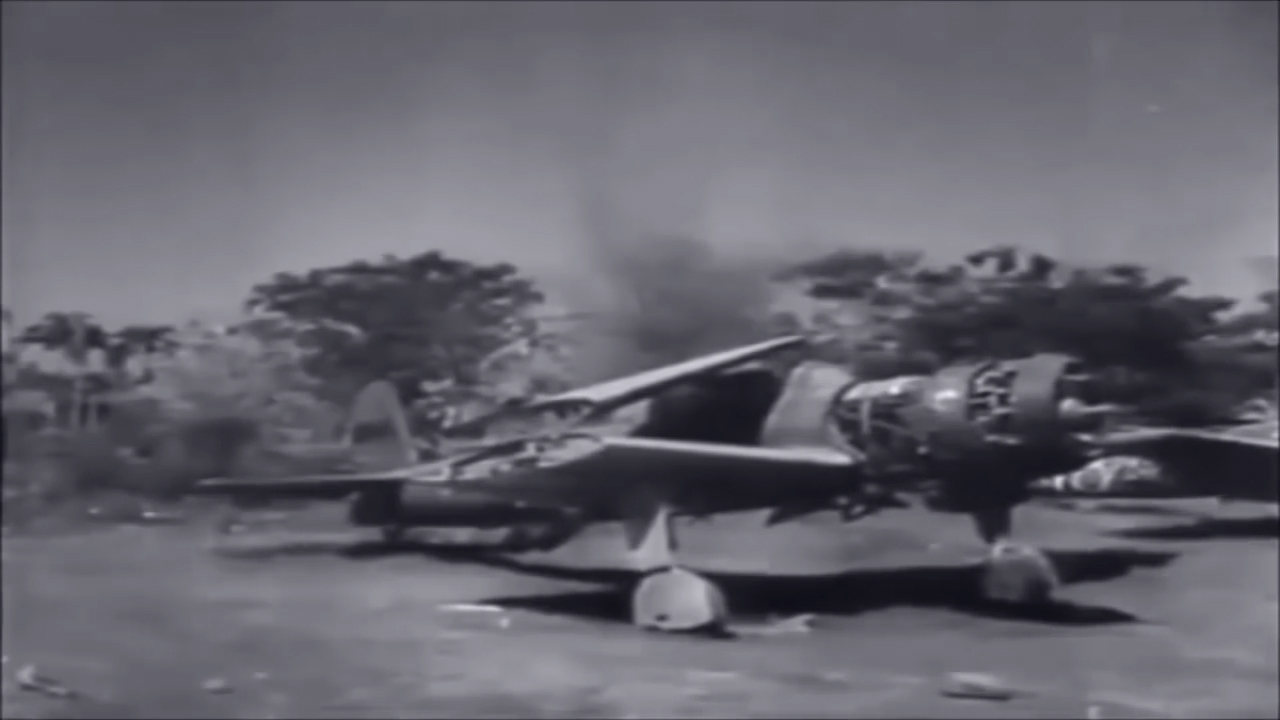
Here's the first part of the video:
Above is a photo taken at "Clark Field" where the TAIU had set shop. The exact location is unknown. Keep in mind that what is known as "Clark Field" was actually a complex of about a dozen airfields.
The Mitsubishi Ki-46-III "Dinah" we first see in the video does not seem to have a tail marking at all and I believe is not in the above photo. We will see her again in the following part of this series.
Next, the video features a Kawanishi N1K1-J "Shiden" (George) which is located in the back of the above panoramic photo, near the building.
Then we see three Kawasaki Ki-61 "Hien" (Tony) fighters all belonging to the 19th Sentai.
They are the aircraft found in this area in the panoramic photo.
We discussed in detail the unit and its "
Hien" found in Clark Field in an older post,
here.
The NARA photo below shows the same aircraft from the oposite side of the video shot.
The next aircraft in the video are two Kawasaki Ki-45 "Toryu" (Nick).
They are these aircaft in the panoramic photo.
They can be seen in this photo.
And even better in this photo...
...where almost all the aircraft in the circled area can be seen.
They are the above mentioned two "Toryu" on the top left, followed by a Ki-46-II and a Nakajima J1N "Gekko".
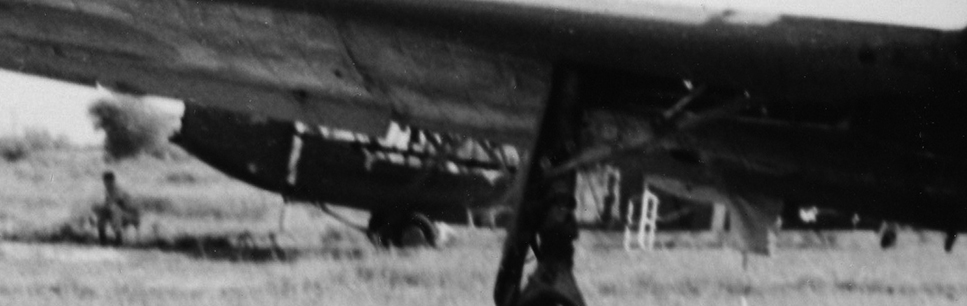
The video then takes a shot at the Mitsubishi G4M2 "Betty" on the opposite side of the above circled group.
It's this aircraft in the panoramic photo.
The photo below from Wikipedia shows the aircraft in great detail.
In case you have any doubts that it's the same aircraft, note that both the "Betty" in the video and in the photo above have a hole on their nose and they are ofcourse of the same type.
According to the caption the aircraft is "probably a G4M2a Model 24 Ko/Otsu" belonging to the 763Ku. FAOW identifies the aircraft as belonging to the 702 Kogekitai of the 763Ku and that it's a Model 24 either Otsu or Hei.
And, what do you know, it's the same "Betty" we found in the previous post.
This "Betty" was stripped of it's paint job and after substantial repair work from the TAIU...
...looked like this. Photo above from NARA, photo below from the Jeff Ethel Collection.
The next aircraft in the video is the "Gekko" we spotted above.
Followed by a "Hayabusa" not seen in the photo. Probably standing next to the "Gekko".
The above mentioned Ki-46-II "Dinah" can be better seen in this photo and although the tail marking has been erased, we can clearly say that it belonged to the 15th Sentai.
Here's another photo of the same aircraft, from the Arawasi collection. We can barely make out a tiny "タ" (TA) on the tail.