Showing posts with label Relics & Museums. Show all posts

Monday, 13 April 2026

Kawanishi N1K2-J "Shiden Kai" (George) Recovered! - update

Some updates.
First up some photos taken after the wreck was brought ashore, from here.

Scott Heinley:
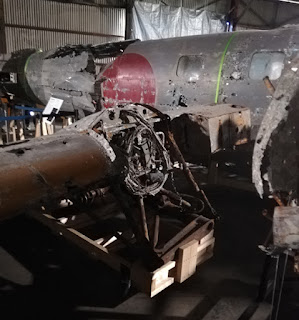
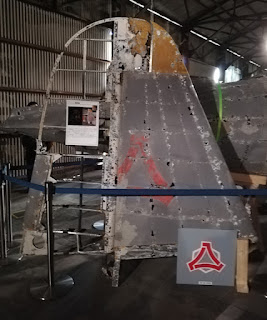
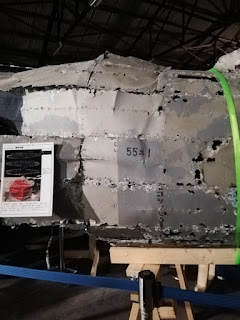
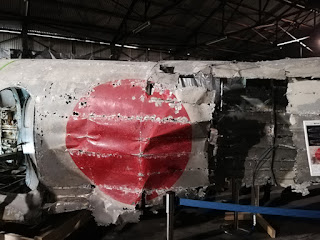
Hello everyone, I actually live near where this plane was recovered. I believe the mission would have been 89, as this plane went down in Akune which is next to Izumi, where the mission targeted. Kanoya is far to the southeast. The plane had a considerable amount of 20mm ammunition left in both wings, so the police and JSDF will remove it and destroy it. Once that process is done it will be moved to desalinization. The plan is to stabilize it and eventually put it on display in a museum in Izumi.
Also, this plane flew from the Kokubu air base in central Kagoshima.

Jan Bobek:
I found a few more details on a Japanese blog yesterday. Hayashi was born on 17 July 1920 in Jōmyōji, Kamakura Town, Kanagawa Prefecture. His grave is located in Kamakura, but unfortunately it does not contain his remains. Most likely, his remains were destroyed by a U.S. aircraft while being transported from Orikuchi to his family home.

Arawasi:
The site of the group working on the recovery of the aircraft (here), mentions that there were two US bombing missions on that day by the XXI Bomber command in that area; Mission #83 and #89. Mission #83 is the more probable because the time and location fits.
I could not find the complete mission report but this is what I found:

Mission # 83
Date: 21 April 1945
Code Name: Famish # 4
Target: Kanoya East A/F 90.38-2516
Participating Units: 313th Bombardment Wing
Number A/C Airborne: 33
% A/C Bombing Primary: 81.8% (27 Primary, 0 Secondary and 4 Opportunity)
Time over Primary: 210809K - 210901K
Altitude of Attack: 16,200 - 17,350
Weather over Target: 0/10 - 2/10
Total A/C Lost: 0
Resume of Mission: Bombing results--several bomb patterns on field with concentration in hangar area. One aircraft damaged. Two aircraft non-effective. Enemy fighter opposition weak----------- 10 attacks. AA heavy, meager to moderate and inaccurate. Average bomb load 13,245 lbs. Average gas reserve 704 gallons.

Mission # 89
Date: 21 April 1945
Code Name: Bullish # 3
Target: Izumi A/F 90.37.2512
Participating Units: 313th Bombardment Wing
Number A/C Airborne: 16
% A/C Bombing Primary: 81.1% (13 Primary and 3 Opportunity)
Time Over Primary: 210814K - 210949K
Altitude of Attack: 14,100 - 14,500
Weather Over Target: 0/10 - 3/10
Total A/C Lost: 0
Resume of Mission: Bombing results---good concentration of hits centered on hangar area and string of bursts across airfield. Enemy fighter opposition moderate----60 attacks. Enemy aircraft destroyed one, probably destroyed three and five damaged. AA heavy, meager to moderate, inaccurate to accurate. Average bomb load 13, 643 lbs. Average gas reserve 744 gallons.


During Mission #89, no US bombers were damaged or shot down, only during Mission #83 this happened as you see above. Perhaps if someone has the complete report, we could find which B-29 was damaged and under what circumstances.

Wednesday, 8 April 2026

Kawanishi N1K2-J "Shiden Kai" (George) Recovered!


"The Imperial Japanese Navy fighter aircraft “Shiden-kai,” piloted by Lieutenant Hayashi Yoshishige from Kanagawa Prefecture, [a member of the Sento 407 of the 343 Kokutai], engaged a formation of U.S. B-29 bombers in April 1945, shot down one aircraft, and then made an emergency alighting near the coast of Origuchi, Akune City.
"The "Shiden-kai" had lain on the seabed for 81 years since its crash, but on the morning of the 8th [today], a salvage operation was carried out and the fuselage was recovered. It is reported that not only the engine and both wings, but also the twin 20mm machine guns—considered a defining feature of the aircraft—remain intact. Plans are being considered to display it in Izumi City to preserve the memory of the war."


From the site of the group working for the preservation of the aircraft, here:
On April 21, 1945, Lt Hayashi Yoshishige took off from Kokubu Air Base as the commander of the 3rd Shotai of the 1st Chutai. He added his own name to the sortie roster and headed for the skies.
Over Fukuyama Town, Aira District, Kagoshima Prefecture (now Fukuyama Town, Kirishima City), he encountered a formation of 11 B-29s. A fierce battle ensued.
So focused on the attack, Lt Hayashi became separated from his wingman and pursued the enemy aircraft alone. The battle shifted to the skies over Izumi.
It was at this point that PO1c Shimizu Toshinobu of the 3rd Chutai rushed to his aid. The two aircraft launched a relentless joint attack. Finally, they sent a radio message reporting “one enemy aircraft shot down.”
However, immediately afterward, Hayashi’s aircraft was also hit. He shut down the engine and, through skillful piloting, glided toward Wakimoto Coast to attempt an emergency landing.
According to recently disclosed records held by then-Commander Genda Minoru, the aircraft crashed into the sea off Orikuchi Coast and, Lt Hayashi struck his head violently against the instrument panel. He died at the young age of 24 from a fracture of the base of the skull.

And a video from the recovery from here:

Friday, 13 October 2023

Mitsubishi F1M "Pete" ON SALE!!!!

Anyone interested to add to their collection FOUR Mitsubishi F1M "Reikan" (Pete) floatplanes in 1:1 scale?
WOW!!!!


Photos and details, HERE

Tuesday, 30 November 2021

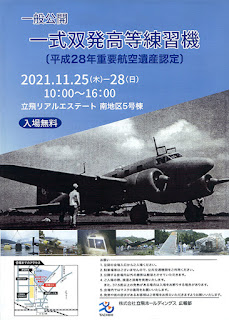
Tachikawa Ki-54 "Hickory" in Tachikawa

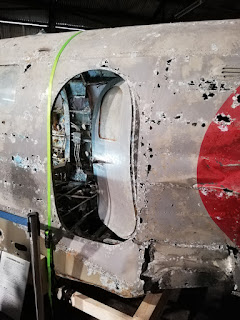
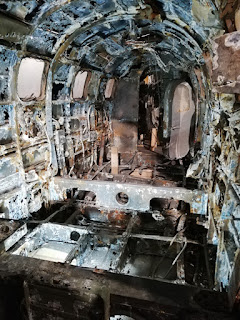
As you probably know by now, a 38 Sentai Tachikawa Ki-54 "Hickory" was found and pulled out of Lake Towada in 2012 (here). Since then it had been cleared and placed on display at the MISAWA AVIATION & SCIENCE MUSEUM in Aomori (here). It seems that a "pacifist" group related to the museum objected to the presence of a "war plane", and declared that only "civilian airplanes should be on display" in the museum. (Even though there are US/JIETAI combat planes on display and only a fence separates the museum grounds from the Misawa military base). As a result the aircraft relocated back home to Tachikawa, Tokyo. 
From the 25th until the 28th of November (i.e. last week), it was on display, open and VERY accessible to the public.
No less than 9600 visitors came to see the aircraft from up close and among them Arawasi paid their respects for a second time last Thursday.
The aircraft was placed in an old wooden aircraft maintenance building, and after a wait of about 20 minutes, when a video detailed the discovery and recovery efforts, groups of visitors entered the large room. 
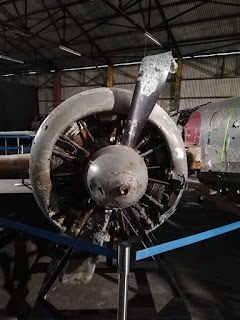
At the entrance of the room was a Ha-115 engine from a Nakajima Ki-43-III Koh "Hayabusa" that was recently unearthed in the dumping ground of a US base in the area. 
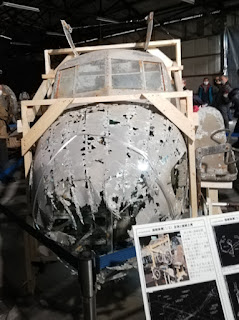
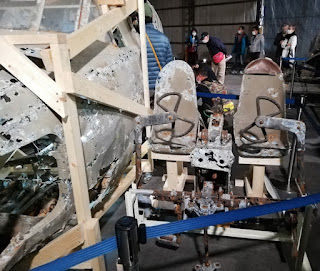
Then we could enjoy the "Hickory" in all its glory. We could have access to most of the areas (except the underwing) and since the cockpit was separated from the fuselage, it was placed on display in a way that visitors could see inside both the cockpit and the fuselage. The both the horizontal and vertical tail surfaces were placed on the ground to give the opportunity to the visitors to see all the details up close. There were plates with photos and images from the manual of the aircraft that explained clearly what the visitor could or could not see, and the VERY friendly staff members were eager to help, answer questions and show the various interesting details.
Enjoy a tiny sample of the photos we took.

All in all, we had a fantastic day, Kiri for the very first time visiting an aircraft museum commented "立川飛行機 最高!!!". The organization was brilliant, although security was fairly lax (there were morons who thought that it would have been okay to knock on the plane to see if it was made of real metal or something) and the complementary drinks, handbags and more, were very appreciated. 
Let's hope this will become an annual event.
立飛さん 素晴らしい展示構成ありがとうございます。飛行機が好きな方々が企画してくれたんだと分かります。来年もよろしくお願いします。

Wednesday, 24 November 2021

Utsunomiya Matsuri

Two weekends ago, the Teikyo University in Utsunomiya organized a matsuri (festival) and the hangar of its Aerospace Department featured some interesting exhibits.
First up, Kojima-san had abrough the propeller of a Nakajima Type 5 Trainer, which most probably belonged to the J-TIBE of the Ito Hikoki Kenkyujo, flown by Fujiwara Nobu.


On top was a model built by Kojima-san of another Nakajima Type 5 with the civilian registration J-TOBF.

The particular aircraft was the first in the fleet of Asahi Shimbun, receiving the name "Asahi 1 go" and was purchased from the IJAAF. It had the Nakajima serial number 97 and a Hall-Scott 150hp engine.
It belonged to "Tozai Teiki Kokuki" and was based on Tokyo's Susaki airfield (see HERE).
It first flew with its civilian designation, J-TOBF, on January 9, 1923. 
In 1923 Asahi Shimbun in cooperation with Shirato and Ito Hikoki, established the "Tozai Teiki Kokuki" to fly weekly mail services between Tokyo and Osaka. Actually, since there were no aircraft available at the time to fly the distance, one aircraft would take off from Osaka's Joto parade grounds, another from Tokyo's Susaki airfield, and they would meet at Mikatagahara airfield in Hamamatsu, Shizuoka Prefecture, where they would exchange their mail bags.
There were six Nakajima Model 5 purchased from the IJAAF and one aircraft each from Shirato and Ito. The latter civilian schools provided ten pilots.
The first flight was on January 11, 1923, and the whole endeavour lasted for only three months.
J-TOBF was destroyed during the "Great Kando Earthquake" of September 1923, when the Susaki airfield was ravaged by a tsunami and the facilities caught fire.

As you have probably noticed, Kojima-san chose to depict the aircraft with what looks like white circles on the wing top surfaces. Below is a close up of J-TOBF and the white circles are easily visible. Note that the civilian registration is clearly in black. In some photos the hinomaru don't look dark at all, more like white, either due to the film quality or the angle the photo was taken causing the hinomaru to sign. In the J-TOBF case it is very probable that they were overpainted so that the aircraft resembled more a civilian one than a military. Asahi Shimbun aircraft had the newspaper logo painted on the top and bottom surfaces of the wings, so perhaps this was a preliminary effort before the Asahi logo was applied.

The Nakajima Type 5 Trainer was based on the U.S. Standard H-3 and the German Albatros C II. 101 were built from 1919 to 1921 and had numerous problems until they were replaced by other types.
In the photo below is a Nakajima Type 5, s/n 15.

Another contribution to the exhbition was by Taiki-san who brought a Ho-103 machine gun together with its box. 

On another table there was a nice collection of Japanese aircraft models, mainly Pearl Harbor themed.

There were a couple surprises too, including a scratch built Kyushu K11W "Shiragiku" and a 5-shiki-sen on a top of an original front windshield of a Ki-100; all by Kojima-san.