Showing posts with label VIPs. Show all posts

Saturday, 4 January 2020

VIPs - Fokker Super Universal - Manshu Koku K.K.

We start the year with more stills from an "Asahi Shimbun" collection video dated January 1, 1935. It features extremely rare footage of a Fokker Super Universal flown by Manshu Koku KK. The registration is not clearly visible but I believe it's "M-138" (Super Universals M-135 & M-139 were added to the MKKK fleet some time in 1935). The airfield setting with the mountains in the background closely resembles Lianshan airfield in Lianoning Province
Unfortunately the video narration caption are generic and do not offer information as who were the VIP's on-board the aircraft.
The video is HERE.


Monday, 30 December 2019

VIPs - Junkers Ju 86 - Manshu Koku K.K.

Apart from photos the "Asahi Shimbun" collection also includes videos. Below are stills from a video dated November 30, 1940 and the caption mentions: "Delegations arrive for signing of China-Japan Treaty Concerning Basic Relations in 1940".
The aircraft is a Junkers Ju 86 belonging to the Manshu Koku K.K. (Manchukuo Aviation Co., Ltd.) fleet. It's name was "Shoryu" (ascending dragon), written on the nose sides, and had the civilian registration M-222. A VERY rare footage of a MKKK Ju 86.
The politician that disembarks from the aircraft is Zang Shiyi, who was serving as ambassador of Manchukuo to the collaborationist Reorganized National Government of China headed by Wang Jingwei. On that day, Zang Shiyi signed for Manchukuo the Japan-Manchukuo-China joint declaration, in which the Wang Jingwei regime recognised the country. It was part of the Basic Treaty by which Japan recognised the Reorganised National Government.
HERE is the link for the complete video.


Note the letter "M" written on the wing and the hinomaru instead of the MKKK roundel.


Friday, 20 December 2019

VIPs - Mitsubishi MC-20

Another photo from the "Asahi Shimbun" collection. On May 5, 1943, Japanese Prime Minister Hideki Tojo landed in Nichols Field, an airfield south of Manila, for a state visit to the Philippines. On his right is General Wachi Takaji, Chief of Staff of the 14th Army responsible for the Philippines.
At least three Mitsubishi MC-20 transport aircraft are seen in the background. Unfortunately no tail markings are visible.

There is also a video from the NHK collection.

The Second Philippine Republic was established a few months later, on October 14, 1943, during the Japanese occupation.

Tuesday, 20 June 2017

VIPS - Mitsubishi Ki-21 "Sally" - video

According to the narrator of this short news clip from the NHK collection dated January 26, 1944:
"On January 7 Mr. Subhas Chandra Bose arrived by aircraft to Burma. Another piece (in the chess game) for the liberation of Asia has been moved together with Japan. With Ba Maw, the two Heads of State are working to change the battle conditions in the Burma front. Mr. Bose feels in his heart that the day to advance to Delhi is coming close and he is visiting the Indian Citizen Army.
On the same day Capt. Lakshmi, the leader of Indian women, and others came to Burma and met with Prime Minister Ba Maw who congratulated them for their relocation to his country and pledged to defeat their common enemies. Prime Minister Tojo has also repeatedly pledged to give his support in the liberation of India. At long last the battlefield is moving to the Burma front."


Of interest is the Mitsubishi Ki-21-II Otsu "Sally" bomber Bose is travelling with.  It is not an MC-20 or Ki-57 transport as it still has the glazed nose and no fuselage windows for the passengers. Note that the dorsal turret has been removed and faired over. Note also the heavy camouflage and the tail marking that could be of the headquarters section of the 5th Air Division  (Hikoshidan Shireibu Hikohan).

Friday, 11 December 2015

VIPS - Mitsubishi MC-20 - China Airways

In June 1941 Wang Jingwei, the head  of the collaborationist Reorganized National Government of China based in Nanjing, travelled to Japan to show his gratitude towards the government and the people of Japan for their support and strengthen the friendly relationship between the two governments. On June 13 departed from Nanjing and arrived in Shanghai the same day. In Nanjing airport bit him farewell General Itagaki Seishiro, who was chief of staff of the China Expeditionary Army at the time as well as other military and civilian officials. Together with Wang Jingwei travelled his Ministry of Finance Zhou Fohai, Propaganda Minister Lin Po-sheng, Vice-Minister for Foreign Affairs Xu Liang and others.
The aircraft they flew with is a Mitsubishi MC-20 belonging to the China Airways Co., Ltd. and is registered C-5105. A very rare video featuring China Airways aircraft.
 
Upon arrival in Shanghai Wang was greeted by Consul General Horinouchi Kensuke and others and boarded the mail steamer Yawata Maru, later to become escort-carrier Unyo, where he was toasted by Admiral Shimada Shigetaro, serving as CIC of the China Area Fleet.
On the 14th at 11:00 Yawata Maru left Shanghai for Japan.     

Tuesday, 25 June 2013

VIPS

A photo from a May 1940 magazine featuring railway minister of the time Matsuno Tsuruhei (1883-1962) visiting the troops at the North China front.
A rather obscure politician who served as railway minister for only seven months with the government of admiral Yonai Mitsumasa.
In the photo he is seen leaving Haneda with a DC-3 bearing the registration J-BDOK belonging to the Dai Nippon Koku. This particular plane was named "Katsura". Cercidiphyllum is the scientific name of the Japanese plants commonly known as "katsura" (nothing to do with laurel).

Friday, 31 May 2013

VIPs

On October 26, 1922 "H.I.H. The Prince Regent (Hirohito) visited the Flying Corps, Tokorozawa.
During the day he visited the main hangar (photo) escorted by the schoolmaster of the Tokorozawa Aviation School, Maj General Arikawa and took a tour in the aircraft assembly workshop, the balloon unit, the pigeon signal unit and the artillery spotting and reconnaissance balloon unit. The programme also included a parachute drop by 1st Ltd Iijima.
A number of Army Otsu-1 Reconnaissance (Salmson 2A2) are visible in the photo.

Sunday, 10 February 2013

VIPs

A photo from the July 20, 1927 issue of "Asahi Graph".
According to the original caption in English:
"H.I.H. Prince Takamatsu, brother of H.M. the Emperor, is seen in a Navy Avro plane in which His Highness has made first flight at the Kasumigawra Naval Aerodrome on July 5. After which he went through the whole course of flying art during his stay there for a week."

The aircraft is an Avro A.V. Roe 504 K trainer. The first sample was brought to Japan by the British Aviation Mission in 1921 led by Sir William Francis Forbes, 19th Lord of Sempill (don't forget to check the links). The Navy liked it so much that sixty eight more were imported from England along with 10 of the floatplane version until Nakajima took over production, building under licence 250 with 30 more built by Aichi. More on Price Takamatsu, here.

Monday, 21 January 2013

VIPs

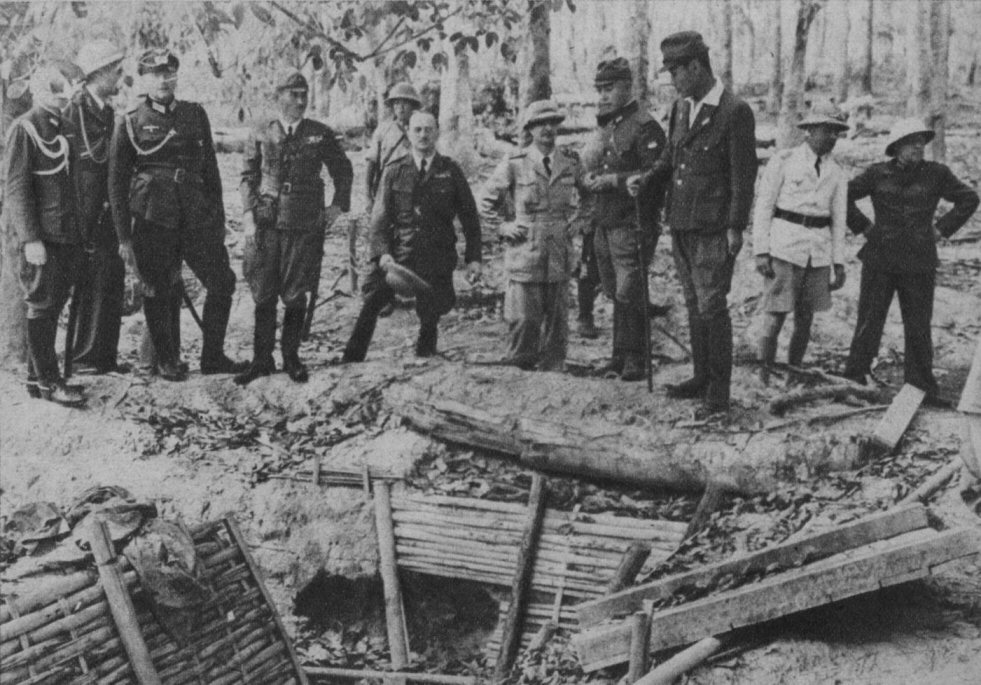
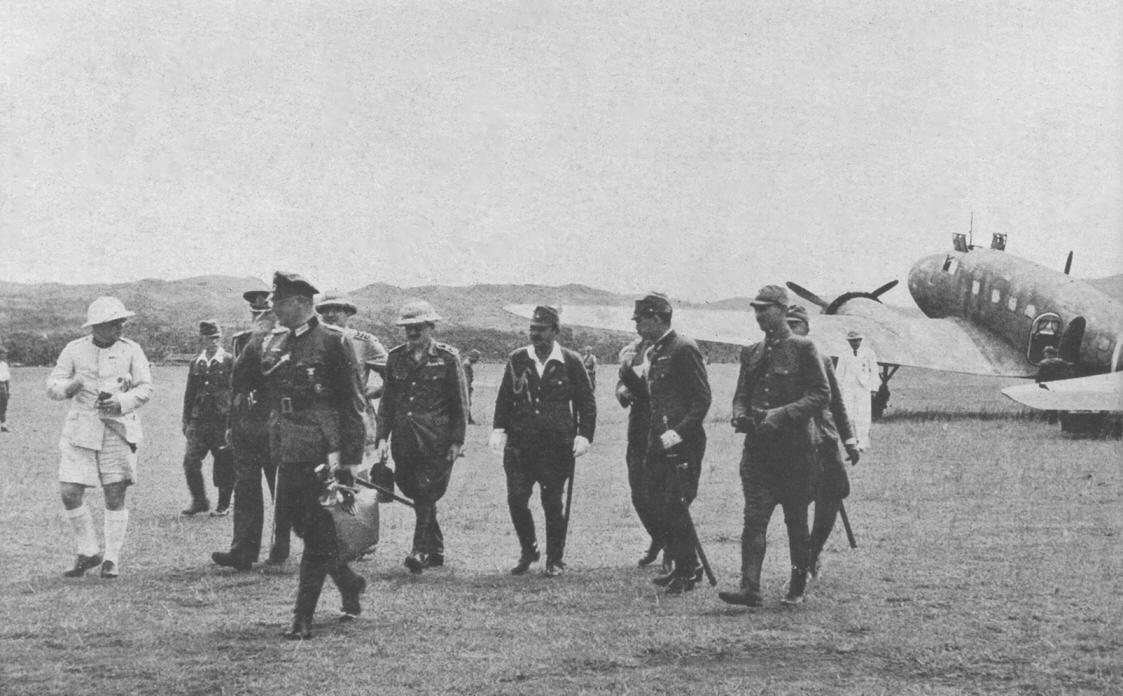
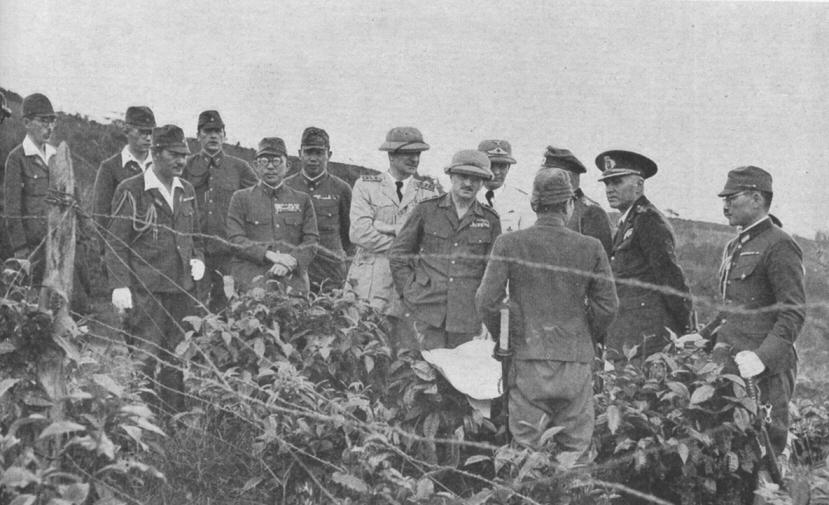
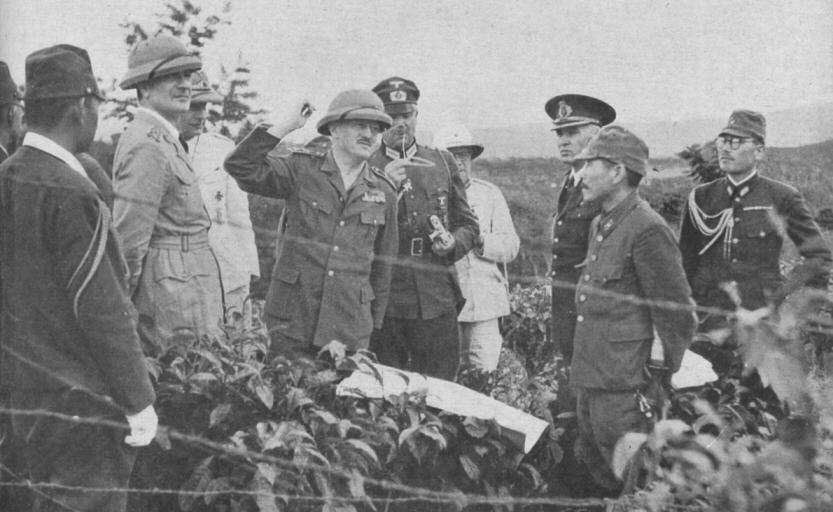
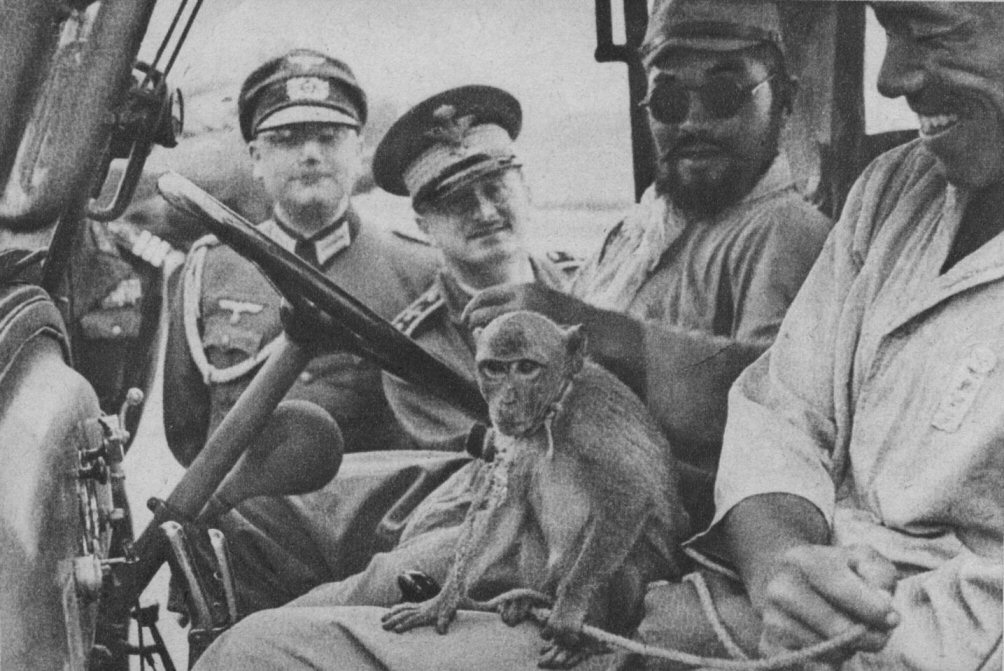
Not long after the capitulation of Allied forces in the Dutch East Indies on March 5, 1942, a military delegation from countries allied to Japan visited the areas where the fiercest battles took place for a close inspection. Although vintage publications mention that there were the military attachés of Germany, Italy, Rumania and Finland, only two names are actually included; Germany's Generalleutnant Alfred F. Kretschmer and Italy's Col Bertoni (first name? photo?). An internet research revealed that at that time military attaché of Romania was Major-General Gheorghe Bagulescu and of Finland Col Auno Kaila (rather interesting link here with photo but poor English translation).
On March 9, 1942 the group left Tokyo and arrived in Hong Kong via Taiwan. On March 13 they visited sights in Kowloon and Hong Kong especially the British fortifications.
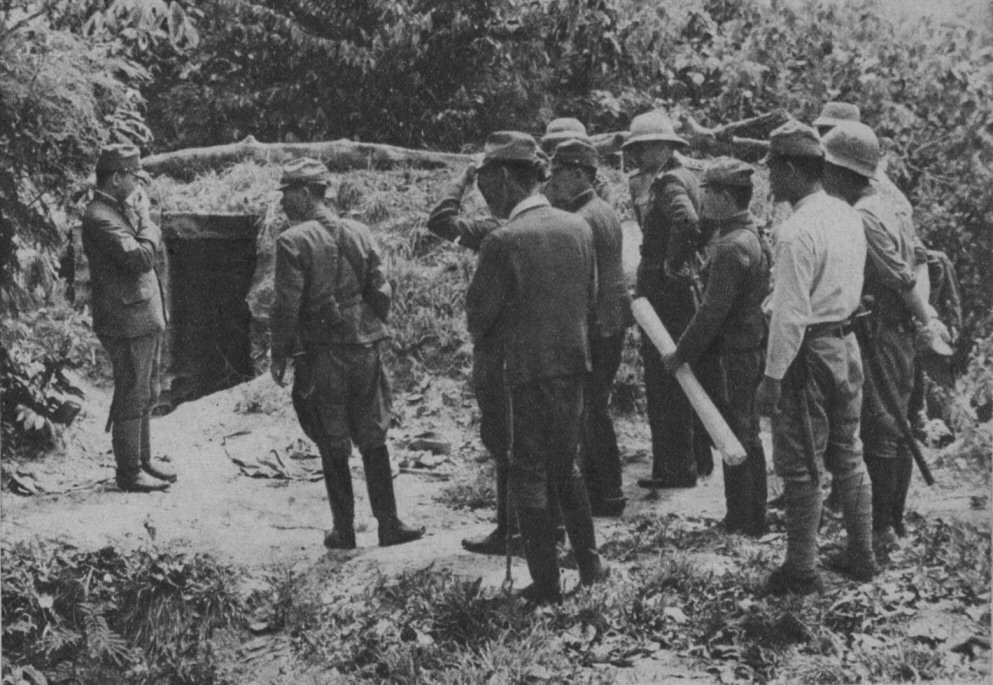
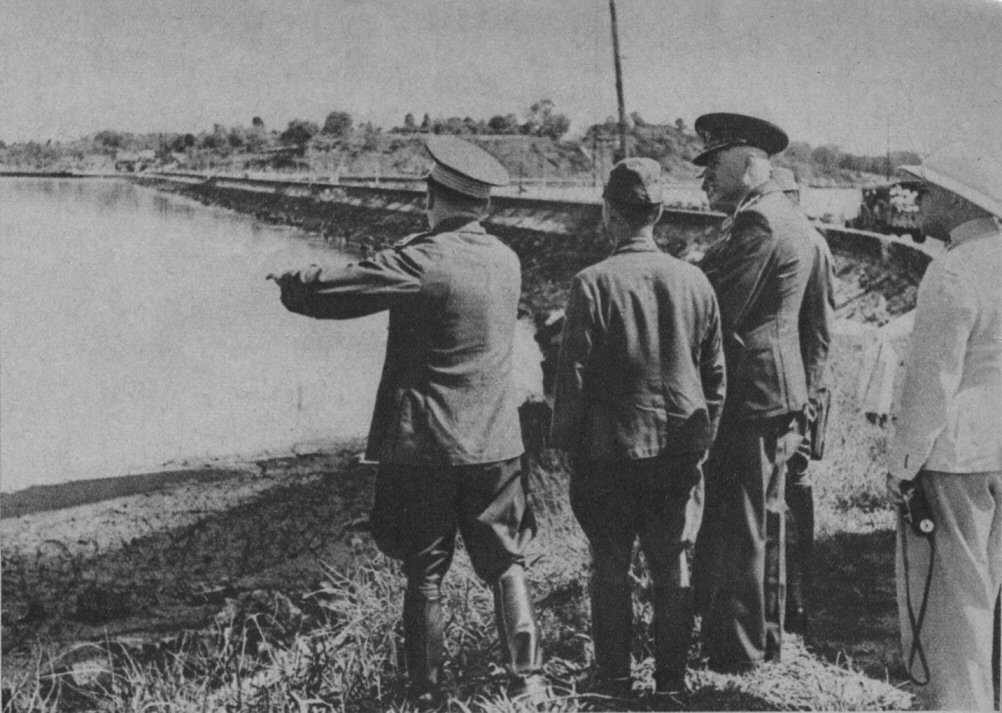
After brief stops in Saigon and Bangkok, on the 19th the group flew from Don Muang airport to Alor Setar in Malaysia. Lt Col Saeki, commander of the 1st Tank Regiment, drove for three days to meet them and explain what happened during the battle of Jitra.
Lt Col Saeki is showing the military attachés British fortifications
encountered during the battle of Jitra.

The next day they were driven from Ipoh to Kuala Lumpur through a difficult road crossing wild jungle. On the 21st the group arrived in Singapore and left immediately for Johor Bahru.
In Johor Bahru

Their next visit was to the military harbour of Seletar back in Singapore. On the 23rd they were able to observe the locations where battles took place from a hill in Kallang and saw first-hand one of the 38cm cannons that protected Singapore.
On the 24th the group flew to Palembang in Sumatra to inspect the areas where the Japanese parachutists fought and also saw the destroyed British, US and Dutch airplanes. 
On the 25 flew to Bandung in Jawa. Then to Lembang and finally to Batavia where they were treated to a lavish feast with more than 20 waiters serving them local dishes (undoubtedly they experienced a rijsttafel course). With this last stop the part of their trip to Malaysia and East Indies was concluded and the second part, which included a visit to the Philippines, started by them returning first to Singapore.
Arriving in Bandung on a Mitsubishi Ki-57 "Topsy", possibly Model 1 with two 850hp engines.

Two more photos above of their visit in Bandung. (Bottom photo) Finland's Col Kaila is second from the left, Italy's Col Bertoni is possibly standing next to him with his right hand raised. Right next to him fiddling with his spectacles is Germany's Generalleutnant Kretschmer and third from the right is probably Romania's Major-General Bagulescu.  

In Singapore

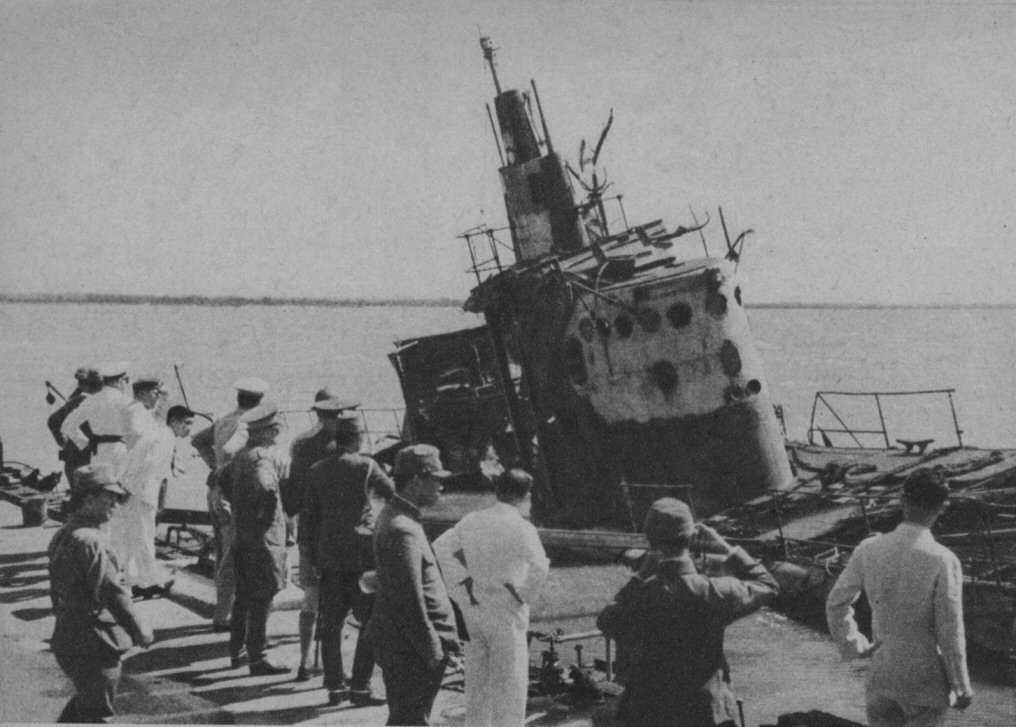
On April 1st the group arrived in Manila and visited the military harbor in Cavite.
Inspecting in Cavite the wrecked submarine is USS Sealion (SS-195) damaged on 10 December 1941 by Japanese bombers and blown up with demolition charges on the 25th by US troops. (Thank you Luca Ruffato)
On the 3rd they drove 300km to Lingayen Gulf and spend the night in the Governor General's residence in Baguio (The Mansion).
On the 4th the group visited Clark Field air base and inspected the captured and destroyed US aircraft.
Clark Field

On the 5th flew to Luzon island and then to Vigan, one of the initial landing spots during the Japanese invasion of the Philippines.
On April 7 the group returned to Haneda airport in Tokyo after covering no less than 20,000km by plane. 

Tuesday, 2 October 2012

VIPs - "Mavis" and Hiro H4H2

Prince Kuni Asaakira became vice-commander of the Yokohama Kokutai on December 1st, 1938 and is seen here in this photo, from a vintage magazine, in front of a Kawanishi H6K "Mavis" and Hiro H4H2 flying boat. Note the ladder used by members of the "Mavis" crew to get into the flying boat.


Friday, 31 August 2012

VIPs-IJAAF Uniforms


On April 1st, 1940, on the 30th Anniversary of the record flight of Lt General Baron Tokugawa Yoshitoshi (here), the "Wild Eagles" of IJAAF invited no less than 414 politicians and dignitaries for an air show in Tachikawa Airfield, Tokyo.
The exhibition started at 10:30 with front-line air combat simulations. Following that the guests were divided into more than 30 groups and flew with the latest bombers of the IJAAF over Tokyo.

President of the Chamber of Representatives, Koyama Shoju, is getting prepped.

Tanakadate Aikitsu (b. 1856) professor of Geophysics in Tokyo University. He was involved with aviation from the very early stages and was nicknamed the "foster father of Japanese Aviation". According to the article, from a vintage publication, he thoroughly enjoyed his flight. One of the asteroids in the Asteroid Belt of our Solar System has been named after him (here).

In the photos below (from Ebay) we can see in colour how exactly these pilot uniforms and boots looked like. It's the later type of IJAAF pilot's winter uniform.

Friday, 17 August 2012

VIPs "Pen Butai"

From the very beginning of the Second Sino-Japanese War in 1937, the Japanese media were interested to cover the hostilities especially in the bigger cities like Shanghai. By 1938 with the war expanding to the Chinese interior, groups of journalists and writers but also painters and musicians visited the front under the auspices, separately as always, of the Japanese Army and Navy. The groups of writers were nicknamed "Pen Butai" (Pen Units) while the musician groups were called "Record Butai". In August 1938 two such groups consisting of 24 writers for the Army and eight for the Navy visited the front where the Battle for the city of Wuhan was at full force (here).
On September 14, 1938 a Navy "Pen Butai" of seven members took-off from Haneda/Tokyo and landed in Shanghai. The previous day a 7-member Army "Pen Butai" had started from Fukuoka in North Kyushu and landed in Shanghai as the photo below from a vintage publication testifies. The mission of both groups was to cover the Battle of Wuhan.


The most famous member of the Army "Pen Butai" was writer Kume Masao (here), standing third from right with the moustache. 
First from left is novelist Kataoka Tepei. In 1932 he was imprisoned for his "leftist inclinations" and while in prison he made a turn to more "popular" literature.
Second from left is poet Sato Sonosuke while next to him is poet Asano Akira. Asano became a member of the Japanese Communist party in 1926. He was arrested during the "March 15 incident" (here) and was imprisoned for one year. After his release he changed to more traditional and cultural poems. It is said that Mishima Yukio read Asano's poem "Ten to Umi" (Heaven and Sea) before taking his own life.
Second from right is novelist Kawaguchi Matsutaro (here) and next to him is writer and mountaineer Fukuda Kyuya (here).
Standing alone in the middle is author Hayashi Fumiko (here) who led a quite adventurous and most interesting life. She often visited the front and from October 1942 to May 1943 she sent reports from French Indochina, Singapore, Java and Borneo.
The star of the Navy group (not in the photo) was Kikuchi Kan (here), one of the most famous Japanese authors.

The various "Pen Butai" were the precursors of the "Nihon Bungaku Hokoku Kai" (Japanese Patriotic Association of Literature) which was particularly active with propaganda during the Pacific War.
Note the Douglas DC in the background especially the very hastily applied camouflage.

Monday, 2 July 2012

VIPs - Battleship "Nagato"

On April 17, 1936 the governor of Shandong Province in North China, Han Fuju (second from right, here for more) visited Battleship Nagato escorted by Commander of the Combined Fleet, Admiral Takahashi Sankichi (third from right, here).
Perhaps the Navy guys can spot lots of interesting small details but for this blog of interest is the two reconnaissance floatplanes most probably Nakajima E4N2 in the background.

Friday, 15 June 2012

VIPs - DC3

Between June 26 and August 19, 1939 a long series of meetings took place between then British ambassador to Japan, Robert Craigie and the Japanese Government headed by Minister of Foreign Affairs Arita Hachiro. The subject was the Tientsin Incident (here) and among those who participated were naturally Army commanders of the Japanese Army stationed in China. The photo below was taken at Haneda Airport on August 14, at 6:00am upon the return to China of the Army officers who participated in the meetings. Front row on the right sits Major General Muto Akira, next to him sits Lt Colonel Ota, while behind Muto sits Major Ota (Kempei) and next to him Major Miyamoto. They all wear Model 1938 service dress, field caps instead of peaked caps and Maj Gen Muto is wearing brown aiguillette indicating he is serving in the field while the other two are wearing gold, the usual formal color.
The airplane interior is of either a DC-2 or a DC-3. Any thoughts?

 
Our friend Iskender Mailibayev sent us the following comment:
I'm fairly sure it is a DC-3. As far as I know the standard DC-2 passenger cabin arrangement included rows of single seats on the left and right, divided by an aisle. DC-3 had its fuselage widened by 60+ cm. compared to DC-2, which allowed for 3 seats arrangement (2+1), and that's exactly what we see on this picture. 
Thank you very much Iskender! 

Saturday, 14 April 2012

VIPs - Showa L2D (Douglas DC-3)

In this photo from a vintage publication Maj General Nishihara Issaku (on the left) is ready to take off from Haneda airport with three other officers on June 26, 1940 to inspect whether the colonial authorities of French Indochina are enforcing the blockade of weapons towards Chiang Kai-shek that came into effect after the strong protests of the Japanese.

Wikipedia has good entry about Nishihara and his involvement in the negotiations with the French.

"In early 1940, troops of the Imperial Japanese Army (IJA) moved to seize southern Guangxi and Longzhou County, where the eastern branch of the Kunming–Hai Phong Railway reached the border at the Friendship Pass in Pingxiang. They also tried to move west to cut the rail line to Kunming. The railway from Indochina was the Chinese government's last secure overland link to the outside world.

Franco-Japanese negotiations
On 19 June, Japan took advantage of the defeat of France and the impending armistice to present the Governor-General of Indochina, Georges Catroux, with a request, in fact an ultimatum, demanding the closure of all supply routes to China and the admission of a 40-man Japanese inspection team under General Issaku Nishihara. The Americans became aware of the true nature of the Japanese "request" through intelligence intercepts, since the Japanese had informed their German allies. Catroux initially responded by warning the Japanese that their unspecified "other measures" would be a breach of sovereignty. He was reluctant to acquiesce to the Japanese, but with his intelligence reporting that Japanese army and navy units were moving into threatening positions, the French government was not prepared for a protracted defense of the colony. Therefore, Catroux complied with the Japanese ultimatum on 20 June. Before the end of June the last train carrying munitions crossed the border bound for Kunming. Following this humiliation, Catroux was immediately replaced as governor-general by Admiral Jean Decoux. He did not return to France, however, but to London.
On 22 June, while Catroux was still in his post, the Japanese issued a second demand: naval basing rights at Guangzhouwan and the total closure of the Chinese border by 7 July. Issaku Nishihara, who was to lead the "inspection team", the true purpose of which was unknown, even to the Japanese, arrived in Hanoi on 29 June. On 3 July, he issued a third demand: air bases and the right to transit combat troops through Indochina. These new demands were referred to the government in France.
The incoming governor, Decoux, who arrived in Indochina in July, urged the government to reject the demands. Although he believed that Indochina could not defend itself against a Japanese invasion, Decoux believed it was strong enough to dissuade Japan from invading. At Vichy, General Jules-Antoine Bührer, chief of the Colonial General Staff, counselled resistance. The still neutral United States had already been contracted to provide aircraft, and there were 4,000 Tirailleurs sénégalais in Djibouti that could be shipped to Indochina in case of need. In Indochina, Decoux had under his command 32,000 regulars, plus 17,000 auxiliaries, although they were all ill-equipped.
On 30 August 1940, the Japanese foreign minister, Yōsuke Matsuoka, approved a draft proposal submitted by his French colleague, Paul Baudouin, whereby Japanese forces could be stationed in and transit through Indochina only for the duration of the Sino-Japanese War. Both governments then "instructed their military representatives in Indochina to work out the details [although] they would have been better advised to stick to Tokyo–Vichy channels a bit longer". Negotiations between the supreme commander of Indochinese troops, Maurice Martin, and General Nishihara began at Hanoi on 3 September.
During negotiations, the government in France asked the German government to intervene to moderate its ally's demands. The Germans did nothing. Decoux and Martin, acting on their own, looked for help from the American and British consuls in Hanoi, and even consulted with the Chinese government on joint defence against a Japanese attack on Indochina.
On 6 September, an infantry battalion of the Japanese Twenty-Second Army based in Nanning violated the Indochinese border near the French fort at Đồng Đăng. The Twenty-Second Army was a part of the Japanese Southern China Area Army, whose officers, remembering the Mukden incident of 1931, were trying to force their superiors to adopt a more aggressive policy. Following the Đồng Đăng incident, Decoux cut off negotiations. On 18 September, Nishihara sent him an ultimatum, warning that Japanese troops would enter Indochina regardless of any French agreement at 22:00 (local time) on 22 September. This prompted Decoux to demand a reduction in the number of Japanese troops that would be stationed in Indochina. The Japanese Army General Staff, with the support of the Japanese Southern China Area Army, was demanding 25,000 troops in Indochina. Nishihara, with the support of the Imperial General Headquarters, got that number reduced to 6,000 on 21 September.
Seven and a half hours before the expiration of the Japanese ultimatum on 22 September, Martin and Nishihara signed an agreement authorizing the stationing of 6,000 Japanese troops in Tonkin north of the Red River, the use of four airfields in Tonkin, the right to move up to 25,000 troops through Tonkin to Yunnan and the right to move one division of the Twenty-Second Army through Tonkin via Haiphong for use elsewhere in China. Already on 5 September, the Japanese Southern Army had organized the amphibious Indochina Expeditionary Army under Major-General Takuma Nishimura, it was supported by a flotilla of ships and aircraft, both carrier- and land-based. When the accord was signed, a convoy was waiting off Hainan Island to bring the expeditionary force to Tonkin.

Friday, 16 March 2012

VIPs - Mitsubishi G4M "Betty"

These two photos from an official IJNAF publication show Prince Kuni Asaakira (Kuni-no-miya) visiting a forward base in the South Pacific. The publication date of the album is December 1943 and of interest is the information from Wikipedia (here) that: "Prince Kuni was promoted to rear admiral on 1 November 1942, and was given command of the Japanese 19th Naval Fighter Wing, which supported the Japanese occupation of Timor in the Pacific War."


Friday, 17 February 2012

VIPs - Lockheed Super Electra Type LO - China Aviation Company

The aircraft featured in this set of photos from vintage publications are Lockheed Super Electra Model 14-38, 14-passenger transports of which 30 were exported to Japan. A first batch of 20 started to be imported from March 1938 by the Army and another ten were imported by Nippon Koku starting from June of the same year. The type was also produced under license by Tachikawa but there were problems with unpaved airfields and complains about the limited cargo. Kawasaki undertook to fixing these problems with famous aircraft designer Doi Takeo as leader of the team. Design work started in September 1939 under the designation Army Type 1 Freight Transport Ki-56 and the first aircraft was completed in the middle of November 1940.

In the above photo featured in the September 1, 1940 issue of magazine "Kokusai Shashin Joho", Wang Yitang, Minister of the Examination Yuan for the Nanking (Nanjing) collaborationist government led by Wang Jingwei, is flying to various cities around China in a Super Electra since the establishment of the new government in March 1940. Note the guy behind him on the left something between a Japanese yakuza and a Chinese Triad member. The plane probably belongs to the China Aviation Company. The cropped guy on the far right of the photo is wearing a cup with what looks like the emblem of the airline.

Japanese flight attendants, called "Air Girls" back then, of the China Aviation Company are posing for this photo commemorating the first time they flew in the Dalian-Shanghai service of the airline on August 17, 1940. To me they look more like school-girls if it wasn't for the pin with the company emblem and I'm certain I would prefer to be serviced by them instead of the uptight flight attendants with the plastic smile I occasionally encounter.

In the photo above passengers and China Aviation Company personnel celebrate the inauguration of the new Peking-Shanghai route on March 14, 1939. A company pilot wearing a leather jacket with a fur collar and a pilot's cup can be seen in the foreground. Note the Douglas DC-2 in the background next to the Super Electra   

Tuesday, 14 February 2012

VIPs - Nakajima-Douglas DC-2

In this photo from a vintage publication second from right War Minister General Sugiyama Gen (Hajime)  is arriving at Ming Ku Kung (Daiko) airfield of Nanking (Nanjing) on April 14, 1938. He is flying with a Nakajima built DC-2 during his China front inspection from April 12 to 21. In December of the same year he was assigned as commanding general of the North China Area Army.

The DC-2 is one of the five Nakajima built under licence from Douglas from February 1936 to 1937. They were pressed into military service in 1938 and received military camouflage as can be seen in the photo.

Tuesday, 31 January 2012

VIPs - Showa L2D (Douglas DC-3)

Jacob sent us the following:
About a month ago I saw on UTube a Dutch documentary about the Indonesian struggle for Independence.
This documentary had some footage about a "propaganda" trip of the first president of the Republik, Mr Soekarno (Sukarno). He travelled in May 1945 with a Japanese L2D2 in the archipelago. The last three digits of the unit code are XX- 200. The images below are stills  I took from that footage. 
My question is: can that Tabby unit be identified?
Jacob Terlouw / The Netherlands.


We asked leading authority on the subject of units and tail markings Akimoto Minoru-sensei and here's what he replied:
The DC-3 belonged to the Dai Nippon Koku with civilian registration J-BKOM and name "WAKASA"*. It was one of about 40 DC-3s that formed a unit by DNK called "Dai Nippon Koku Choyo Yusoki Tai" (DNK Commandeered Transport Unit) and operated for the IJNAF. The particular plane belonged to the 2nd Choyo Yusoki Tai
Tail number. The second katakana is the first "YU" of "YUsokitai" but the first katakana is difficult to discern. It could be "SE" or "NA" or "CHI" or even a "2". If the first is a "CHI" then it's the first katakana for "Choyo"**. If it's a number "2" then it could signify the 2nd Yusoki Tai.
I believe the photo was taken when Sukarno was visiting Singapore to discuss the details regarding the forthcoming independence of Indonesia.

*"Wakasa" probably refers to the gulf starting from Fukui prefecture and ending in Kyoto.
**"Choyo" is written as "CHIyoUYOU" in kana but it's pronounced as Choyo with stretched "o"s.

We are grateful to Jacob and Akimoto-sensei for their contribution to our blog.

Saturday, 28 January 2012

VIPs - Mitsubishi Ki-57 "Topsy"

The cover of the March 31, 1943 issue of the magazine "Shashin Shuho". The leader of the Burmese Executive Administration Dr. Ba Maw is visiting Tokyo accompanied by a delegation of Burmese officials. The photo was taken during his arrival on a charter flight at Tokyo's Haneda airport on March 18 at 14:00. In the background is a heavily camouflaged Mitsubishi Ki-57 "Topsy" probably belonging to Dai Nippon Koku K.K.
Five months later, on August 1, 1943 the "independent" State of Burma was declared with Ba Maw as Head of State and Prime Minister.