Showing posts with label Aikoku. Show all posts

Thursday, 2 January 2025

Nakajima Type 91 fighter, Aikoku #84 & #86 - 中島 九一式戦闘機, 愛国号 #84, #86 - video


On May 7, 1933, in the Parade Ground in Joto, Osaka, three Nakajima Type 1 Fighters were donated to the IJAAF; Aikokugo #84, #86 and #87. The donors were Tamura Komajiro, "Osaka Prefecture, City, and other industry-related parties" and the "Osaka Association of Honmon Butsuryū" respectively.
In the clip we can see the donation ceremony of #84 and #86 taking place with the Shinto Priest permorming a Harai Ceremony before the two pilots are taking the fighters for a spin.

Friday, 19 April 2024

Aikoku Nakajima Type 91 Army Fighter - video

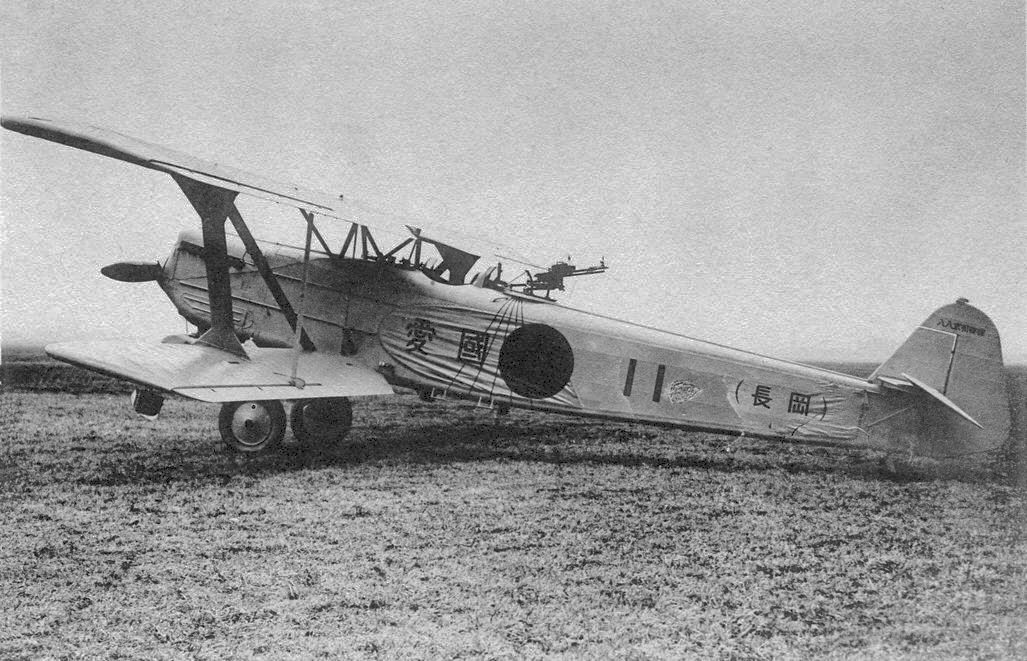
The Aikoku (Donation) ceremony took place on June 26, 1932, at Kyoto's Fukakusa Drill Grounds. The citizens of Kyoto gathered enough funds to donate a variety of military hardware including one Nakajima Type 91 Army Fighter which received the aikoku number #38.

Friday, 27 November 2015

"Aikoku" Ceremony - Nakajima Ki-27 "Nate" - Video

No less than 51 newly delivered Army and Navy aircraft were presented to the public at Haneda airport on September 20, 1941, the second Aviation Day. 16 of them became IJNAF Hokoku-go and 35 became IJAAF Aikoku-go. The ceremony started at 13:00 and was attended by the Navy Minister Admiral Oikawa Koshiro and the Army Minister (at the time) Tojo Hideki as well as a huge crowd who, according to the video commentator, enjoyed low passes, formation flights and skillful acrobatics by the pilots who were elated to receive their brand new aircraft.  
The photo above is from a vintage publication and the video below from the NHK collection.
 

Tuesday, 3 March 2015

Kawasaki Type 88 Reconnaissance/Bomber KDA-2 - Aikoku #15

A set of photos today featuring Kawasaki Type 88 Reconnaissance/Bomber KDA-2s.
The top is a photo of Aikoku #15 donated on April 24, 1932 by citizens of Miyagi Prefecture.

 
The other two photos show a KDA-2 getting bombed up and a close-up of the rear Army Type 89 flexible machine gun (special) detailing the particularly complex mount. 


Friday, 11 October 2013

Aikoku #10, #11, #12

Aikoku #10 was a Type 88 Reconnaissance Aircraft or Kawasaki KDA-2 donated April 7, 1932 by Korean officials and people


Aikoku#11 was also Type 88 Reconnaissance Aircraft donated on April 10, 1932 by citizens of Nagaoka city, Niigata prefecture.


Aikoku#12 was a Type88 Light Bomber or Kawasaki KDA-2 donated also on April 10, 1932 by citizens of the Toyama prefecture.

Wednesday, 2 October 2013

Aikoku #8 & #9

Aikoku #8 (sn 121) was a Type 91 Fighter or Nakajima NC donated April 3, 1932 by Kawakita Hisataya (photo below) who, at the time, was president of the local for Mie Prefecture Hyakugo Bank, Ltd. 

Aikoku #9 (sn 126) was also a Nakajima NC and was donated by a Kawano or Kono Yoshi (no further details available) one week later during a ceremony that took place in the Yoyogi Parade Ground in Tokyo.
Thanks to Yokokawa Yuichi and his Aikokuki site.

Friday, 13 September 2013

Aikoku #6 & #7

  Aikoku #6 was a Type 88 Reconnaissance or Kawasaki KDA-2 that was donated by Nippon Keori KK (Nippon Woolen Co Ltd) (see also Hokoku #1, here) on March 13, 1932 during a ceremony that took place at 10:00 in the Joto Parade ground of Osaka. The ceremony was concluded with captain Hayashi taking the plane for a spin. He flew over Osaka, Kobe and Himeji but encountered heavy clouds on his way to Kakamigahara and returned to Osaka flying over lake Biwa.
  The plane saw action during the Pacification_of_Manchukuo and on a bombing mission on September 9, 1932 the engine cooler was hit by a/a fire. Pilot 1st Ltd Kinoshita and rear gunner Sgt Yamagi managed to safely land the plane west of Jinzhou but during the night a number of "bandits" completely destroyed the plane. No information exists regarding the fate of the crew.
     
Aikoku #7 was a Type 91 Fighter or Nakajima NC that was donated by citizens of Gunma prefecture during a ceremony that took place on March 8, 1932 in Takasaki. The serial number of the plane was "171".

Thursday, 5 September 2013

Aikoku #3, #4, #5


A follow up of the previous posting, today we feature photos of the very first aircraft Obuse Shinzaburo (photo in the middle) donated to the IJAAF. These were a Type 91 Fighter or Nakajima NC which received the designation Aikoku #3, a Type 88 Light Bomber or Kawasaki KDA-2 which became Aikoku #4 and a Type 88 Reconnaissance Model 1 or Kawasaki KDA-2 which was named Aikoku #5. Their donation ceremony was held on March 6, 1932 at the Yoyogi parade ground.   

Tuesday, 20 August 2013

Aikoku #141 - Nakajima Ki-4

"Aikoku-ki" (Patriotism-planes) were called the Army aircraft that were donated to the IJAAF with funds from worker associations, schoolchildren and their parents, citizens of cities or prefectures and many other kind of groups.

Obuse Shinzaburo the 2nd, was a rich Japanese born in Yokohama that inherited and continued his father's foreign exchange and stock market business. On September 2, 1937 during a ceremony held in Tokyo's Haneda airport he donated to the Army no less than six aircraft; four Type 95 Fighters or Kawasaki Ki-10, Aikoku #137-140 and two Type 94 Reconnaissance Aircraft or Nakajima Ki-4, Aikoku #141&142 which were named after the donor. In the photo below Obuse is standing next to Aikoku #141, a Ki-4 offering an excellent view of the rear twin Type 89 flexible machine gun mount.

In the photo below, Field Marshal Sugiyama Hajime, War Minister at the time, is offering a certificate or receipt to Obuse-san who not only donated aircraft to the Army but also to the Navy and for this received the nickname "King of Aikoku airplanes".

Tuesday, 28 May 2013

Kawasaki Type 88 Reconnaissance/Bomber KDA-2 - Aikoku #22


Aikoku #22 "TeiSei" was an Army Type 88 Reconnaissance/Bomber or Kawasaki KDA-2 that was donated by the workers of the Teikoku Seimei Hoken Kabushiki Kaisha (Imperial Life Insurance Co Ltd) on June 19, 1932 during a ceremony in Yoyogi parade grounds.
From March 1932 until May 1933 one KDA-2 model 1 Reconnaissance, five Model 2 Reconnaissance and 19 KDA-2 Light Bombers were donated as Aikoku-ki. The price of one light bomber was 30,000Yen. At that time a bottle of Johnnie Walker whiskey red label was 5.5Yen (3,580Yen or $US20 at today's prices). 

The insurance company was founded in 1888 by IJN paymaster Kakara Tameshige with Fukuhara Arinoba and members of of the IJN accounting school who had studied in the UK. In 1936 the company merged with Tokyo Seimei Hoken and in 1947 became Asahi Seimei Hoken (Asahi Mutual Life Insurance) which is now one of the biggest life insurance companies in Japan.

Friday, 10 May 2013

RACCOON MODELS Pt. 2

Master Modeller Saito Hisao sent us photos of his exquisite Raccoon Army Type 88 Reconnaissance or Kawasaki KDA-2 in 1:48 that he built 20 years ago.
The subject is Aikoku #28 (Tokushima-go) which was donated by the citizens of Tokushima, in Shikoku, the hometown of Saito-san. The donation ceremony was not done in an airfield, since there was none in the area but on the banks of river Yoshinogawa.
After some time the model started to melt and deform and was ultimately discarded. Saito-san commented that parts of Raccoon models have just the basic shape and need a lot of work to resemble the real thing. Especially biplanes need extra strengthening of the wings.
 

And here is a photo of the real aircraft.

Thursday, 11 October 2012

Tachikawa (Ishikawajima) KKY-1 & KKY-2

Our good friend Harold K sent us the following heads-up:
"A new release from Amodel (as shown on the Modelimex site HERE); two other variants as well. I have never even heard of this airplane; can you tell us something about it?"

First the KKY-1.

It was designed by Endo Ryokichi under the supervision of Nakagawa Moriyuki inspired by imported deHavilland D.H. 83 Fox Moth. The designation KKY stands for "Kogata Kei Kanja Yusoki" (Small Type Light Patient Transport). The first prototype was completed in the beginning of December 1933 with the first flight taking place on December 9. It was not built under orders of the Army so it didn't have any Ki or Shi registration but it was still an Army type. It could carry two patients on stretchers, one medical attendant and medical supplies. It could land and take off from short airstrips making it particularly useful for emergency evacuations. Total 25 were produced until 1940.
Originally the type was fitted with a Cirrus Hermes Mk.IV and was registered KKY-1 but due to vibration problems the engine was changed to Gasuden Jinpu Model 3, 150hp which solved the problems and increased the overall performance. With the Gasuden engine the designation became KKY-2. Originally the propeller was metal but later it was wooden. The type was widely used during the Sino-Japanese War in patient transport and communication duties until the beginning of the Pacific War.
Most of them were Aikoku (donated) aircraft. Three examples below.

Aikoku 97 "Osaka Yakushu Seiyaku" - Donated by drug manufacturing and retailer associations on April 22, 1934. Note the metal propeller.

Aikoku 127 "Katoriku" - Donated by Catholic groups of Nagasaki in May 1937. Wooden propeller.

Aikoku 136 "Shonen Sekijuji" - Donated by the Japanese Red Cross and their Youth Organisations on May 30, 1938.

Tachikawa KKY-1 Data (source - vintage publication):
Span: 10m / Length: 7.933m / Height: 2.932 / Wing area: 22 sqm / Weights Empty: 626kg / Cargo: 361kg (standard), 431kg (max) / Loaded weight: 987kg (standard), 1,057kg (max) / Wing Loading: 45 kg/sqm / Power loading: 8.2 kg/hp
Max speed: 182 km/h (at low altitude) / Landing speed: 85 km/h / Climb to 1000 in 5.55 mins, 3000m 26,30mins / Service ceiling: 3,600m (normal), 4,300(design) / Flight time: 4h / Take-off distance: 150m / Landing distance: 180m

Amodel has also released the KKY-2 version (HERE) which is very camera-shy with only a couple photos I know of. Very interesting releases by Amodel.

Monday, 23 January 2012

Nakajima Ki-27 "Nate"

Two photos from a vintage magazine taken during the donation ceremony of a Nakajima Ki-27 "Nate" at Tokyo's Tachikawa airfield on February 2, 1939. Donations for this aircraft, Aikoku #313, were gathered from about 70 Sumo wrestlers (rikishi/sekitori) and Sumo Association members; therefore it was called "Sumo-go". 
The Sumo wrestlers were all from the Juryo and Makuuchi divisions and one of the most famous Sumo wrestlers of all times, Yokozuna Futabayama, performed the Dohyoiri ceremony. 
For further reading about sumo: