Friday, 8 April 2022

Nakajima Ki-43 "Hayabusa" - 59 & 77 Sentai pt.3

Let's talk about the 59 Sentai "Hayabusa" now. We already saw some photos of the aircraft together with a 77 Sentai fighter in the previous post. Below is a photo (Haya11) from the SDASM Archive featuring the same aircraft. 
Note the absence of the rear part of the canopy and the piece missing on the leading edge of the tailfin.

Another photo (Haya12) I spotted on the net of the same aircraft from a different angle.
Note the badly damaged and missing starboard aileron.

Another photo from the net (Haya13).

More photos (Haya14 & 15), this time from Model Art #395.

Finally, there are two colour photos of the same aircraft in the Jeff Ethell collection (Haya16 & 17).

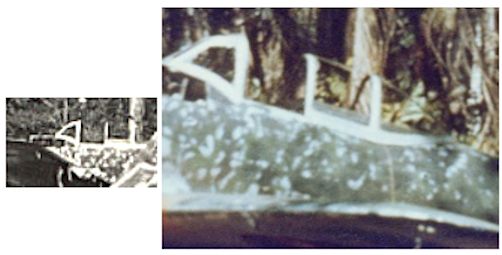
At first glance the aircraft looks to be in overall light brown, but a closer look at the section between the fuselage hinomaru and the tail marking in the top (Haya16) photo, reveals that the top camouflage is actually green.
Without working on the photo too much but just by clicking only once the "automatic colour correction" of the Corel, we can clearly see again that in the lower photo the top colour is green.

Ed DeKiep has noticed a rather unusual "marking" on the horizontal tail surfaces.
He suggested that what looks like a band is part of the 59th Sentai unit marking. Although it's not impossible, personally, I can't say with 100% certainty that there is a red (?) band there with a white surround. The rest of the aircraft looks quite bland without any personal markings. Bands on the tail were meant to indicate sentaichutai or hentai leaders. So in this case the particular "Hayabusa" would have had more bands on the fuselage if it belonged to a high ranking pilot. As far as I know no other sentai used the horizontal surfaces to paint the unit marking or part of it. The main reason is that these surfaces are not very visible in the air. There are indeed two white (?) lines painted on the elevator hinges but the rest could just be scratch.
It would have been great if we had a colour photo to prove beyond any doubt what we see there. Or perhaps someone has the time to do a colour comparison analysis between the "band", the tail marking and the green camo?

Radek Pelikán sent over the following great photo (Haya19).

In this photo, the "white" line looks exactly like a line, not a scratch. But is there a red band? I still think we need better evidence to be sure.

Finally, a closer look at Haya15 photo reveals that probably US personnel draw some arrows and stuff, perhaps indicating a part that needed to be removed to be used on another aircraft.

Also, did you notice in the colour photos the red spinner and the absence of antiglare panel on the cowling top? 

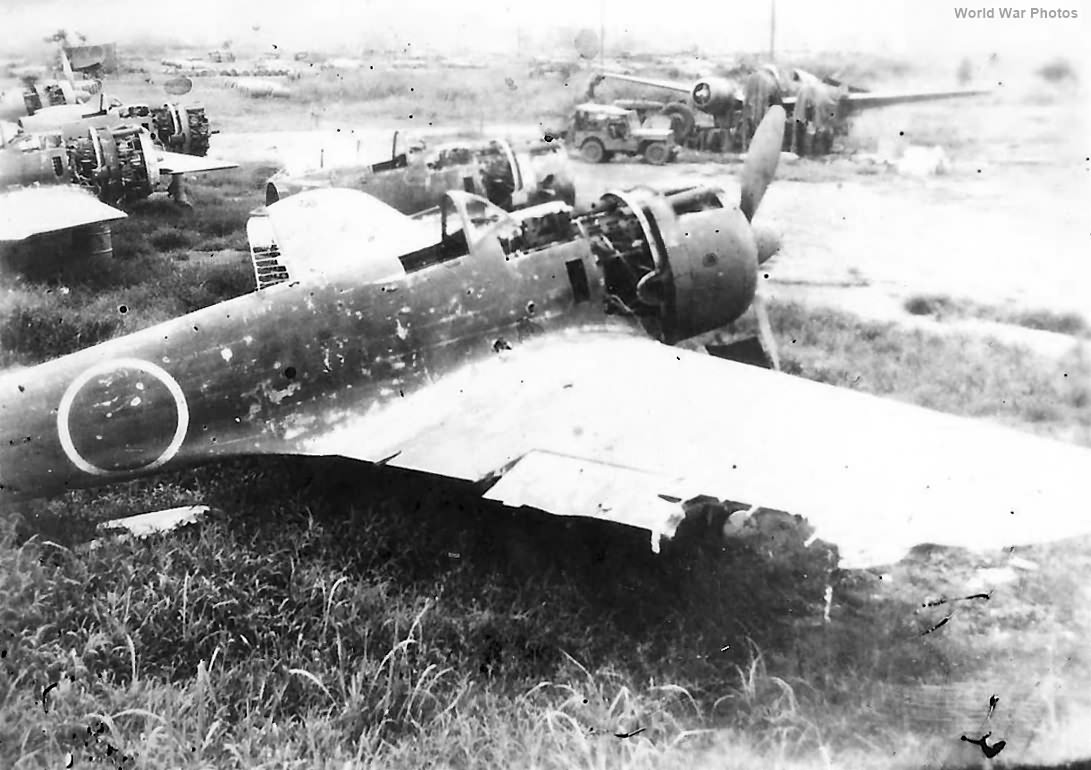
And last but not least, here's another photo(Haya18) of the 59 Sentai "Hayabusa", in the foreground with other captured IJAAF fighters or what's left of them.
Thursday, 7 April 2022

Nakajima Ki-43 "Hayabusa" - 59 & 77 Sentai pt.2

Thank you all for your feeback regarding these photos. Let's try to organize and present them little by little instead of posting two dozen photos of the same and different planes in one confusing batch.

So, today let's have a closer look at two more "Hayabusa" that were placed side by side, one from the 59th and one from the 77 Sentai.
Let's start by putting up again the colour photo of the previous post.

There is the 77 Sentai "Hayabusa" in the foreground, and the number "5" Ki-43 of the 33 Sentai behind it. Behind both aircraft there is only thick jungle and a dirt road in front of them. 

In the brilliant photo below (Haya8), I spotted on the net, we can see again the 77 Sentai "Hayabusa", this time missing its rudder. In the foreground is a 59 Sentai "Hayabusa" flown by a pilot of the 2nd Chutai (red tail marking).
In this photo, behind the aircraft there is no longer jungle but a small road and a tent. Unlikely, the seabees to have cleared the jungle behind the planes without disturbing them. I think they were simply moved into the open. 

The Ki-43 in the background behind the tent is again the number "5" of the 33 Sentai. The non-camouflaged patterns on the fuselage next to the canopy/cockpit, are a match.
Voytek Kubacki & Ed DeKiep, sent over one more photo, this time from a slightly different angle. Wonderful!


Let's turn our attention to the 77 Sentai "Hayabusa" seen in the b/w photo above.
According to MA#395, it was flown by 2nd Chutai commander Captain Matsuo Yoshihide and is depicted as shown in the illustration below.

It is obviously not the same with the aircraft seen in the colour photo. The colour of the tail marking and the camouflage are different. 

Note that Matsuo's aircraft has some panel hanging under the firewall (Haya8b). 
It's a small detail but very helpful to identify the plane in other photos too. 
Like this photo (Haya12) that was recently on sale on ebay.
Although the tail marking is not visible on the Ki-43 on the left, we can see the 59 tail marking on the plane on the right. 
The photo above (Haya12) was sold with the photo below (Haya13) which features a front view of the 59 Sentai "Hayabusa". Note the cables hanging on the wing edge next to the engine on the starboard side, visible on both photos.

Another photo of the same two Ki-43s found on the net. Although no tail markings are visible, note the panel hanging under Matsuo's plane.
This time there is "a classic US field crane" in front of them, as Radek Pelikán correctly noticed.

Here's another photo from the net of the same two aircraft. 

Thursday, 31 March 2022

Nakajima Ki-43 "Hayabusa" - 33 & 59 Sentai pt.1

A number of quite interesting Nakajima Ki-43 "Hayabusa" photos were offered on ebay this week but they went too high for my badget.

The first photo features a "Hayabusa" belonging to the 3rd Chutai of the 33 Sentai, most probably in Hollandia, New Guinea. 

Top green but note the unpainted canopy. It could have a hidden-by-the-tarp number on the fuselage between the hinomaru and the tail.
Voytek Kubacki noticed that it's the same aircraft in the photos below.

Note in the photo below the 77 Sentai, 1 Chutai Model 2 Ko in the foreground. The white band right behind the fuselage hinomaru, probably indicates that it was flown by a hentai commander.


A close up of the tails and a comparison of the scratches, proves beyond and doubt that it is indeed the same plane.

The second photo, from a different set, features in the foreground another 3rd Chutai, 33 Sentai "Hayabusa" with the number "2" painted on the fuselage.

Of particular interest is the other "Hayabusa" in the background. Arawasi believes it belonged to the commander of the 3rd Chutai of the 59th Sentai, as indicated by the three yellow fuselage bands and the yellow tail marking. Since this photo was also taken in New Guinea, the unit had two (three) commanders during its time there: 1. Capt Mizoguchi Yuji who was shot down over Tsili Tsili airfield in August 1943 and bailed with his parachute. He was temporarily replaced by Lt Atarashi Tadanobu until 2. Capt Kobayashi Kenjiro took over command of the 3rd Chutai, from November 1943 until December 1944, during the time the unit fought in New Guinea. 
Quite unlikely that Mizoguchi's plane survived the crash and was brought by U.S. troops to an airfield, so the only other possibility is that it belonged to Kobayashi.
The chutai of the 59 had the unit tail marking painted in white for the 1st, red for the 2nd and yellow for the 3rd.

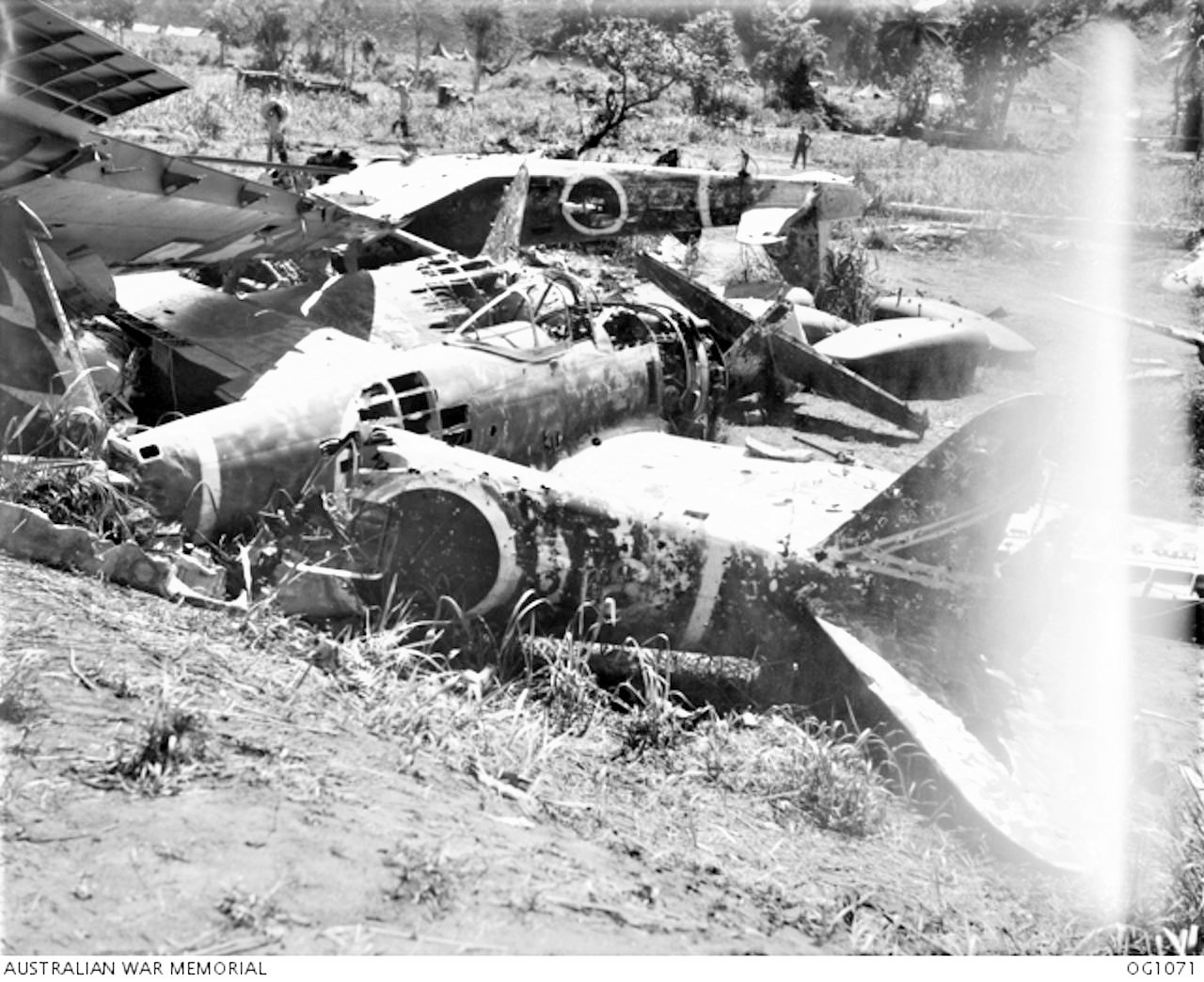
Voytek Kubacki noticed that in the Australia War Memorial, there is another photo of the same scrapyard with the same aircraft from a different angle. Notice the 248 Sentai "Hayabusa" on the left.
In this case the fuselage number looks more like an "8" but in the closeup of the photo further above looks to us more like a "2". Could be an "8" though.

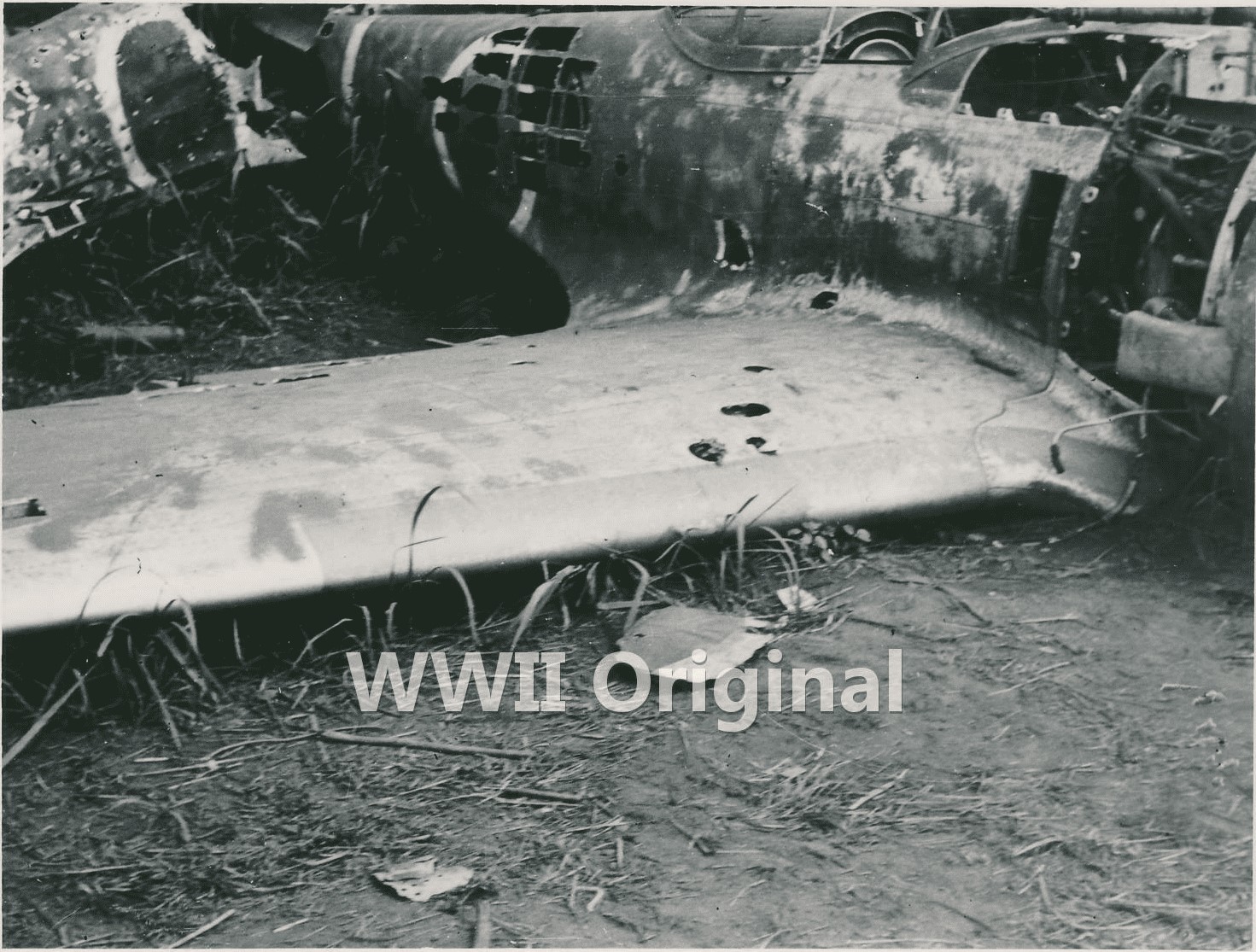
 Three more photos from the same collection.
Note Kobayashi's fighter in the background.


Note the IFF stripe, not being straight but following the curve of the wing edge near the fuselage. A common mistake in illustrations and models.

Saturday, 12 March 2022

Eduard A6M2b I-GO Sakusen by Jean Barby

Here is the very nice Eduard’s Zero in the markings of the Hiyo during the I-Go Sakusen operation in April 43. It is out of the box except for the markings made with my own masks.The model is pretty good but has some weak points. The undercarriage is tricky to instal and remains fragile. The cockpit must be built following the instructions, otherwise you‘ll be in trouble. Guess how I know! 

- Jean Barby -

Wednesday, 2 March 2022

Tamiya 1/48 A6M3 Model 22 Ko by Woody Kubacki

The kit was painted with AK Real Color and Mr Color paints, and the Honomaru and fuselage stripes were hand masked. Oils and panel line washes were used to weather the model.  There are some errors (no arrestor hook and interior of canopy is painted the wrong colour), which I would like to remedy in a future build, but I am happy with how it turned out.

- Woody Kubacki -

An excellent model indeed. It's rare to see a properly weathered Zero where the red brown primer is seen under the top paint. Good job Woody!