The "Civilian Nakajima E4N2" posting on 15 October 2014 gave a fascinating insight into the early years of Japanese fish spotting. It also mentioned the aircraft concerned being named Giyȗ #9 and some further notes on use of the term Giyȗ (unusual in relation to fish spotting) might be of interest.
Numerous surplus/obsolete Nakajma navy aircraft were converted for civilian use and four of these were specifically designated Fisheries Floatplanes, all modified as indicated for J-BABP. The term Giyȗ was applied to them by the concern to which they were initially supplied, namely the Teikoku Kaibo Gikai (Imperial Maritime Defence Volunteer Association), where the term "loyalty and courage" is obviously more relevant. The Association obtained various types of aircraft as follows:
Giyȗ #1 Kawanishi K-8B Transport Floatplane J-TUST; loaned to airline Nippon Kôkȗ Kabushiki Kaisha (Japan Aviation Company Ltd.)
Giyȗ #2 Kawanishi K-8B Transport Floatplane J-TUTU; loaned to the same airline as above.
The back of the above postcard with
the marking of Teikoku Kaibo Gikai.
Giyȗ #3 Kawasaki Experimental Flying-boat; Tested by IJN, parts later used for materials research
Giyȗ #4 Kawasaki KDC2 Experimental Transport J-BAKH; loaned to Asahi Shimbun
Giyȗ #5 Kawasaki KDC2 Experimental Transport J-BALH; loaned to Asahi Shimbun
Although the J- registration is not all visible,
the inscription on the fuselage side
confirms that this is indeed Giyȗ #5.
Giyȗ #6 Junkers F-13 Transport J-BALG; loaned to airline Nippon Kôkȗ Kabushiki Kaisha (Japan Aviation Company Ltd.)
J-BALG before it was assigned to Teikoku Kaibo Gikai.
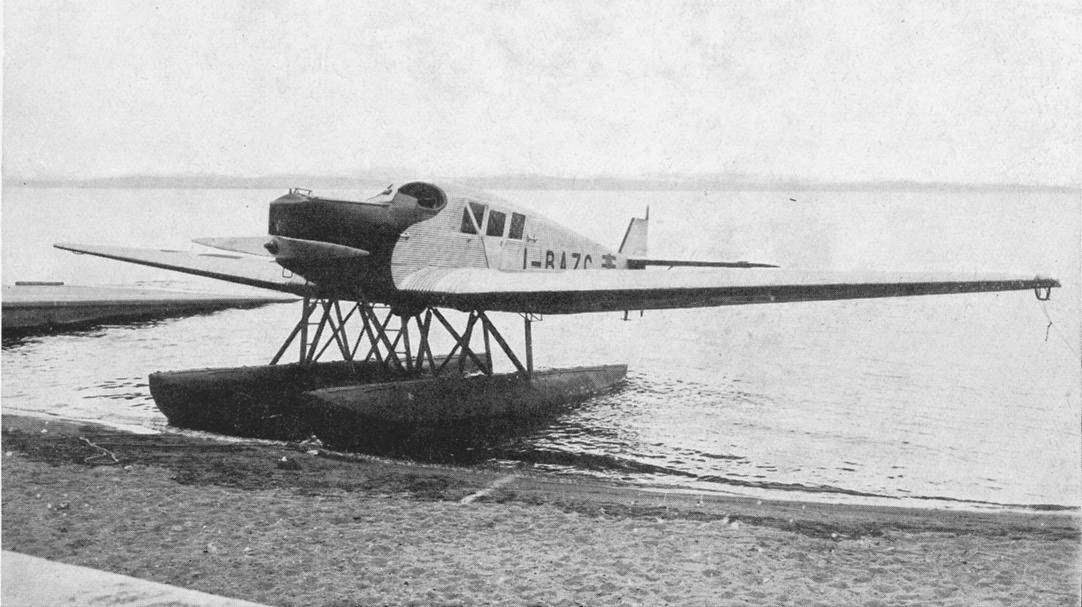
Giyȗ #7 Junkers F-13 Transport J-BAZG; loaned to the same airline as above.
Giyȗ #10 Ishikawajima R-3 Trainer J-BEPB; donated to Nihon Gakusei Kôkȗ Remmei (Japan Students Aviation League)
Giyȗ #11 Nakajima E4N1 Transport Floatplane J-BERG; loaned to airline Tôkyô Kôkȗ Yusô Sha (Tokyo Air Transport Company). See also here.
As the Association appears to have done little other than to pass on these aircraft (reportedly free of charge) as indicated, it would be interesting to know who set it up and what its purpose was. Also, whether it acquired any more aircraft than the 13 that I have managed to discover. Can anyone help here?
A photo that often appears cropped featuring the very first prototype of the Experimental 9-shi Single Seat Fighter or Ka-14 next to one of the eleven prototypes of the Type 93 Attack Bomber or Ka-4 or3MT5.
The first Ka-14 prototype was equipped with a "Kotobuki" Model 5 engine, flush riveting and inverted gull wings.
The 3MT5 was supposed to be carrier operated but by the time it was tested problems with the design and its slow development rendered it already obsolete. Only 11 were completed, and from the fifth prototype onward they had twin fins and rudders and additional struts.
Mark has made quite some progress. Below he is sharing some photos with us and explains the challenges he is facing.
This update is about the wing.
The first picture is the center section. I built in double spars on the bottom surface with some extra reinforcing where the center support struts will mount. There is an additional support on the top surface that fits between the two lower ones.
Second picture shows the same idea with the outer panels. A stub spar was made for the center section with the correct dihedral, with corresponding spars that will slot over it. You can also see the backing plate for the float mounts, and the tabs on the center section both top and bottom that will provide a gluing surface.
Third picture shows the fit of the outer wing panel when attached. The center slot had some 5 minute epoxy gooped in there, then slid over the spar and started gluing the surfaces. Because the ailerons were cut out, it made them very flexible, so I started at the leading edge and wrapped it back tight. By the time it’s all done, you can hold the wing by one wingtip- it’s way overbuilt, but it’s mostly done with scrap so that’s OK!
Last picture is another teaser to show size- the Sally fits under the wing, and the wingspan is about four Zeros. Next project is the struts- the four in the center will be first, then the rest will be built on the plane so the lengths are correct. Wish me luck!
By the time we were about to post the above update, Mark sent us more photos of the progress he's made.
The first picture shows the beginnings of the wing mounts. I used two sizes of tubing, taped to both ends of a board. I squished them one at a time in a vise, flipping and checking size so they came out the same oval shape. The ends were then simply crimped with pliers to flatten them so they’d fit through the slots in the fuselage.
Second picture is an older one, showing the support shelves I built into the midsection. I was able to reach through the cockpit opening and glob some epoxy on the shelf for the struts.
Third picture shows the struts installed and cleaned up. They should have fairings on them, but it’s clean now and I’d like to keep it that way!
Last picture shows the installed tail. Wing struts will be the same way, cut to the proper length then inserted into cut slots. Next step is installation of the glass in the fuselage, then I can work on joining the wing.
The 20shi "Sozan" (Blue Mountain), known to the Allies as "Rose", was to be a very...very beefed up "Renzan" version. The concept and the artwork is from THIS site which is the ultimate what-if destination for unusual, fantasy and incredibly interesting J. planes but also tanks and ships. Check HERE for more on the "Sozan".
Don't tell me you don't feel like building one. I know I do.
The artist (wish I knew his name to give full credit) mentions that his inspiration for the design came from the Corvette, below, in the manga "Nausicaä of the Valley of the Wind".
Apart from the Wiki entry,HERE, below is information we translated from FAOW.
Chief designer of the Nakajima G8N "Renzan" was Matsumura Kenichi who graduated from Tokyo University in 1932 and joined Nakajima in 1934. He designed the Nakajima LB-2 (note the wrong way his name is written in the Wiki entry) and later the Nakajima G5N "Shinzan", the Nakajima B6N "Tenzan"and was involved in the Nakajima G10N "Fugaku"design; in effect in all the Nakajima aircraft of the "mountain series". He also participated in the initial steps of the "Kikka" project.
From 1950 he worked in US bases in Japan remodelling American aircraft. He died in April 1951 in an accident. He was only 42 years old.
The order for the development of the "Renzan" was given during a critical war period for Japan, therefore, from the beginning, the time consuming process of building numerous prototypes and extensive testing was out of the question. The design was to be mass produced as soon as possible. With the above in mind not even one day was to be wasted and Matsumura put together a development plan along the following important points.
1. Reliable data was to be used for the engines and the overall construction of the aircraft.
2. Everything was to be researched and tested thoroughly before the beginning of the construction of the aircraft.
3. "Renzan" was to be built with the present, not the future, in mind. Meaning that currently available technology was to be incorporated without relying on future developments and improvements.
4. The designated weight should not be exceeded.
5. Special consideration should be taken to make the fuel tanks leak-proof.
6. Superchargers should be installed
7. Special attention should be payed to the defencive armament positions, predicting whatever imperfections and problems because in the past there were numerous problems with other aircraft designs.
8. The experience with other large aircraft should be put into use to design the fin and the tail surfaces but always keeping everything small. Also, various tail designs/configurations should not be tested but once a design is decided effort should be put only to improve it if necessary.
9. The aircraft should be built using immediately available material that will continue to be available when the design will be put into production.
In hindsight the above may sound very logical and natural but they reflect the problems the Japanese designers had with other aircraft which took too long to be designed and tested and when they were put into production they were soon obsolete.
Development progress until the completion of the first prototype
End of 1942
IJNAF unofficially ordered the N40 plan.
"N40" was the designation for the experimental design. Within Nakajima the aircraft was nicknamed "G8" (from the G8N1). The name "Renzan" was given around the middle of 1944, after the first prototype was completed and around the time the unofficial order for the pre-production aircraft was given.
March 5, 1943
N40 first research meeting
April 2
Discussion of the IJNAF specifications
May 12
Test of the wooden mock-up of the fore machine gun mount
May 30
Preliminary test of the wooden a/c mock-up
June 12-16
The IJNAF specifications were preliminary discussed between the eight departments responsible for the development of the project.
June 24-28
Second meeting with two of the above mentioned departments
July 29-30
First test of the wooden mock-up
August 14
General inspection of the development progress by the IJNAF
September 3-4
Second mock-up test
September 14
Received by the IJNAF the official order
September 30
Third mock-up test
December 15
Sixth mock-up test
April 29, 1944
Beginning of the construction of the first prototype
June 13
Material test
June 14-15
First structure test. A/c 50% complete
July 30
Second structure test. A/c 75% complete
September 5-6
Third structure test. A/c 90% complete
October 1
Test of completed aircraft
October 10
Taxing test
October 23
First flight. Small damage during landing
October 31
Meeting regarding the radioman's position
November 10
Fore armament research meeting
December 5
Fore armament wooden test
December 25
Nakajima acceptance ceremony
January 12,
1945
Aircraft delivered to the IJNAF. Eighth flight
As mentioned above On December 25, 1944 an acceptance ceremony was held in the Nakajima factory in Koizumi. The video below from UTube shows this ceremony.
The very first prototype after it was delivered to the IJNAF, flew to Oppama base, Yokosuka, where it was speed tested. Then from May 1945 it was tested in Misawa, Aomori prefecture.
The history of the four prototypes is as follows:
1st prototype
Finished: end
of Sept. 1944
1st fight:
Oct. 23, 1944
2nd prototype
Finished: Dec.
29, 1944
1st flight:
Apr. 12, 1945
3rd prototype
Finished: Mar.
26, 1945
1st flight:
June ?, 1945
4th prototype
Finished: June
?, 1945
The 3rd Prototype was burned and destroyed during an air raid in Koizumi. The 1st and the 2nd were in Misawa at war's end while the 4th was in Koizumi partially incomplete. Parts from the 1st and 2nd were used to complete it and was sent to the States for evaluation. The 1st and 2nd prototypes were then scrapped. In April 1945 there were heavy air raids everywhere in Japan and the "Renzan" design team evacuated to the Girl's Highschool in Kumagaya, Saitama prefecture. Various designs and documents were damaged while there and at the end of the war all blueprints and documents were burned in Nakajima.


 Giyȗ #9 (2) Nakajima E4N2 Fisheries Floatplane J-BABP; replaced J-BBYG. See here.


