Monday, 22 July 2013

Vintage magazine cover


Cover of the July 1930 issue of magazine "Koku Jidai"...83 years ago. Another brilliant artwork by artist Suzuki Gyosui (see previous posting here). 

The flying boat is a Dornier Do J Wal belonging to the Nippon Koku Yuso KK, with the registration J-BARH and named "Kamitaka". It was the first Wal built by Kawasaki with parts imported from Germany and various modifications including changing the engines from Rolls-Royce Eagle, 360hp, to Kawasaki-BMW-VI, 500hp, and making room for six passengers in the front part of the fuselage with windows and cargo in the rear. The cockpit on this plane was located behind the passenger cabin. It was completed in October 1930 and tests in Kobe were most sasatisfactory. It was placed in the Osaka-Fukuoka route. The illustration shows the plane before it's completion without the name "Kamitaka" written on the fuselage side in hiragana. 

Saturday, 20 July 2013

Manga - "The Sky Crawlers"


"The Sky Crawlers" is a Japanese anime movie based on the novel by writer MORI Hiroshi. The film was directed by Oshii Mamoru, creator of the famous and brilliant anime films Ghost in the Shell and its sequel Ghost in the Shell 2: Innocence.
The animation for the "The Sky Crawlers" was created by Production IG and the film was released in 2008 by Warner Japan.
A quite interesting cast lent their voices including Kikuchi Rinko, "Babel" & Guillermo del Toro's 2013 film "Pacific Rim" as well as Kuriyama Chiaki, famous for her role in "Kill Bill, Volume 1" (she was as Gogo Yubari, the bad-ass schoolgirl bodyguard of yakuza boss O-Ren Ishii (Lucy Liu).

Here's what our good friend Devlin Chouinard has to say about the movie:

The Sky Crawlers
Impressions and Observations

  Imagine that you are an adolescent, maybe 16 or 17 years old,  fuzzy memories of childhood that are not quite yours. You cannot age. You fly and fight for the company as well for country in set-piece battles, as if from some great chess game. This is your entire reason for living, and dying.......
  The Sky Crawlers is an interesting mix of characters, aircraft, setting and story. Some things seem distinctly modern, while others are a throwback to times long past, all woven together. This can be seen mostly in the aircraft featured in the film, but also in the settings and other details. Characters, too, follow this same path, however they seem more up-to-date than old fashioned. Much of this is blended together rather well and seems to work.
  The story starts in the middle, the viewer finding out the “how and why” as the movie progresses. Much of the main characters' back stories are supplied in this manner. Some aspects of the story seem to raise more questions than answers and this leaves the viewer to fill in the blanks. This and the fact that the viewer is “dropped” into the situation, with little explanation of events, can leave one a bit lost at first.
  While the CGI rendered flying is fast paced and exciting, the rest of the film is quite slow, but very well done. I think this almost forces you to be in the same situation as the young pilots, moments of fast paced action interspersed with long periods of boredom. “Boredom” may be the wrong word in a way because there are subtle movements, sounds, and visual textures that can be observed throughout.
  One of the best visual elements of this movie are, of course, the aircraft. They look as though they are advanced prop driven World War 2 designs but with a modern twist. In fact, many will know the influences once they see them on the screen. All are rendered in CGI form and blend well with the traditional cell type animation. The backgrounds are well done, looking much like England and Europe in the 1940s, however the control tower at the airfield has a very up to date looking array of antennas! The same situation holds true for many things throughout the film - look for the flat screen television in the cafe that the characters frequent, for example! A mash-up between old and new.
  Even more interesting subjects are brought up by the characters - who and what they are, and  the emotional turmoil that they go through. You also find out other surprising twists dealing with the characters toward the latter part of the movie. There are enough turns in the plot to keep you interested, even in the slower parts of the film. In many ways, you will never know the complete story behind the characters. That part is left up to the viewer to work out as noted above.
  So, we end up in a strange world where past, present, and near future exist together, and while a bit slow moving at times, seems to convey the feeling and mood of what being in that situation must be like - too much time to think punctuated by life or death struggles. I would say that The Sky Crawlers works on many levels, but is especially interesting for those of us who like historic aviation and flying. It may not be a movie for everyone, but I found it very enjoyable and intriguing.


Note: The above article expresses my impressions of the film, and it is somewhat vague intentionally. I did not want to give anything away, and this may be looked upon as my attempt to get you to see the movie, and thus form your own opinion. 

Here's the opening scene of the film with the amazing air combat sequence.


We feature this anime on our blog because the fighter aircraft "Sanka Mk.B" is largely based on the Kyushu J7W Shinden as you can see from the blueprint below.


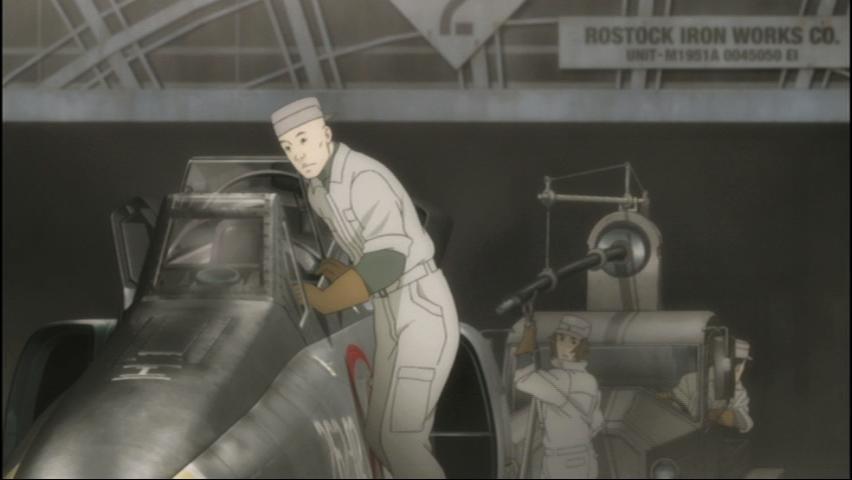
Some stills from the movie showing the beautiful artwork and various details of the aircraft. Note the contra-rotating prop, the position of the cannons and...the starter truck.


BANDAI has released a kit of the "Sanka Mk. B" in 1:72 but unfortunately it's not that easy to find.

A highly recommended film, especially for the aircraft scenes, that we are pretty sure will fill your head with modeling ideas of exotic and what-if planes.

Thursday, 18 July 2013

Mitsubishi "Tobi" Experimental Reconnaissance a/c

Since we posted the photo of the IJNAF 2MR2 yesterday and you liked it so much, here's a photo of an experimental IJAAf aircraft.
In 1926 the IJAAF wanted to replace the older Otsu 1 (Salmson 2A2) reconnaissance aircraft and asked four companies, Ishikawajima, Kawasaki, Mitsubishi and Nakajima to submit their proposed designs and prototypes for competitive trials.
Mitsubishi's design team included Nakata Nobushiro as chief designer with Tokunaga Satsuo assisted by Dr Alexander Baumann, a Stuttgart University professor. The result was a very unusual aircraft with the top wing very higher than the lower to improve visibility. To reduce drug the number of struts was significantly reduced and to improve communication between the crew the observer's seat was placed right behind the pilot's. It had the possibility to change the wheels to floats.
In July 1927 the first prototype was delivered and during trials reached a speed of 227km/h at 5,000m, faster than the Army requirements, with Mitsubishi test pilot Ito Jiro.
Nevertheless during the Army competitive tests, there was problem with the shock absorber of the landing gear, one of the wheels fell off and during landing the a/c was damaged.
Total number of aircraft completed was two and received the company designation 2MR1 and the name "Tobi" meaning kite.


DATA
Engine: 450-600hp Mitsubishi Hispano-suiza 12-cylinder V water-cooled, Mitsubishi-Reed fixed-pitch two-bladed metal prop.
Dimensions - Span: 17.40m, Length: 9.55m, Height: 4.35, Wing area: 50sqm, Empty weight: 1,350kg, Fully loaded: 2,500kg, Wing loading: 50kg/sqm
Performance - Max speed: 227km/h at 5,000m, Service ceiling: 8,280m, Endurance: 6hours
Armament: Two forward-firing fixed 7.7mm machine guns and twin flexible 7.7mm in dorsal position.  
Crew: 2    

Tuesday, 16 July 2013

Mitsubishi 2MR4

Only a vintage photo today of a Type 10 Carrier Reconnaissance aircraft or Mitsubishi 2MR4 belonging to the Yokosuka Kokutai. I can make out a Yokosho K2Y trainer on the right with "ヨ-415" (YO-415) in the background on the right but not sure about the other type on the left.
Wikipedia has a nice short article about the 2MR, HERE.

Monday, 15 July 2013

Border incident

Captain Ishiki Akira was a member of the weather department in the headquarters of the 2nd Air Army in Manchukuo. One day in February 1942, the Special Operations Office of the Army called capt Ishiki, pilots and observers to participate on a very special training flight. The mission called for two Type 100 Command Reconnaissance or Mitsubishi Ki-46 "Dinah" to fly over Vladivostok and Lake Khanka and take photos of the enemy positions and seaside roads. The two aircraft were to have their hinomaru and every other identification marking removed as well as all armament and unecessary equipment. The crew were to have their rank insignia also removed and to be extra careful under no circumstances to make an emergency landing inside Russian territory. If they were spotted by enemy fighters they should escape with maximum speed and if they were shot they should try to fall in the Sea of Japan. Capt Ishiki was quite surprised since this was his first such mission but asking around found out that such flights were done 2-3 times a year. His job as a meteorologist was to let the pilots know of a day with nice weather suitable for the flight. The altitude was to be between 9,000-10,000 meters to avoid the aircraft being detected. But photography from this high altitude required perfectly clear skies from any clouds that would obstruct the view. Another consideration was the fires set by farmers that created huge billows of smoke, therefore the flight was to take place before noon. Special German Zeiss cameras were carried by the planes and the intelligence department took extra care to receive the weather forecast from the Russian side, which was easy to decipher.
Capt Ishiki left the headquarters in Changchun for Dunhua, the base of the aircraft, and stayed there for a week until the weather was finally perfect for the mission. During that time the planes and their crew were on stand-by and when Ishiki gave the go ahead they rushed to their mission. The Soviet border was too close from Dunhua so "Dinah" number #1 had to fly back to Changchun to reach the altitude of 9,000meters. "Dinah" number #2 tried to cross the border from lake Khanka but when both aircraft were near the border they noticed that they were leaving massive contrails behind them that could be spotted from the ground. So "Dinah" #2 abandoned the effort while #1 continued hopping that the contrails would not be noticed.
Near  Vladivostok "Dinah" #1 started taking photos of the enemy lines when pilot captain Sato ordered his observer to put on his oxygen mask. "Why? What happened? Are we to fly higher?" asked the observer. "Look down" replied Sato and two Soviet I-16 were fast climbing to intercept them. The Japanese crew had two options, either to escape back to Manchukuo or towards the Sea of Japan. They chose the second and just when the I-16 were about 300meters behind them, they broke the engagement leaving "Dinah" alone to make a big semicircle and re-enter Japanese air space in Chongjin in (North) Korea. Flying at an altitude of 3,000meters the plane was quickly spotted by the ground forces setting off the alarm about an aircraft without any markings but only briefly.
Later it was discovered that it was air defence day in Vladivostok and perhaps the Soviet aircraft didn't carry ammunition. Russian diplomatic protests were expected for this border incident but none was placed perhaps because Soviet aircraft also regularly performed similar missions especially over Dalian.

Source: "Maru" November 1976, issue #363

Saturday, 13 July 2013

Japanese X-plane Library #4


Title: "Rikukaigun Shisaku Sentoki" (Army/Navy Experimental Fighters)
Author: Komine Bunzo, Kunimoto Yasufumi, Tanaka Kazuo, Ibukuro Toyohiko
Published by: Gakken 2001 p/b, out-of-print
Pages: 182, Size: 18X26cm, Photos: 132 of which 26 in colour, CG Illustrations: 24 in colour.

An excellent publication by Gakken with plenty of very realistic and inspiring CG illustrations by Hosaka Muneo and a good collection of high quality photos of four types: Mitsubishi "Reppu, Kyushu J7W1 "Shinden", Mitsubishi Ki-83 & Tachikawa Ki-94. Includes manual drawings of the four as well as super detailed "Shiden" interior illustration fold-out and multi-view drawings of all four  aircraft in 1/100.  

The book is all in Japanese and highly recommended to all Japanese X-plane fans.
A small number is now available through our on-line shop for $US30. Send us an email if interested.

Thursday, 11 July 2013

Kawanishi H8K "Emily" Type 2 Flying Boat


A Type 2 Flying Boat or Kawanishi H8K "Emily" is featured in this NARA photo. According to the caption dated 2, July 1944:
"Japanese "Emily" shot down by a PB4Y piloted by Lt. Stoughton Atwood of VB-115 somewhere in the Central Pacific."
It is a late Model 12 equipped with Type 3 Ku Mk.6 ASV radar as can be attested by the antennae on the nose. The radar was the first IJNAF type for large aircraft and could detect a ship from a height of 4,000m at a distance of 280km. Note that the fuselage side blister has been replaced by a window.

The particular flying boat belonged to the 851 Kokutai. Originally called "Toko Kokutai" from the Japanese reading of the Chinese name of it's base, Donggang in Taiwan, the unit changed it's designation to 851Ku on November 1, 1942 and was equipped with 16 Type 97 Flying Boats or Kawanishi H6K "Mavis". Initially deployed in Rabaul from where they night bombed the US base in the Espiritu Santo Island, the unit moved to the Shortland_Islands in the beginning of 1943. Returned to its home base in Taiwan to recuperate and then deployed to Surabaya in Jawa in April 1943 and stayed in the area until February 1944. During that time the unit performed patrol missions in the Indian Ocean and bombed targets in West Australia. By March 1943 the unit had changed all its flying boats to Kawanishi H8K "Emily".
On March 31, 1944 the most famous tragic event involving flying boats of the unit took place. Two "Emilies" were to transport Admiral Koga Mineichi who had succeeded Yamamoto Isoroku as Commander in Chief of the Combined Fleet, from Palau to Davao but they encountered a typhoon and the admiral's "Emily" was lost.
The unit eventually moved the Davao and on July 1944 to Singapore where it was dissolved with members and material distributed to the 801Ku and other units.
851Ku had the letter O for its marking from November 1942~1943 and then the numbers 51 or 851 from end of 1943~1944.

Tuesday, 9 July 2013

Gasuden Koken-ki #7

The last posting in this series is about the brilliant Koken-ki replica in the MISAWA AVIATION & SCIENCE MUSEUM, AOMORI.
The project started in 1998, five years before the museum opened. The main parties involved were glider company Maeda Koken in the technical details, the "Sanai Senpaku Sekkei" ship design and building company who were mostly responsible with the building of the project with Mizushima Eiji overall project manager and head of Model Art Ida Hiroshi.

The engine on display is the original 700-715hp Kawasaki 12-cylinder V water-cooled installed on the aircraft. 

And before closing one small addition regarding the black and white markings on the fuselage and wings of the plane. These were applied in order to help in the calculation of the take-off and landing speed, distance, angle etc. In September 1937 six of them were applied on both sides of the fuselage front, middle and rear. During the May 1938 record flight the plane had only two on the middle and rear of the fuselage starboard side. The plane carried black/white markings on the wing edges from the beginning until July 1938 when all of them were removed for unknown reasons.   

Sunday, 7 July 2013

Gasuden Koken-ki #6

Japanese modeller "Avion Road" sent us photos of his very nice Koken-ki model.


The model is in 1:72 and the kit is the resin released in the '90s by "Mechadoll". Not easy to find any more.

The only other more accessible kit was released by PLATZ a few years ago. But the price 14,000Yen ($US155) is certainly a bit steep.

Saturday, 6 July 2013

Gasuden Koken-ki #5

BIBLIOGRAPHY 

Title: "Koken-ki" -  (Koken long range mono-plane)
Author: Tomizuka KiyoshiPublished by: Miki Press pbs, 1996 h/b
Pages: 212, Size: 21X14.5cm, Photos: 61 b/w, Illustrations: 6
Price: 2000 Yen, IN PRINT


Title: "Shashinshu Koken-ki" -  Long range flight test plane
Author: Various
Published by: Seirinsha pbs, 2003 p/b
Pages: 163, Size: 21X30cm,
Price: 3150 Yen Out-of-print