Wednesday, 17 September 2014

Nakajima Ki-44 "Shoki" by Andrey Temnyy

An excellent Nakajima Ki-44-II Hei "Shoki" today by Andrey Temnyy. 70th Sentai, 3rd Chutai, flown by Makoto Ogawa from Kashiwa, June 1945. Scale is 1/72, kit by Sword. Andrey was not particularly impressed with the kit experiencing fitting problems and he suspects there might be some inaccuracies with the fuselage size but it's the best kit around at the time. He finished the model before Sword released their photo-etched set. Enjoy!


Monday, 15 September 2014

Gliders - Ito A-1 Primary & "Dai 1kai Zen Nihon Guraida Taikai"

Today we would like to share with you a number of very interesting glider photos and material but we would also like to show you the tedious and time consuming process necessary to gather all this information and material.
Everything begun about two weeks ago when our good friend Jacob Terlouw sent us the photo below (with permission to feature it on this blog) asking for further information.

Immediately we consulted the best post-War source for Japanese gliders, the Model Art publication "NIHON NO GURAIDA 1930-1945" (The gliders of Japan 1930-1945) by Kawakami Hiroyuki.

Unfortunately we couldn't spot any photo or illustration that would have a glider like the one in Jacob's photo therefore we turned to the best two vintage glider publications. First "Kakuki 1890-1941" (Gliders 1890-1941) by Asahi Shimbun in August 1941. 
We found that the glider in Jacob's photo, registered B-202 and the one behind it, B-203, were in the truly amazing photos taken during the "Dai 1kai Zen Nihon Guraida Taikai" (1st All Japan Glider Competition) held in mount Kirigamine, Nagano prefecture. 
 
But nothing else is mentioned. The second vintage book "Kaku Nihon Rekishi Shashin-shu" (Glider  Japan Historical Album) by Koku Jidai-sha, published in August 1943, had some more photos of the event but of poor quality.

According to the accompanying text the event took place for three day starting on September 2, 1936 and was sponsored by Asahi Shimbun. 75 were the competitors in the primary glider class, 22 in the secondary glider class and five in the soarer.  
Before the beginning of the competition a referee is explaining to the competitors some of the things they should be careful about.
 Some of the spectators that gathered to watch the competition.

Members of the competition committee and a journalist. From right: captain Fujita Yuzo, major Suzuki Masahiro and Watanabe Kazuhide. 
 
Going back to the "Nihon no guraida" book the event is mentioned but the only additional information is that the event was supported by the Ministry of Communication, the Army headquarters and Imperial Aviation Society. 20 primary gliders, six secondary and six soarers were flown by no less than 42 glider groups. Much to our frustration the glider types were not mentioned in any publication, therefore we couldn't identify the glider in Jacob's photo.
While going through a vintage magazine, "Hiko" (Flight) April 1939 issue,  for our current publication project (secret!), we encountered two photos of the same glider type.
 
According to the captions: "First time in Japan gliders on ice! The Kamisuwa Glider Research Group is training on the frozen lake Suwa." In a small article featured in the same issue it is explained that the Kamisuwa Glider Research Group borrowed from the Nagano headquarters of the Aviation Society one Type Ito Primary with the registration B-203. Thus we found the type of the glider. Going back to "Nihon no Guraida" we found that the type was named Type Ito A-1 Primary and was based on the Schneider Grunau 9 glider. Wing span: 10.3m, length: 5.54m, weight: 90kg. The glider was built by Ito Hikoki Seisakujo (Ito Aircraft Factory).
Unfortunately we were not able to find out who exactly the officer in Jacob's photo was but most probably he is a Marine.
We hope our readers will acknowledge and appreciate the fact that our blog is the only one among the well-known blogs and message boards that touches on the highly overlooked subject of the Japanese gliders.

Sunday, 14 September 2014

Mitsubishi J2M3 "Raiden" (Jack) by Bernhard Tomaschitz - WIP#5

The fifth part of building SWS J2M3 Raiden.
This contains all missing steps according to the manual. Except complete assembly.
The a/c is painted and got decals. Weathering is not finished. External parts are all done and completed and painted. Not all parts are yet assembled.
The decision for the a/c was easy done, since the a/c with the lightning looks great. Question decal or painting? I started with cutting the decals and reproducing them for masking from masking sheet from Tamiya. It worked out good. So I decided to spray the lightning. To spray the hinomarus, I tried to avoid the task of masking the white outline. The error which may ruin the model is an eccentric hinomarus, which happened to me at a Ki-43. The decals have a very thick film. Therefore I removed the film of the decals for the hinomarus. The setting of the decals without film is very poor. Here Zoukei Mura could improve drastically on the quality of decals.
What did I find to improve?
• The aerial. Where does the wire start at the fin? Where does it end? What about the wire which leads to the radio compartment?
• The lighting of the cockpit does not exist. Like in most kits of a/c. The pilot who is flying an a/c needs to see the instruments. To read it. Lighting is necessary in every cockpit. Like Oxygen.
• Oxygen equipment is not here, but just the bottles.
• What can I learn out of it? The guys from Zoukei Mura should learn to operate an aircraft, so they can find out by themselves, that the wonderful kit represents now just the grounded a/c in the museum. There are some gaps to the real a/c. Some details like this mentioned are missing.
• How about mirror equipment in the hood? I do not know it. Does anybody know something about it?
• The installation of the external fuel tank I do not understand. Since manuals and drawings show a different mounting. Does anybody know more about it in detail?
The last part will show the assembling and the weathering.


Friday, 12 September 2014

Nakajima Ki-84 "Hayate" 104th Sentai by Jean Barby

Here is my latest built, Hasegawa 1/48th with the FM cockpit, Ultracast seat and CMK armament set. The flaps were put back in the closed position as normal on the ground and the whole model was riveted. The chipping effect is due to the hairspray technique and worked just fine! This Ki-84 is a 1945 series and she wears the same colour close to olive drab colour in the cockpit, on the prop/spinner and on the upper surfaces. Decals are from Lifelike n°1 set on the "Hayate"!
Jean Barby
 
An exquisite model as I'm sure you will agree with excellent weathering. Merci Jean!


Tuesday, 9 September 2014

Aichi E8A1

A few weeks ago I purchased a postcard with two photos. One had Hokoku#68 but the other featured a much more interesting aircraft; the only known photo of the Experimental 8-shi Reconnaissance Seaplane or Aichi E8A1.
 
Our good friend Zygmunt  Szeremeta kindly created artwork exclusively for our blog based on the above photo.
 
Two years after the acceptance by the IJNAF of the E4N2 (here) which was based on the Vought O2U-1 Corsair, a replacement reconnaissance seaplane was sought. Back at that time it was common for the Army and Navy to simply submit required specifications and the various companies to build prototypes which were then tested and compared between them in order to find the best design. Naturally this meant a substantial wasted effort for the losing entries but the competition guaranteed high standards and quality that ultimately led to the advancement of Japanese Aviation industry.
For the E4N2 replacement, the competition included three companies: Nakajima, Aichi and Kawanishi and the requirements included to be able to be catapult launched and to have manoeuvrability equal to a fighter, the latter being particularly demanding for a seaplane.
Aichi's entry was designed by Matsuo Yoshihiro, was based again on the Corsair and was basically an improved E4N2. The Nakajima and Aichi test aircraft were very similar in performance except for manoeuvrability and stability. On those two the Nakajima design was superior and therefore it was eventually accepted by the IJNAF becoming the well-known Nakajima E8N1 "Dave".
The Kawanishi entry was the most interesting but ill-fated E8K1.
Nothing else is known about the Aichi E8A1 but Choroszy Modelbud has released a resin kit in 1:72.  

Sunday, 7 September 2014

Mitsubishi J2M3 "Raiden" (Jack) by Bernhard Tomaschitz - WIP#4

The forth part of building SWS J2M3 "Raiden" with steps 3.3 A to 3.3 H, 3.4 A to 3.4 G and 3.6 A to 3.6 D regarding the wing construction.
I concentrated in the possibility to assemble the replacement landing gear from the extra parts when the wing is finished together with photo etched parts in the wheel well.
Also, the guns from the special parts. As you can see in the photos, the outer gun barrel causes trouble. Part # 2 is wrong in shape but correct in length, part # 3 correct in shape but wrong in length. The kit parts are all perfect.
The landing flaps. The underwing is made from etched parts. First I checked the geometry of the etched parts and I found it correct. The alignment needs some grinding on the kit parts. The bonus is, when the a/c is assembled, lots of stiffness in the fuselage rear wing junction.
Troubles occurred when I put the cowling parts in place. A gap on left side of the rear cowling toward the fairing showed up. This gap is probably the result of an error which happened to me. I suppose the reason is because I assembled just one half of the fuselage to the wing, following the manual 3.4 A. Here is a chance to glue the fuselage not in the correct angle to the wing. Another result is, that the fin is inclined to the symmetry of the wings.
Everything else, the assembly of the kit and photo-etched parts is straightforward. Just the problem with the special gun part as mentioned in the beginning.


Friday, 5 September 2014

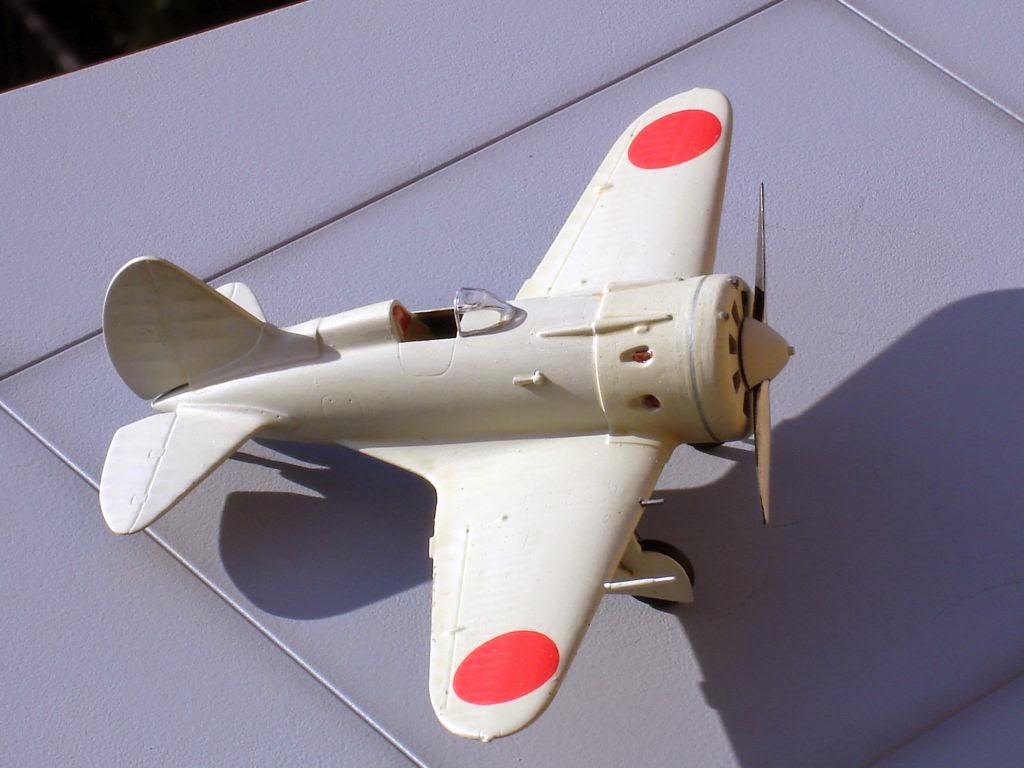
Japanese Polikarpov I-16 by Stefan Müller

Our friend Stefan Müller shared with us photos of his Japanese-captured Polikarpov I-16 in 1:72.
Kit: Hasegawa, decals: Kora, paints: Agama.


And below is a photo of a I-16 captured and displayed by the Japanese. It still carries the Nationalist China markings. Because of its small wings, dumpy fuselage and the odd sound of its Shvetsov M-25 engine (based on the Wright R-1820 Cylone), the type was nicknamed "abu" (horsefly) by the Japanese ground units in the Nomonhan area.