Saturday, 1 November 2014

Nakajima G8N "Renzan" (Rita) #3 - Extra info & Video

Apart from the Wiki entry, HERE, below is information we translated from FAOW.
Chief designer of the Nakajima G8N "Renzan" was Matsumura Kenichi who graduated from Tokyo University in 1932 and joined Nakajima in 1934. He designed the Nakajima LB-2 (note the wrong way his name is written in the Wiki entry) and later the Nakajima G5N "Shinzan", the Nakajima B6N "Tenzan" and was involved in the Nakajima G10N "Fugaku" design; in effect in all the Nakajima aircraft of the "mountain series". He also participated in the initial steps of the "Kikka" project.
From 1950 he worked in US bases in Japan remodelling American aircraft. He died in April 1951 in an accident. He was only 42 years old.    
 
The order for the development of the "Renzan" was given during a critical war period for Japan, therefore, from the beginning, the time consuming process of building numerous prototypes and extensive testing was out of the question. The design was to be mass produced as soon as possible. With the above in mind not even one day was to be wasted and Matsumura put together a development plan along the following important points. 
 
1. Reliable data was to be used for the engines and the overall construction of the aircraft.
2. Everything was to be researched and tested thoroughly before the beginning of the construction of the aircraft.
3. "Renzan" was to be built with the present, not the future, in mind. Meaning that currently available technology was to be incorporated without relying on future developments and improvements.
4. The designated weight should not be exceeded.
5. Special consideration should be taken to make the fuel tanks leak-proof.
6. Superchargers should be installed
7. Special attention should be payed to the defencive armament positions, predicting whatever imperfections and problems because in the past there were numerous problems with other aircraft designs.
8. The experience with other large aircraft should be put into use to design the fin and the tail surfaces but always keeping everything small. Also, various tail designs/configurations should not be tested but once a design is decided effort should be put only to improve it if necessary.
9. The aircraft should be built using immediately available material that will continue to be available when the design will be put into production. 
 
In hindsight the above may sound very logical and natural but they reflect the problems the Japanese designers had with other aircraft which took too long to be designed and tested and when they were put into production they were soon obsolete.
 
Development progress until the completion of the first prototype
   
End of 1942
IJNAF unofficially ordered the N40 plan.
"N40" was the designation for the experimental design. Within Nakajima the aircraft was nicknamed "G8" (from the G8N1). The name "Renzan" was given around the middle of 1944, after the first prototype was completed and around the time the unofficial order for the pre-production aircraft was given. 
March 5, 1943
N40 first research meeting 
April 2
Discussion of the IJNAF specifications 
May 12
Test of the wooden mock-up of the fore machine gun mount
May 30
Preliminary test of the wooden a/c mock-up 
June 12-16
The IJNAF specifications were preliminary discussed between the eight departments responsible for the development of the project.
June 24-28
Second meeting with two of the above mentioned departments 
July 29-30
First test of the wooden mock-up 
August 14
General inspection of the development progress by the IJNAF 
September 3-4
Second mock-up test 
September 14
Received by the IJNAF the official order 
September 30
Third mock-up test 
December 15
Sixth mock-up test 
April 29, 1944
Beginning of the construction of the first prototype 
June 13
Material test 
June 14-15
First structure test. A/c 50% complete 
July 30
Second structure test. A/c 75% complete 
September 5-6
Third structure test. A/c 90% complete 
October 1
Test of completed aircraft 
October 10
Taxing test 
October 23
First flight. Small damage during landing 
October 31
Meeting regarding the radioman's position 
November 10
Fore armament research meeting 
December 5
Fore armament wooden test 
December 25
Nakajima acceptance ceremony 
January 12, 1945
Aircraft delivered to the IJNAF. Eighth flight  
As mentioned above On December 25, 1944 an acceptance ceremony was held in the Nakajima factory in Koizumi. The video below from UTube shows this ceremony.
 
 
The very first prototype after it was delivered to the IJNAF, flew to Oppama base, Yokosuka, where it was speed tested. Then from May 1945 it was tested in Misawa, Aomori prefecture.
The history of the four prototypes is as follows:
 
1st prototype
Finished: end of Sept. 1944
1st fight: Oct. 23, 1944
2nd prototype
Finished: Dec. 29, 1944
1st flight: Apr. 12, 1945
3rd prototype
Finished: Mar. 26, 1945
1st flight: June ?, 1945
4th prototype
Finished: June ?, 1945
 
 
The 3rd Prototype was burned and destroyed during an air raid in Koizumi. The 1st and the 2nd were in Misawa at war's end while the 4th was in Koizumi partially incomplete. Parts from the 1st and 2nd were used to complete it and was sent to the States for evaluation. The 1st and 2nd prototypes were then scrapped. In April 1945 there were heavy air raids everywhere in Japan and the "Renzan" design team evacuated to the Girl's Highschool in Kumagaya, Saitama prefecture. Various designs and documents were damaged while there and at the end of the war all blueprints and documents were burned in Nakajima.  

Friday, 31 October 2014

Nakajima G8N "Renzan" (Rita) #2 - Photos

Prototype Number 4 found at the Nakajima plant in Koizumi, Gunma prefecture. This was the one that was brought back to the USA for testing. All photos from NARA.
Three photos of Prototype Number 2 found in Misawa base, Aomori Prefecture. It suffered serious damage on the fuselage, as can be seen in the photos, when it was strafed during an air raid. 

Thursday, 30 October 2014

Nakajima G8N "Renzan" (Rita) #1 - Bibliography

The Japanese bibliography of the Type 18 land-based attack aircraft or Nakajima G8N "Renzan" (Rita) is really sparse.
 
There is the old Blue FAOW #90 published in October 1977 by Bunrin-do on the "Renzan" and the Nakajima G5N "Shinzan". 
 
Which was reprinted a few years later in November 1984 with a different cover as No. 146.
 
The only other publication worth mentioning is issue 680, September 2000, of the magazine "Aireview" which includes multi-view detailed drawings of the aircraft in 1/72, with English captions, by long-missed artist Matsuba Minoru. Most helpful to modelers. 
 
Very small numbers of the above out-of-print publications are available through our site.
Email us for availability and prices. 

Tuesday, 28 October 2014

IPMS-​Hellas 33rd C&E 2014

Celebrating the "Ohi day" we feature today photos of the Japanese aircraft models in 1/48 that participated in the "33rd C&E" of IPMS-Hellas that took place October 2-5. All photos by Panagiotis Koubetsos. Efharisto poli Pano and special greetings to President Megas Tsonos (if you don't know who he is, check HERE for a small sample of his art). Many many more photos from the exhibition, HERE.

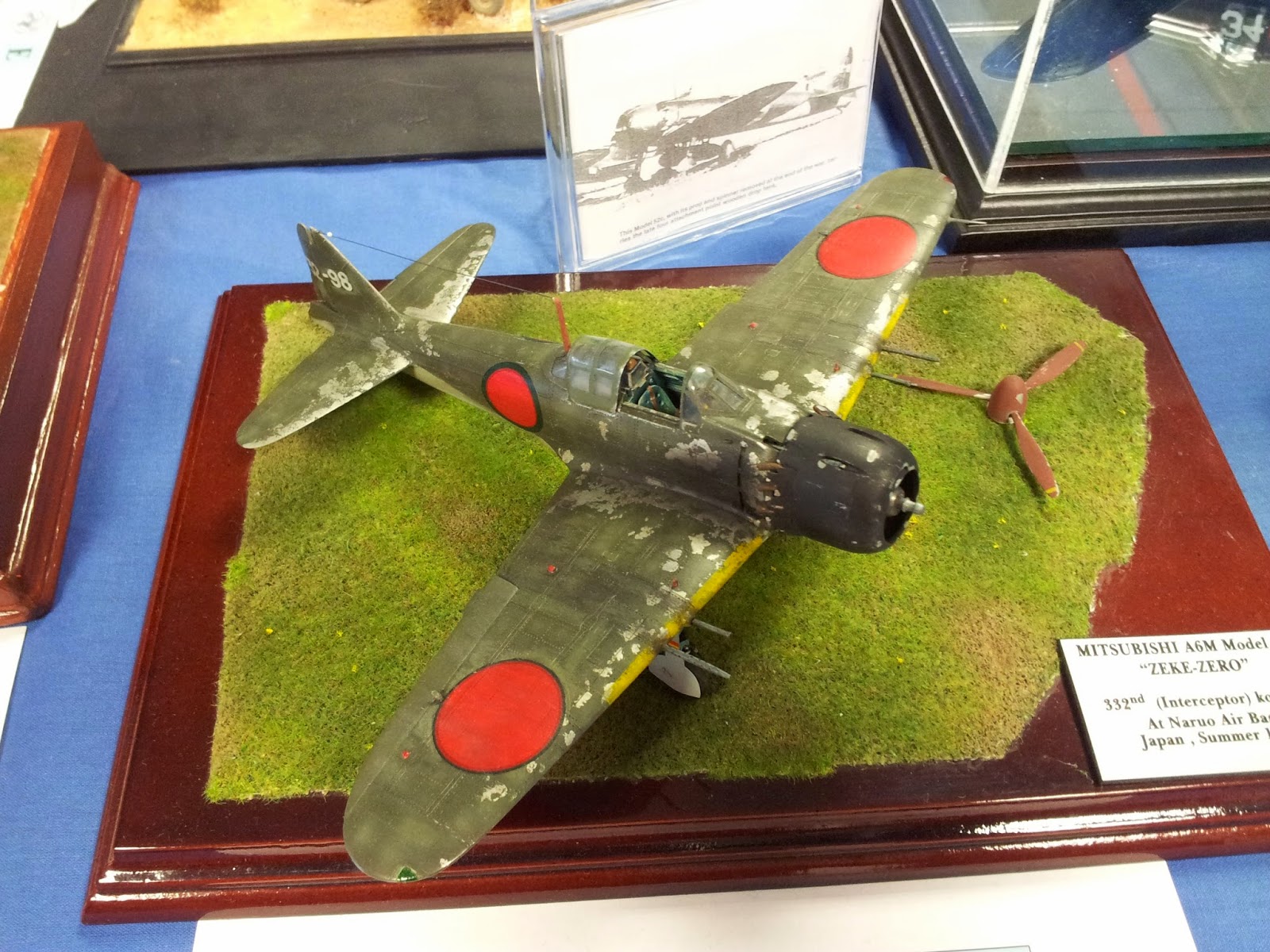
This quite weathered Zero was built by Dimitris Palasis and received a commendation.
 
Another Zero but the name of the modeller is currently unknown.

The Nakajima "Gekko" was built by Yorgos Yanopoulos.

The Mitsubishi "Sonia" below was built by Alexandros Agelopoulos and won silver medal.

Saturday, 25 October 2014

Captured "Betty" by Vance Gilbert

The Mitsubishi G4M "Betty" is 43” wingspan, swinging 7.75 inch propellers. It is all balsa and tissue. The plastic canopy and fuselage nose, tail, and bulges were vacuuformed in my kitchen out of light and thin clear plastic sheet acetate, the window framing done with 1/16th inch tissue strips backed with a plastic/Elmer’s type glue called Sobol. Known to many in the Radio control world as RC 56.  The empty weight of the aircraft is 85 grams - it was a real exercise in keeping things light. Best flight of it’s career is 75 seconds.
It is currently in need of repair after 3 successful seasons. I broke the wing taking it out of the car about 2 years ago. She’ll be back in action next year, with any luck.
Vance Gilbert - Massachusetts, USA
 
 
And here are two brilliant videos with Betty gracefully and beautifully taking to the air at the 2009 Flying Aces Nats, Geneseo, NY in 2010! Thank you so much Vance for sharing your Betty with our blog. Wish we had more Japanese planes like yours featured here.


Thursday, 23 October 2014

Gliders - Kyu-Te Model 5 Secondary Glider "Aso-go"

The Kyu-Te Model 5 Secondary Glider "Aso-go" was designed and built by the shipbuilding faculty of the University of Kyushu; called at the time "Kyushu Teikoku Daigaku" (Imperial Kyushu University) and therefore the "Kyu-Te" part of the name. The only example of the type, with the civilian designation J-BCYH,  started to be built in early June 1933 and was completed in the middle of August of the same year. 
 
The first flight was on August 27 near Mount Aso, Kumamoto prefecture (don't forget to take a look at the Wiki link) from where the glider took its name. In the cockpit was the famous Japanese glider pilot Shizuru Tadao and the 20 minute flight established an unofficial national endurance record.
 
"Aso-go" next to another Kyu-Te glider, Model 3 Secondary Glider "Jumonji-go" J-BCAH 
 
 After the first flight pilot Shizuru is standing in front of "Aso-go".
 
On August 2, 1934 Count Fushimi Hirohide visited Kyushu University for a close inspection of the glider. In the photo below starting from the right is Count Fushimi's aide-de-camp, professor Shogenji principal of the engineering department of the university, professor Hashimoto, Count Fushimi and associate professor Sato Hiroshi main designer and responsible for the Kyu-Te Model 5 glider programme.
 
 
On September 11, 1934 at 12:37, again with Shizuru Tadao in the cockpit, "Aso-go" took off again and soared for 1 hour, 26 minutes and 10 seconds, covering a distance of about 50km and reaching a height of about 830m. It was the first time the 1 hour record for a secondary glider was broken in Japan.  


The map below shows the record flight.
 
The area where Shizuru landed is called Kuju highlands and there is a monument commemorating the flight. The area is still used for gliding by Japan's Student's Aviation League. (photo from here)

Tuesday, 21 October 2014

Kawanishi H6K "Mavis" by Mark Jahsan WIP#3

As I said in a previous post, people build for different reasons. When there’s debate about different styles, it’s usually derogatory, with “rivet counters” on one side, and whatever the other guys are called on the other. Too bad, I think that’s the wrong attitude- I think we should be able to appreciate all kinds of styles.
  The builds going on here are two good examples of differing styles. Panagiotis is a freak, and I mean that in a good way! He’s what I would call a Technician, and having followed several of his builds, it’s easy to see he’s developed a style and a method that works for him to produce an incredible amount of detail- he’ll have something that’s totally unique, and totally his own.
  I consider myself more of a Craftsman. I get my enjoyment working with difficult kits and figuring out solutions. I’ve also figured out a system that works for me, and in the end gives me something totally unique and totally my own- I’ve never seen a 1/48 Mavis, either in person or online!
  Today’s update is a good example of figuring out a solution, how to attach the tail. The vacuform kit is a smooth fuselage, with no indication of where the tail mounts- locating pins? What are those???
As you can see in the picture, first step was to saw off the top of the tail. The tail feathers are all flat pieces, with faint scribing for the moving surfaces. All those were cut out and built up, with beveled edges so they slot together cleanly when reassembled. The half circle cutouts on the tail are for clearance for the sprue spars.
  Same procedure for the vertical surfaces. Slots were cut in the top of the horizontal stabs, then triangles of scrap were glued in through them to the bottom surface. The fins were filled with Milliput and squished over the triangles and glued down.
The second picture shows it just set into place. The fit is as good as you make it, and I take pride in doing what few others attempt.
When I’m not working on the big pieces, I like to set them up, keeps me motivated to keep going!

WIP#1, WIP#2

I absolutely agree with you Mark. Personally I find all the models on this blog (except mine) at least inspirational and a challenge for every one of us to do better. Even though they are certainly intimidating, I've never considered Panagiotis's models to be the "ultimate" on any subject and certainly not prohibitive for someone else to try. On the contrary I think they offer plenty of ideas as to what is possible just as your excellent Mavis does. So do keep up the good work! 

Sunday, 19 October 2014

A6M7 "Zero" - San Diego Air and Space Museum

Our good friend Devlin Chouinard visited San Diego, California last week and sent us the following report and photos.
  
The San Diego Air and Space Museum houses some unique and rare aircraft, and that description fits the A6M7 hanging for the ceiling. On loan from the National Air and Space Museum, it was restored by SDASM volunteers and put on display in 1984. It is also mentioned that the aircraft served with the Yokosuka Naval Air Group. (Tail marking “yo”-143)
 The restoration looks reasonably good although it's hard to say how much of the plane is original. The underside of the tail looks rather rough, so this might indicate original aluminum skin. As it is displayed overhead, it's hard to get an idea of the upper surfaces, especially the wings. Maybe one day I can persuade the museum staff to let me have access to a stepladder?
I leave color accuracy to others, being indoors under artificial light makes this impossible to determine. However under the current lighting conditions, it looks the part.
 If you happen to find yourself in San Diego, California, pay a visit to the SDASM. They have plenty to look at, including a nice selection of Japanese aircraft models and relics, both will be featured later.
-Devlin Chouinard

On to the photos.....  


Friday, 17 October 2014