Sunday, 10 February 2013

VIPs

A photo from the July 20, 1927 issue of "Asahi Graph".
According to the original caption in English:
"H.I.H. Prince Takamatsu, brother of H.M. the Emperor, is seen in a Navy Avro plane in which His Highness has made first flight at the Kasumigawra Naval Aerodrome on July 5. After which he went through the whole course of flying art during his stay there for a week."

The aircraft is an Avro A.V. Roe 504 K trainer. The first sample was brought to Japan by the British Aviation Mission in 1921 led by Sir William Francis Forbes, 19th Lord of Sempill (don't forget to check the links). The Navy liked it so much that sixty eight more were imported from England along with 10 of the floatplane version until Nakajima took over production, building under licence 250 with 30 more built by Aichi. More on Price Takamatsu, here.

Saturday, 9 February 2013

Artist: Kabashima Katsuichi

Artist Kabashima Katsuichi, born July 21, 1888 in Isahayashi, Nagasaki Prefecture, was a magazine illustrator and manga artist. He created many illustrations of aircraft, tanks, ships and animals for magazines like the "Shonen Club" (Youth Club) and others.
Although he initially moved to Kagoshima to attend a merchant commercial high school, he had to abandon his studies due to his stuttering problems. He relocated to Tokyo and started painting but without any money he couldn't attend an art school. Inspired by foreign geography magazines he developed his own personal style using tiny pen strokes. He was hired to work exclusively with Asahi Shinbun and from November 1923 started illustrations for the manga "Shochan no Boken" (The adventures of Shochan).
After the end of the War the subjects naturally changed but Kabashima-san continued to create art inspired by future technology and rockets until his death on May 31, 1965.

Title: "Zenki Kikan" (all the aircraft came back)
From "Koku Shonen" magazine, October 1943 issue.

Title: "Yumo Maishin Suru Waga Kubo No Iyo" (Our majestic aircraft carriers make a bold push). From "Koku Shonen" magazine, January 1944 issue.

I would say that Kabashima-san's style although definitely unique reminds me of vintage book illustrations from the late 1800s, early 1900s.
Among modern comic artists, I can see similarities in the style of the great Hugo Pratt and his "Corto Maltese" and in one of my most favourite comic artists, Andrea Pazienza (who left too early).
Check the fabulous work of modern British artist Mark Powell.  

Friday, 8 February 2013

Collector's Items

Aoshima, Aichi E16A "Zuiun", 1:72
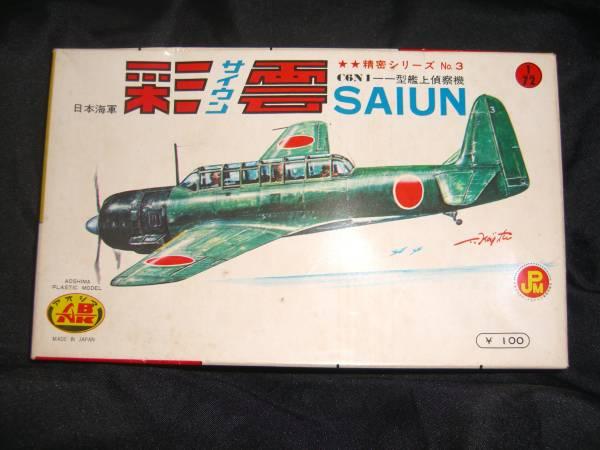
Aoshima, Nakajima C6N "Saiun", 1:72
Aoshima, Kawasaki Ki-100, 1:72
CROWN
"Crown (クラウン) was a manufacturer of plastic model kits based in Japan. Active in the 1970s and 80s, Crown is best known for a series of World War II combat aircraft and modern jet fighters that it produced in 1/144 scale. Crown models were distributed in the United States by AHM, and their products have been reissued by several companies including Academy, Minicraft, and Revell." (source: here)

Crown, Mitsubishi G4M1 "Betty", 1:144
FUJI
Released by "Fuji Hobby" in the 70s in "1:48", as stated on the box, this is probably a re-issue of the older "Marusan" kit which was in 1:50 (the instructions actually say so).
Fuji, Mitsubishi Ki-46-II "Dinah", 1:48/1:50
Kogure, Yokosuka D4Y "Suisei", 1:40 
Lucky Sun, Mitsubishi Ki-46 "Dinah" resin kit, 1:48
Marusan, Nakajima Ki-43 "Hayabusa", 1:100
Marusan, Mitsubishi J2M3 "Raiden", 1:100
Nichimo, Yokosuka P1Y1 "Ginga", 1:120
Nitto, Nakajima B5N "Kate", 1:75
Nitto, Kawanishi N1K2-J "Shiden-kai": 1:75
Nitto, Nakajima B6N "Tenzan", 1:75
Okamoto, Nakajima Ki-115 "Tsurugi", ? 
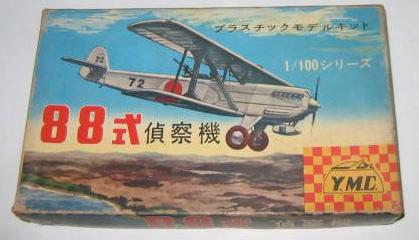
YMC, Kawasaki KDA-2 Recce, 1:100
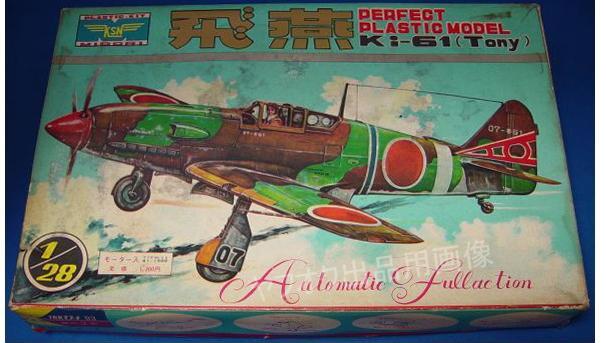
Midori, Kawasaki Ki-61 "Hien", 1:28
Best for last.
Kawasaki Ki-61 "Tony", scale 1:28, "Automatic fullaction". The kit included a motor which was connected to the flaps, rudder and elevator with piano strings. By removing the canopy and pressing the "on" button in the cockpit the model moved on the ground. When the model turned direction all the controls moved too. Also made an aircraft engine sound. Considered too complicated kit for it's time.
Starting price: 600$

Thursday, 7 February 2013

Nakajima Ki-44 "Shoki"

Two Army Type 2 Single-seat Fighters or Nakajima Ki-44 "Shoki" (Tojo) of the Rikugun Koku Seibi Gakko (Army Maintenance School) in Tokorozawa.
The aircraft in the foreground has all the surface panels of the port side removed to help with maintenance tutoring and lacks the starboard wing.
The aircraft in the background is in a more complete state. But note that both aircraft lack radio antennas. The typical tail marking of the Maintenance School is a horizontal bar with a hiragana above it. Akimoto-sensei states that the bar and the hiragana are black and indeed this is how it looks in many photos. Nevertheless there is also a number of photos where the band looks lighter than the hiragana.
Examples, in MA#329 (1989), p.61 middle, the hiragana "き" (KI) looks darker than the bar on the tail of the Ki-43 "Hayabusa" although in MA#395 (1992), p.33 top profile, illustrator Nohara Shigeru chooses to depict both as black.
Same in the photo on p.65 of Koku Fan Illustrated#80. Kawasaki Ki-61 "Hien" with hiragana "I" on the tail. And again on p.68, a Mitsubishi Ki-30 "Ann" with a brighter bar than the hiragana "HA". 
In the Schiffer publication (1970) on p.30, top photo, "Shoki"  with dark "KO" on the tail seems again to have a brighter bar. Nohara decided to depict it with a red bar in the latest Model Art #779, Profile#5 (2009) p.110 although he is unsure about the white bands around the hinomaru
That is exactly why color photos are so important.

Monday, 4 February 2013

FAOW#153 Army Type 97 Heavy Bomber

 
FAOW#153, Bunrindo March, 2013, p. 88, photos: 111 b/w.
Illustrations: Watanabe Rikyu and K. Koizumi Productions.
Text: Akimoto Minoru, Torikai Tsuruo
Captions: Izawa Yasuho
Civilian chapter & photos: Yanagisawa Koji

Ten (!!!) years after the publication of the fabulous FAOW#98 on the Ki-67 "Hiryu", Bunrindo finally decided to release a new FAOW on one of the least covered Japanese twin-engine bombers; Army Type 97 Heavy Bomber or Mitsubishi Ki-21 "Sally".
I have mixed feelings about this publication. Starting positively, I'm happy that Bunrindo finally made a break from the Zero fighters and such to turn their attention to an overlooked subject like poor "Sally".
On the other hand, considering that the FAOW series relies heavily on the photo coverage of its subject I must admit that I was quite disappointed by this publication with the photo quality and quantity well below that of previous FAOWs. Simply put, although there are plenty of high quality photos from various Japanese sources available, 80% of the photos in this new FAOW are from vintage publications, unfortunately not that nicely reproduced. I spotted for example only one photo from the Kikuchi Collection. The artwork although not bad is too spartan for such a colourful aircraft. I mean...six flat side views..really? Where is the always amazing Watanabe Rikyu-san's fold-out?
All in all, a publication that seems to have been put together in haste. Perhaps somebody's preparing the release of a "Sally" kit?
Incidentally Maru Mechanic #29 (1981) is far better than FAOW#153. Although out-of-print, limited number of copies are available through our on-line store HERE.   
But staying positive, I have to admit that I don't feel bad about this FAOW since it means that the Eagle Eye we are preparing on the "Sally" will definitely be much much better!

So, yes, FAOW#153 is recommended because except for the old Maru Mechanic there is nothing else out there.

Sunday, 3 February 2013

Mitsubishi K3M "Pine" - Suzuka Ku

Three stills from a very short and very rare vintage movie clip showing a Navy Type 90 Crew-trainer or Mitsubishi K3M "Pine" belonging to the Suzuka Ku, as indicated by the katakana "ス" (SU) on the tail, taking off.


One of the best aviation artists in the world and a good friend of ours, Zygmunt Szeremeta created a beautiful side view of this particular plane, especially for our blog.

The Suzuka Kokutai was organised as a reconnaissance training unit on October 1, 1938 in Suzuka City, Mie prefecture. It was equipped with Mitsubishi K3M, Kyushu K11W "Shiragiku", Mitsubishi B5M1 and a single Zero-sen model 21 for defence.

Below is an illustration, from this blog, showing the Navy Air installations is Suzuka.
  As you can probably make out there are two airfields. Suzuka Ku operated from the "Dai 1 Suzuka Kaigun Koku Kichi" (1st Suzuka Navy Air Base), top left.
The "Dai 2 Suzuka Kaigun Koku Kichi" (2nd Suzuka Navy Air Base), top right, was the home of units like the Mie Ku and from 1943 of the 1001 Ku which was a transport unit for Mitsubishi aircraft, material as well as personelle. Around the end of the War it was also home of the 1021 Ku, the 3rd and the 4th Reconnaissance Hikotai.
On the bottom right of the illustration is the Mie factory of Mitsubishi Heavy Industries.
Most of the buildings in the base were used by civilian companies after the War until about 1975 when they were gradually demolished.

As far as I know AZ model is the only company that makes a kit of the type in 1:72
I also have a resin looking Japanese kit of unknown origin in a plastic bag I purchased many years ago during our visit to Germany (hi Joern).

Friday, 1 February 2013

Kawanishi H6K2-L "Mavis"

A photo, from a vintage publication, of two Navy Type 97 Transport Flying-Boats or Kawanishi H6K2-L (Mavis) in flight.
The main easily recognisable external difference between the H6K2-Ls and the K6K4-Ls is the number of windows on the fuselage sides in front of and right behind the cockpit. The K6K2-Ls had 2-3 or less openings while H6K4-Ls had at least six windows. 
 

Wednesday, 30 January 2013

Capt Masao Miyamaru Ki 43-II by Jean Barby

Here is my rendition of the "Hayabusa" of this famous JAAF ace, depicting his plane when the 50th Hiko-Sentai moved to Malaya after the hard battle over Burma. In my opinion the Fine Molds model in 48th is way much more accurate than the Hasegawa kit. I did some improvements like riveting the kit and replacing the cowling cooling panels with thin plastic card.
Best regards from France - Jean Barby -


Tuesday, 29 January 2013

Mitsubishi Ki-46 "Dinah" & Vintage Ad

A photo from the November 1943 issue of magazine "Koku Asahi" of a Type 100 Command Reconnaissance Aircraft Model 2 or Mitsubishi Ki-46-II "Dinah" taken at the front by reporter Hasegawa.

The ad in the insert says:
"A1
High quality superglue
Available everywhere in Japan from aviation related shops, modelling stores, stationary and pharmacies.
Resin white, 21gr 50sen*
Cellulose red, 14gr 30sen
Distributed by Fujiyama Shoten - Tokyo"

*Sen was the old one-hundredth subdivision of the Yen (1Yen=100Sen).

Monday, 28 January 2013

Nakajima B5N "Kate", Kure Kaigun Kokutai

Three stills from a movie on UTube (link, 06:30) of a Type 97 Carrier Attack Bomber or Nakajima B5N "Kate" belonging to the Kure Ku as indicated by the katakana "ク" (KU) on the tail. The aircraft does not seem to be NMF on the lower surfaces but it is probably painted green-top, gray-bottom. Note the fuselage hinomaru with the square surround, painted parallel to the ground, not following the a/c centre-line, and the absence of surrounds on the wing hinomaru. Probably yellow tail marking with the two digits "14" repeated on the leg covers and black cowling.
(The aircraft carrier looks like "Akagi" to me. Corrections welcome.)

Emilio & Sidnei add that the scene is from the movie "Hawai Mare oki kaisen" (here). Thank you both very much for the information.


One more still that confirms that the katakana on the tail is a "KU"; not a "TA".

The Kure Ku begun as a brunch of the Sasebo Ku on Apil 1, 1925.
On June 1, 1931 the unit became independent and received the name "Kure Kaigun Kokutai". It was basically a unit equipped with seaplanes patrolling Setonai (here) and equip with Kure based ships with aircraft. 
In 1934 an airfield was also constructed and land-based aircraft like Zero-sen and "Kates" were also based there.
On May 5, 1945 the unit was dissolved.